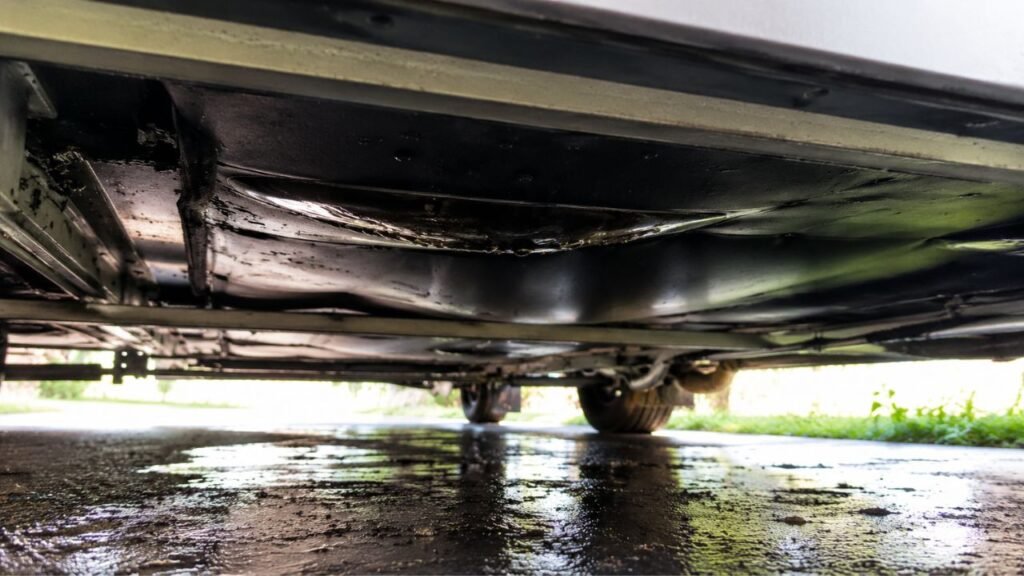
Water collects inside an RV underbelly when leaking plumbing, damaged tanks, faulty fittings, or outside water reaches the enclosed space above the Coroplast. Because the underbelly acts like a shallow basin, water can travel away from the original leak and collect at the lowest point.
The tricky part is finding where that water started. Below, I’ll help you narrow the source based on when the leak appears, which system you are using, and what the water looks or smells like.
Key Takeaways
- Water trapped inside an RV underbelly usually indicates a leak.
- The visible drip may be far from the actual source.
- City-water leaks often involve pressurized plumbing or fittings.
- Pump-only leaks point toward the onboard freshwater system.
- Water appearing after showering may come from drain plumbing.
- Rainwater can enter through poorly sealed underbelly openings.
- Saturated insulation should be dried or replaced before resealing.
- Never blindly cut or drill through an RV underbelly.
Why Does Water Collect Inside an RV Underbelly?
Most enclosed RV underbellies use Coroplast or similar plastic sheeting. This material protects tanks, plumbing, wiring, insulation, and other components underneath your RV.
The problem is that this protective layer can also hold water.
If a pipe begins dripping above the Coroplast, gravity pulls the water downward. However, it may first travel across insulation, framing, wires, tanks, or the plastic liner.
That is why the place where water drips outside your RV may not reveal the actual leak location.
I have seen this confuse RV owners because everything directly above the drip looks dry. The source can easily be several feet away.
A small leak may slowly saturate insulation before becoming visible. A larger leak can cause the Coroplast to sag noticeably.
Neither situation should be ignored.
What Usually Causes Water Inside an RV Underbelly?
Several systems run above or near your RV underbelly. The most likely cause depends heavily on when the water appears.
Leaking PEX Lines or Plumbing Fittings
RV freshwater plumbing commonly uses flexible PEX tubing with various fittings.
Those fittings deal with constant vibration while you travel. Over time, a connection can loosen slightly and begin dripping.
Common problem areas include:
- Kitchen sink supply lines
- Bathroom faucet connections
- Shower plumbing
- Exterior shower fittings
- Water heater connections
- Water pump fittings
- Utility panel connections
- Washer hookups
PEX itself can also become damaged.
A line rubbing against framing may eventually develop a tiny hole. Freeze damage can also crack fittings or weakened plumbing.
Small leaks are especially troublesome because they may stay hidden.
Instead of creating an obvious puddle inside your RV, the water disappears through a floor opening and collects underneath.
Water Pump or Check-Valve Problems
Your water pump can also lead you toward the source.
If water appears only when the pump operates, inspect the pump connections and nearby plumbing first.
Loose pump fittings can drip whenever the freshwater system becomes pressurized.
There is another possible problem.
Some RV plumbing systems contain check valves that control water direction. If one fails, campground water may travel where it should not.
For example, city water can sometimes make its way toward the freshwater tank. The tank may then unexpectedly fill.
Once full, water may escape through an overflow system or faulty connection.
Plumbing layouts vary between RV manufacturers, so check your model’s system before replacing anything.
Fresh Water Tank Overflow or Fill-System Problems
Accidentally overfilling the freshwater tank can produce plenty of water.
However, there is an important distinction here.
A properly routed freshwater overflow should normally direct excess water outside the RV. It should not routinely dump gallons above the underbelly liner.
If overfilling repeatedly leaves water inside the belly, investigate further.
Possible problems include:
- Loose overflow tubing
- Damaged vent tubing
- Poorly routed overflow lines
- Leaking tank-fill fittings
- Cracked hose connections
- Damaged tank fittings
- An obstructed vent
- City water unintentionally filling the tank
Watch what happens as you fill the tank.
If the underbelly remains dry until the tank becomes nearly full, the overflow or upper tank fittings become stronger suspects.
Cracked Fresh Water Tank or Tank Fitting
Freshwater tanks can eventually develop leaks.
The tank itself may crack around a fitting, seam, mounting point, or stressed area.
Road vibration can contribute to the problem.
A tank can also rub against a support or nearby component. Repeated movement may eventually damage the plastic.
Pay close attention to the tank level when water begins appearing.
Suppose the leak starts every time the tank reaches half capacity. That pattern may point toward a fitting or crack near that height.
If the leak begins almost immediately, inspect lower fittings and tank connections.
Gray Water Tank or Drain Plumbing Leak
Water in the underbelly does not always come from pressurized plumbing.
Your sink and shower drain system can leak as well.
Potential trouble spots include:
- Sink drain fittings
- Shower drain connections
- P-traps
- Gray tank inlet fittings
- Vent connections
- Tank seams
- Dump valve assemblies
- Tank outlet fittings
One helpful clue is usage.
If the underbelly stays dry until somebody takes a shower, inspect the shower drain system.
If it happens after washing dishes, focus on the kitchen drain plumbing.
Some RVs also have more than one gray tank. Knowing which fixture drains into each tank can save significant troubleshooting time.
Black Tank, Flush System, or Toilet Plumbing Leak
Black-water problems need more caution.
Possible sources include the black tank itself, flush system, vent connection, toilet plumbing, or dump valve area.
A black-tank flush system can leak behind walls or underneath flooring.
This is particularly possible when a fitting or vacuum breaker fails.
You might notice water only while operating the tank flush.
Stop the flush immediately if water begins appearing underneath.
If the liquid has a sewage odor or visible contamination, avoid direct contact. Treat it as wastewater until you confirm otherwise.
Water Heater or Bypass Plumbing Leak
The water heater is another commonly overlooked source.
Water heaters have several plumbing connections packed into a relatively small area.
Inspect:
- Hot-water outlet fittings
- Cold-water inlet fittings
- Bypass valves
- Nearby PEX connections
- Drain plug area
- Tank connections
- Tankless water heater fittings
A small leak here can run downward without appearing inside.
If the water heater sits above an enclosed floor cavity, water may quickly reach the underbelly.
Shower, Sink, or P-Trap Leak
Drain plumbing deserves special attention because it is not pressurized.
A fitting may remain completely dry until you use that fixture.
For example, your shower may drain perfectly at first glance. Yet water might be escaping through a loose drain connection underneath.
Kitchen sink P-traps can do something similar.
Try running one fixture at a time.
Then check whether water begins appearing below.
This simple test can isolate the problem much faster than randomly removing underbelly panels.
Rain or Road Spray Entering the Underbelly
Not every underbelly water problem comes from plumbing.
Heavy rain and highway spray can enter poorly sealed openings.
Common entry areas include:
- Coroplast seams
- Frame penetrations
- Wheel wells
- Suspension openings
- Slide mechanisms
- Utility penetrations
- Underbelly edges
- Damaged tape or seals
Driving rain is especially useful as a diagnostic clue.
If your RV remains dry while parked in rain but fills after towing through heavy rain, road spray becomes much more likely.
Water can also enter higher on the RV.
It may travel behind exterior panels before eventually reaching the underbelly.
Condensation Inside the Underbelly
Condensation can create some moisture inside enclosed spaces.
Warm humid air contacting cold surfaces can produce droplets.
However, condensation usually should not be your first explanation for large amounts of trapped water.
If the Coroplast is sagging heavily or gallons drain out, look for an actual leak first.
Plumbing, tank, and rainwater problems are generally more concerning.
How Can You Tell Where the Underbelly Water Is Coming From?
The easiest way to narrow the source is by watching when the water appears. Instead of opening the entire underbelly immediately, connect the leak with the system you were using beforehand.
| When Water Appears | Most Likely Areas to Check |
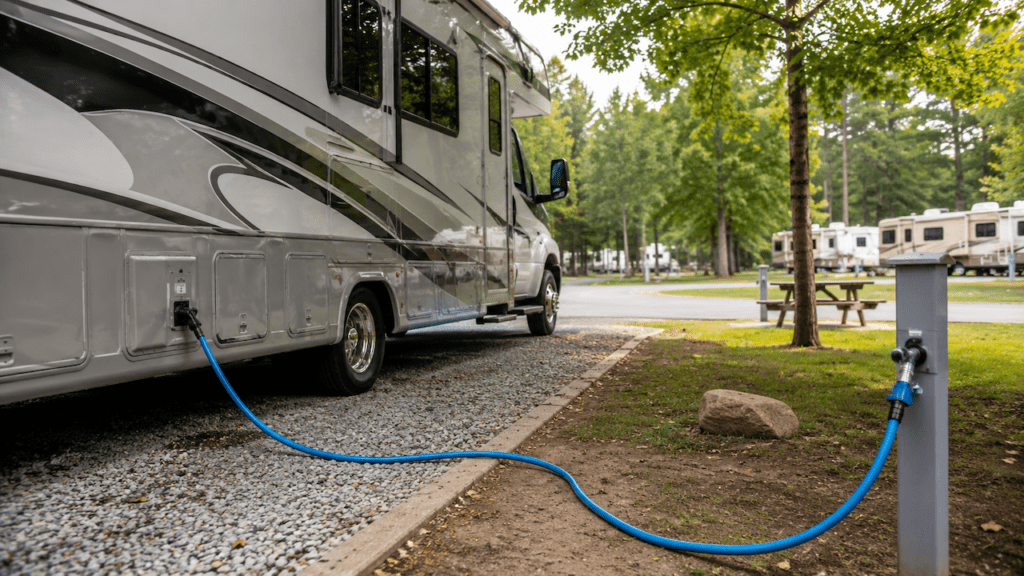
| Only while connected to city water | PEX fittings, utility connections, water heater, valves |
| Only when the water pump runs | Pump fittings, pressurized lines, freshwater plumbing |
| While filling the fresh tank | Fill hose, vent, overflow hose, tank fittings |
| At the same fresh-tank level | Tank crack or fitting near that height |
| After taking a shower | Shower drain, P-trap, gray tank plumbing |
| After using the kitchen sink | Sink drain, P-trap, kitchen gray tank |
| As the gray tank fills | Tank seam, inlet, vent, outlet, dump valve |
| During black-tank flushing | Flush fitting, vacuum breaker, hose, black tank |
| Only after stationary rain | Roof, sidewall, slide, exterior seal, frame opening |
| Only after towing in rain | Wheel wells, underbelly seams, frame penetrations |
This timing method can dramatically reduce unnecessary disassembly.
You are essentially turning the leak into a controlled test.
Does the Color or Smell of the Water Help Identify the Leak?
The water itself can provide additional clues. Do not rely on appearance alone, but combine it with what your RV was doing beforehand.
Clear, Odorless Water
Clear water may come from your freshwater plumbing, water heater, freshwater tank, rainwater, or condensation.
Check whether you were using city water or the pump.
Also remember that clear appearance does not guarantee safe drinking water.
Water may become contaminated after passing through insulation or dirty underbelly surfaces.
Soapy or Slightly Odorous Water
Soapy water usually suggests gray-water plumbing.
Think about your recent activity.
Did someone shower shortly beforehand?
Did you wash dishes or drain the kitchen sink?
If yes, inspect those drain lines before disturbing freshwater plumbing.
Strong Sewage Odor or Contaminated Water
A strong sewage smell should immediately raise concern about black-water plumbing.
Stop using the toilet and black-tank systems until you know more.
Wear suitable gloves when inspecting contaminated areas.
Saturated insulation exposed to sewage should generally be replaced rather than simply dried.
Pink Water
Pink water often points toward leftover RV antifreeze.
You may see this shortly after winterizing or dewinterizing the RV.
However, antifreeze-colored water still needs a source.
Check winterization valves, plumbing fittings, low-point drains, and nearby connections.
What Should You Do Immediately If the RV Underbelly Is Full of Water?
If your underbelly is already sagging with water, focus first on stopping additional flow. Avoid immediately crawling underneath and cutting into the lowest spot.
- Turn off the campground water supply.
- Switch off the RV water pump.
- Stop using sinks and showers temporarily.
- Avoid flushing tanks until you identify the source.
- Drain holding tanks when appropriate.
- Photograph severe sagging before opening anything.
- Support loose Coroplast carefully if necessary.
- Keep water away from exposed electrical equipment.
- Locate the leak before resealing damaged panels.
Be especially careful with heavy sagging sections.
One gallon of water weighs more than eight pounds. Several gallons trapped above you can make a Coroplast panel surprisingly heavy.
Never blindly drill into the belly.
Plumbing, wiring, tanks, LP components, heating ducts, and structural pieces may sit directly above the plastic.
How Do You Find an RV Underbelly Leak Without Removing Everything?
You can often narrow the problem substantially before opening the belly. The key is testing individual systems instead of using everything simultaneously.
Start With Accessible Plumbing Inside the RV
Begin with plumbing you can actually see.
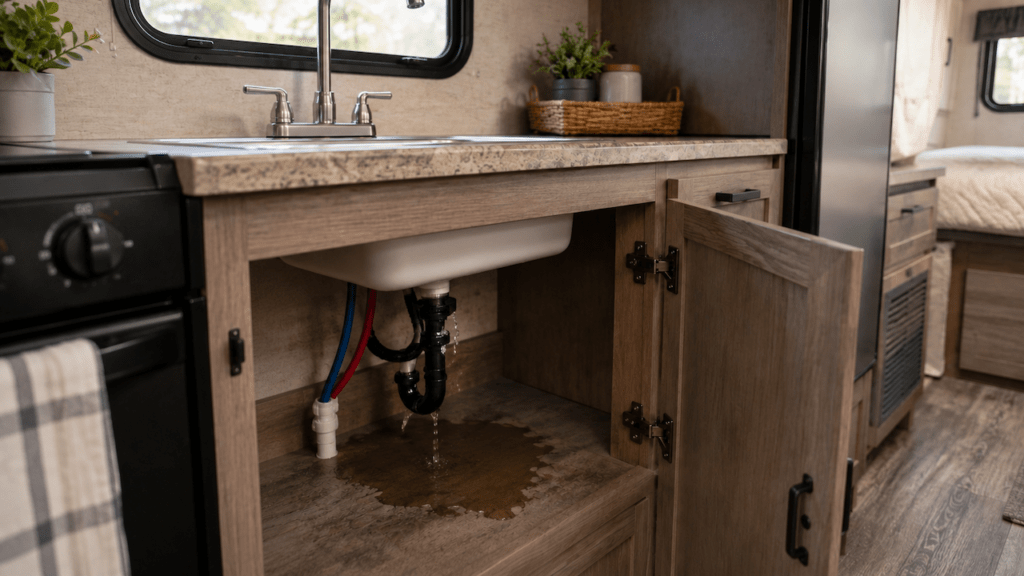
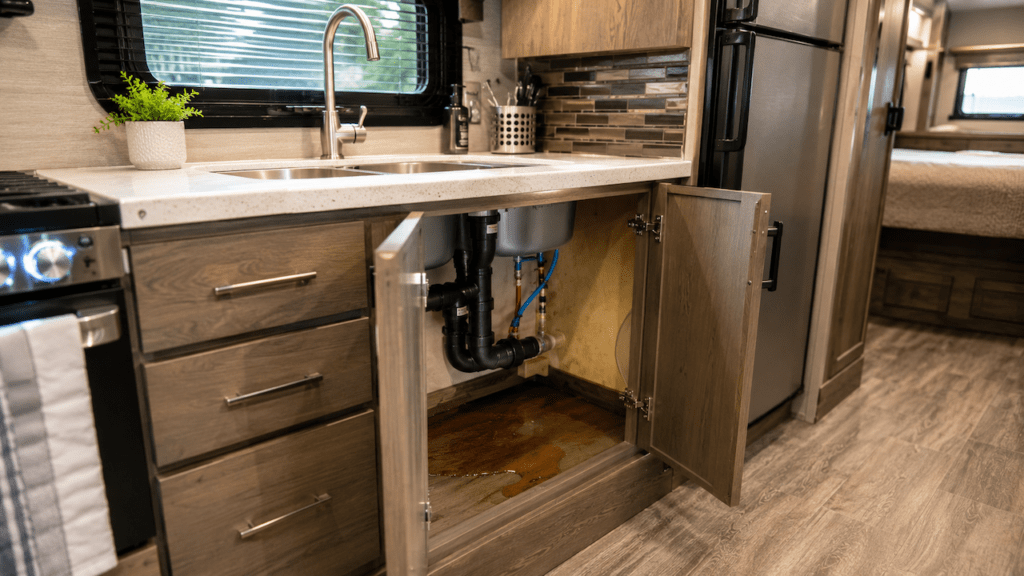
Open cabinets underneath sinks.
Inspect the water pump compartment.
Check behind removable shower panels when accessible.
Look around the water heater and utility bay.
Run your fingers around fittings if conditions are safe.
A paper towel is also useful because tiny leaks may leave moisture that is difficult to see.
Test One Water System at a Time
Avoid running multiple fixtures while troubleshooting.
Try testing in this order:
- Freshwater tank without running the pump.
- Water pump and pressurized freshwater plumbing.
- City-water connection.
- Kitchen sink supply and drain.
- Bathroom sink supply and drain.
- Shower plumbing.
- Gray-water tanks.
- Black-tank flush system.
Watch the underbelly after each test.
If the leak appears after only one specific activity, you have already narrowed the search dramatically.
Watch When the Leak Begins
Timing matters even within one tank.
Imagine water starts dripping only when the freshwater tank reaches approximately three-quarters full.
That suggests looking near fittings or cracks around that height.
Now imagine water begins immediately after adding only a few gallons.
Lower tank connections become more likely.
Patterns like this are much more useful than simply following the lowest drip.
Use an Inspection Camera Where Practical
A small inspection camera or borescope can sometimes look through existing openings.
This may help you inspect difficult cavities without dropping an entire panel.
However, the camera must have a useful access path.
Wet insulation can also obstruct your view.
Treat the camera as a helpful diagnostic tool, not a guaranteed solution.
Check for Water-Pump Cycling
Listen to your water pump when every fixture is closed.
If the pump occasionally runs by itself, the system may be losing pressure somewhere.
That can indicate:
- A plumbing leak
- A dripping fixture
- A faulty valve
- An internal pump issue
- Another pressure-related problem
Pump cycling does not tell you exactly where the problem is.
But it confirms that further investigation is worthwhile.
Should You Cut or Remove the RV Underbelly to Find the Leak?
Sometimes you eventually need underbelly access, especially when tests narrow the problem to an inaccessible tank or fitting.
Do not begin by removing the entire Coroplast sheet.
Look for existing service openings first.
Many RVs provide partial access around tanks, drains, or mechanical components.
If you need to remove fasteners, support the panel beforehand.
Wet insulation and trapped water can add substantial weight.
Also identify what sits above the area before cutting.
This is especially important around propane lines, wiring, tanks, and plumbing.
If your RV is still under warranty, document the issue first.
Dealer inspection may be the better approach for tank failures or extensive hidden damage.
Is It Safe to Poke a Drain Hole in a Sagging RV Underbelly?
A controlled drain opening may sometimes be necessary when large amounts of water are trapped. However, blindly stabbing or drilling the lowest section can damage components sitting directly above it.
If you can confirm a safe empty area, carefully releasing trapped water may reduce weight before further inspection.
But remember one thing.
Creating a drain does not fix the leak.
It only removes the water already inside.
Leaving random holes permanently can also allow road spray, dirt, insects, and rodents into the underbelly.
Once everything is repaired and dry, damaged Coroplast should be restored properly.
Can Water in the RV Underbelly Cause Damage?
Trapped water is more than an inconvenience. The longer moisture remains inside, the more surrounding materials can become affected.
Wet or Collapsed Insulation
Many enclosed RV underbellies contain insulation.
Once saturated, some insulation can hold substantial amounts of water.
Wet fiberglass loses much of its insulating effectiveness.
Its added weight may also make the underbelly sag further.
Mold and Odor
Persistent moisture creates conditions where unpleasant odors and microbial growth can develop.
This is especially concerning around wood products, flooring, fabric-backed insulation, and trapped debris.
Drying the visible Coroplast alone is not enough.
Moisture may remain hidden higher in the cavity.
Subfloor and Wood Damage
Water can eventually reach plywood, OSB, cabinetry bases, or structural wood.
Possible signs include:
- Soft flooring
- Swelling
- Discoloration
- Delamination
- Musty odors
- Loose flooring materials
Finding the problem early greatly reduces the chance of expensive repairs.
Corrosion and Electrical Problems
Metal brackets and fasteners can corrode after repeated moisture exposure.
Electrical connectors can also become vulnerable.
Not every wire getting wet automatically means electrical failure.
However, standing water around damaged connectors should never be ignored.
Damaged Coroplast and Tank Supports
Coroplast is lightweight and durable, but it is not designed to hold heavy water.
A large trapped water pocket can stretch the material.
Fastener holes may tear.
Seams may separate.
The added weight can also pull damaged sections downward around tanks and supports.
Do You Need to Replace Wet RV Underbelly Insulation?
Whether you need replacement depends on the insulation type and how badly it became soaked.
A small amount of clean freshwater exposure may sometimes dry completely if you open the area quickly and provide strong airflow.
Heavily saturated insulation is different.
Fiberglass that stays wet can hold moisture against surrounding materials.
Contaminated insulation is even more straightforward.
If gray or black water soaked it, replacement is usually the safer approach.
Do not reseal wet insulation simply because the outer surface feels dry.
Check deeper layers first.
How Do You Dry an RV Underbelly After Fixing the Leak?
Once the leak is repaired, give the underbelly enough time and airflow to dry thoroughly. Closing everything too quickly can trap moisture you worked hard to remove.
- Drain all remaining trapped water.
- Open enough Coroplast for proper airflow.
- Remove badly saturated insulation.
- Remove contaminated materials.
- Use fans where practical.
- Allow framing and flooring to dry.
- Check corners and hidden pockets.
- Retest the repaired plumbing.
- Confirm no new moisture appears.
- Replace insulation only after drying.
- Close the underbelly once everything remains dry.
There is no universal drying time.
Humidity, temperature, insulation thickness, and water quantity all matter.
Use actual dryness rather than a fixed number of hours.
How Do You Repair and Reseal the Underbelly?
Repairing the plastic liner should be the final step, not the first. Make sure the original leak is corrected and hidden materials are completely dry.
Repair the Leak Before the Coroplast
Fix the actual source first.
That may mean replacing:
- A PEX fitting
- A damaged hose
- A loose drain connection
- A tank fitting
- A valve
- A cracked tank
- A failed seal
Then test the repaired system before closing anything.
Replace Damaged or Contaminated Insulation
Do not reinstall insulation simply because you want the underbelly closed quickly.
Replace insulation that is badly damaged, compressed, contaminated, or unable to dry completely.
Try to match the original insulation approach where practical.
Your specific RV construction should guide the repair.
Repair Torn Coroplast
Small damaged sections may often be patched.
Larger tears might require replacement material or additional mechanical support.
Use materials intended to tolerate road exposure and vibration.
The repair should remain secure during highway travel.
Avoid temporary household tapes that quickly loosen underneath a moving RV.
Seal Water-Entry Points
If rainwater caused the problem, seal the confirmed entry point.
Do not simply coat every opening you find.
Some openings serve important purposes.
Freshwater tank vents, overflows, drains, and other designed outlets must remain functional.
The goal is stopping unwanted intrusion without blocking intentional drainage.
How Can You Prevent Water From Collecting in the Underbelly Again?
Prevention mostly comes down to catching small problems early. A few quick inspections can save you from dropping a soaked underbelly later.
- Use an appropriate RV water-pressure regulator.
- Inspect accessible plumbing fittings regularly.
- Check underneath sinks for moisture.
- Inspect around the water pump.
- Watch water heater connections.
- Monitor the fresh tank while filling.
- Never intentionally block tank overflow lines.
- Investigate unexplained pump cycling.
- Inspect Coroplast seams after long trips.
- Check wheel-well areas for missing seals.
- Inspect the underbelly after severe road spray.
- Address small Coroplast tears promptly.
- Turn off campground water when leaving for long periods.
I also recommend looking underneath your RV occasionally before traveling.
A slightly loose panel or small sag is easier to address before it becomes a major water pocket.
When Should You Call an RV Technician?
Some underbelly leaks are straightforward DIY repairs. Others involve tanks, contaminated wastewater, electrical systems, or structural materials that deserve professional attention.
Consider calling an RV technician when:
- Black water is leaking.
- A holding tank appears cracked.
- A tank has shifted from its supports.
- The underbelly is severely sagging.
- Electrical connections became submerged.
- Large areas of insulation are saturated.
- The floor feels soft or swollen.
- You cannot isolate the leak source.
- Water continues after plumbing repairs.
- The repair requires major tank removal.
- Your RV is still under warranty.
There is nothing wrong with stopping once the repair exceeds your comfort level.
Finding the likely system before visiting a technician can still save diagnostic time.
Final Words
Water inside an RV underbelly usually means something above that protective liner needs attention. The Coroplast is often only where the water collects, not where the leak actually began.
Instead of immediately following the lowest drip, ask yourself two questions: When does the water appear, and which system was operating beforehand?
Those clues can quickly separate city-water leaks from pump problems, tank leaks, drain plumbing issues, and rain intrusion.
Once you identify the source, fix it first. Then dry the entire cavity thoroughly before repairing and resealing the underbelly.
Related FAQs
Why Is My RV Underbelly Sagging With Water?
Your RV underbelly may sag because leaking plumbing, a damaged tank, or rainwater has collected above the Coroplast. Wet insulation can also add significant weight, making the plastic liner bow downward.
Can Rain Get Inside an RV Underbelly?
Yes. Rain and road spray can enter through poorly sealed Coroplast seams, wheel wells, frame openings, slide mechanisms, and utility penetrations. Water may also enter higher on the RV and travel downward.
Why Does My RV Underbelly Leak Only When Connected to City Water?
A leak appearing only on city water usually points toward pressurized plumbing. Check PEX fittings, utility connections, water heater plumbing, valves, and areas that remain pressurized while connected.
Why Does Water Leak From My RV Underbelly When the Fresh Tank Is Full?
If water appears only when the fresh tank becomes full, inspect its overflow hose, vent line, fill connection, upper tank fittings, and tank itself. Normal overflow should generally exit outside.
Can a Bad RV Water Pump Cause Water in the Underbelly?
Yes. Loose pump fittings, damaged lines, or related valve problems can allow water into the underbelly. A pump that cycles unexpectedly can also indicate pressure loss somewhere in the system.
Why Does My RV Underbelly Leak After Using the Shower?
A leak appearing after showering often points toward the shower drain, P-trap, drain pipe, or gray tank. Supply plumbing behind the shower can also leak when pressurized.
Can a Gray Tank Leak Into the RV Underbelly?
Yes. A cracked gray tank, loose inlet, damaged vent connection, outlet fitting, or dump valve assembly can release gray water directly above the enclosed underbelly.
Can Water Travel Across the RV Underbelly Before Dripping Out?
Absolutely. Water can move across insulation, tanks, framing, wiring, and sloped Coroplast before reaching the lowest point. The visible drip may therefore be several feet from the actual source.
Should I Drill Holes in My RV Underbelly for Drainage?
Avoid blindly drilling into the underbelly because plumbing, tanks, wires, ducts, and other components may sit above it. Controlled draining may sometimes be necessary, but only after identifying a safe location.
Will Wet RV Underbelly Insulation Dry on Its Own?
Lightly damp insulation may eventually dry with sufficient airflow, but heavily saturated insulation often retains moisture for a long time. Opening the belly and actively drying the cavity is usually more reliable.
Does Wet RV Underbelly Insulation Need to Be Replaced?
Heavily saturated, damaged, or contaminated insulation should generally be replaced. Light freshwater exposure may sometimes be dried successfully if the material remains intact and completely dries before resealing.
How Do I Know if Water Under My RV Is Fresh, Gray, or Black Water?
Freshwater is usually clear and odorless, gray water may appear cloudy or soapy, and black water may have a strong sewage odor. Always combine appearance with which RV system was recently used.
Can High Campground Water Pressure Cause an Underbelly Leak?
Yes. Excessive campground water pressure can stress RV plumbing fittings and expose weak connections. Using a proper RV water-pressure regulator reduces unnecessary strain on the freshwater system.
Should I Turn Off City Water When Leaving My RV?
Turning off campground water when leaving your RV for extended periods is a smart precaution. If a fitting fails while you are away, shutting off the supply can greatly limit water damage.

Gregory Allen covers outdoor RV camping, essential gear, and travel preparation. His reviews are based on real conditions, not spec sheets alone. He helps RVers choose equipment that works reliably in everyday outdoor use.