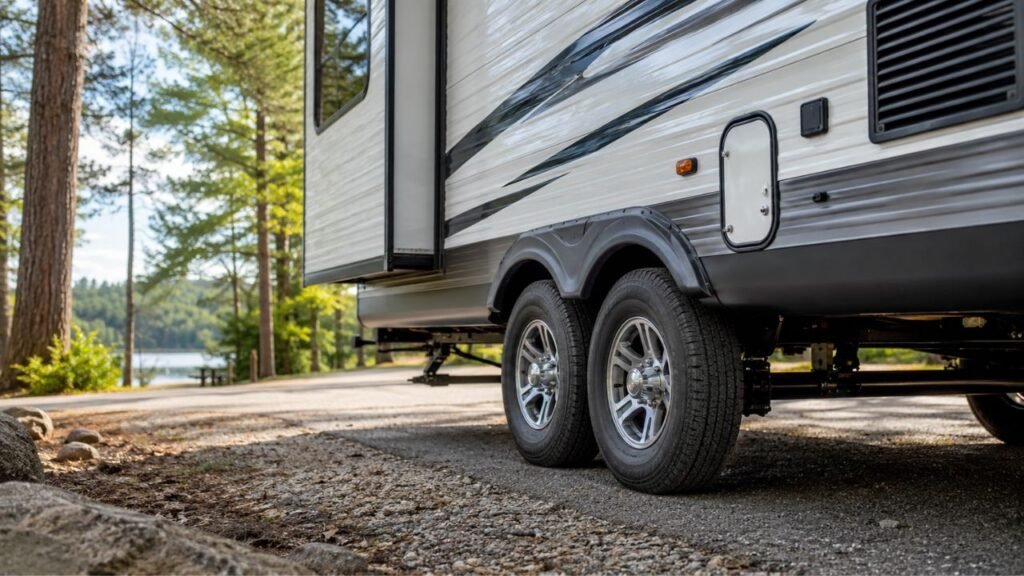
For most towable RVs with conventional serviceable wheel bearings, plan on repacking them at least once every 12 months. Mileage limits vary by axle manufacturer, so your specific axle manual should always take priority over a generic mileage recommendation.
In this guide, I’ll help you understand when RV wheel bearings need service, why intervals vary, and when you should have them checked sooner. I’ll also cover low-mileage RVs, E-Z Lube systems, sealed bearings, used trailers, and motorhomes.
Key Takeaways
- Most conventional RV wheel bearings should be serviced every 12 months.
- Mileage limits depend on the axle manufacturer and bearing design.
- Some Dexter axles use a 12-month or 12,000-mile interval.
- Some current Lippert axles allow more mileage but still require annual service.
- Low yearly mileage does not automatically mean you should skip annual maintenance.
- E-Z Lube systems still require regular bearing and hub inspection.
- Sealed bearings normally do not require conventional grease repacking.
- Excessive heat, noise, grease leaks, or wheel play require earlier inspection.
How Often Should RV Wheel Bearings Be Repacked?
The safest general rule is to service conventional trailer wheel bearings every 12 months. However, mileage limits vary, so you should match the schedule to your axle manufacturer.
| RV Bearing or Axle Situation | Typical Service Timing | What You Should Know |
| Conventional Dexter bearings | About 12 months or 12,000 miles | Follow whichever limit comes first |
| Many current Lippert serviceable bearings | About 12 months or up to 36,000 miles | Verify your exact axle manual |
| High-mileage RV use | When mileage limit arrives | Mileage may trigger service before one year |
| Low-mileage seasonal RV | Usually still every 12 months | Time matters even when mileage stays low |
| E-Z Lube-equipped axle | Follow normal axle maintenance schedule | Grease fitting does not replace inspection |
| Sealed bearing cartridge | Usually no conventional repacking | Follow inspection or replacement schedule |
| Oil-lubricated hub | Manufacturer-specific | Different maintenance system |
| Used RV with unknown history | Inspect before relying on it | Establish a fresh service baseline |
The important point is that there is no single mileage number that applies to every RV.
I would use the annual interval as your easy-to-remember baseline, then check the axle manufacturer for the mileage limit that applies to your trailer.
Why Is “Once a Year or 12,000 Miles” Not the Same for Every RV?
You will see the 12-month or 12,000-mile rule repeated frequently. It is useful, but it should not be treated as a universal rule for every axle.
Dexter Wheel Bearing Intervals
Many conventional Dexter trailer axles use a maintenance interval of about 12 months or 12,000 miles, whichever comes first.
That means an RV traveling 15,000 miles during one season should not wait until the end of the year.
The mileage limit arrived first.
On the other hand, a trailer traveling only 2,000 miles may still reach its yearly maintenance date long before the mileage limit.
Lippert Wheel Bearing Intervals
Some current Lippert axle schedules allow considerably more mileage between bearing grease service than the traditional 12,000-mile recommendation.
However, the important detail is that the annual time limit may still apply.
This is why I would not tell every RV owner that 10,000 or 12,000 miles is always the maximum.
Your actual axle specification matters.
Your Axle Manual Should Override a Generic Rule
The axle underneath your RV determines the correct maintenance schedule.
Your trailer brand alone may not tell you enough.
Two travel trailers from different years can use different axle assemblies, bearings, hubs, and lubrication systems.
If you can identify the axle manufacturer and model, use that information when deciding your service interval.
Should RV Wheel Bearings Be Repacked Every Year With Low Mileage?
Yes, in many cases you should still follow the yearly schedule even when your RV travels very few miles.
This surprises owners who only use their trailer several weekends each year.
You might think a trailer that traveled 1,500 miles barely used its bearings.
Mileage is only one part of the maintenance equation.
Bearings also sit through temperature changes, humidity, condensation, and long storage periods.
Grease seals can age while the RV is parked.
Moisture can also contribute to corrosion inside a hub.
That does not mean the grease suddenly becomes useless exactly one year after service.
It simply means low mileage does not automatically cancel the manufacturer’s time-based maintenance interval.
If your axle schedule says 12 months, I would follow the 12-month schedule.
Can You Go Two or Three Years Without Repacking RV Wheel Bearings?
Some RV owners do stretch their bearing service intervals for two or three years, especially when their trailers barely move.
That does not mean it is the best schedule for your RV.
If your axle manufacturer calls for annual inspection and service, going several years means you are extending maintenance beyond that recommendation.
Another problem is that online discussions often compare completely different bearing systems.
One owner may have traditional serviceable bearings.
Another may have sealed cartridges.
Another may have an E-Z Lube system.
Their experiences are not directly comparable.
If you own conventional grease-packed trailer bearings, I would use the manufacturer’s scheduled interval rather than copying someone else’s multi-year routine.
When Should RV Wheel Bearings Be Serviced Sooner Than Scheduled?
Mileage and time are only your normal maintenance limits. Certain conditions should make you consider an earlier inspection.
Watch for situations such as:
- You reach the axle manufacturer’s mileage limit early.
- You tow full-time or travel extremely long distances.
- Your trailer regularly operates near its weight limit.
- One wheel hub becomes significantly hotter than the others.
- Grease appears around the wheel, hub, or inner rim.
- Water may have entered the hub.
- A grease seal shows signs of leaking.
- The trailer has unknown maintenance history.
- You recently bought a used RV without service records.
- You hear unusual grinding, chirping, or growling.
- A wheel develops noticeable looseness or wobble.
- Brake service reveals grease contamination or hub problems.
You do not necessarily need a fixed six-month schedule just because you travel frequently.
Instead, use your mileage, axle requirements, and actual wheel condition together.
Do New RV Wheel Bearings Need to Be Repacked Right Away?
A brand-new RV does not automatically need its wheel bearings repacked immediately.
If the axle was assembled correctly and the trailer has normal lubrication, there should be no reason to dismantle everything simply because the RV is new.
However, I would still verify your maintenance schedule from the beginning.
Record the axle manufacturer and expected service interval.
Also look for obvious grease leakage around the hubs during your first few trips.
If a new trailer develops excessive hub heat, unusual wheel noise, or leaking grease, have it inspected rather than waiting for the first annual service.
What If You Buy a Used RV and Don’t Know When the Bearings Were Repacked?
Unknown maintenance history is one situation where I would not simply start counting twelve months from your purchase date.
You do not know when the previous owner last serviced the bearings.
They may have been done six months ago.
They may also have been ignored for several years.
If there are no reliable service records, having the wheel bearings professionally inspected gives you a clean starting point.
After that, record the service date and mileage.
You will then know exactly when the next inspection should happen.
This is especially worthwhile before taking a newly purchased used trailer on a long highway trip.
Does an E-Z Lube Axle Need Regular Wheel Bearing Repacking?
An E-Z Lube system makes adding grease easier, but it does not automatically eliminate normal bearing maintenance.
That distinction causes a lot of confusion among RV owners.
The grease fitting allows lubrication to be added through the hub.
It does not give you a complete view of the bearings, races, seals, hub, or brakes.
Therefore, an E-Z Lube axle should still follow the inspection and maintenance schedule specified by its manufacturer.
Think of the grease fitting as a lubrication feature, not a permanent replacement for scheduled wheel-end inspection.
Do Sealed RV Wheel Bearings Need to Be Repacked?
Not every RV wheel bearing can or should be repacked. Some systems use sealed cartridges or different lubrication methods.
Dexter Nev-R-Lube Bearings
Nev-R-Lube bearings use a sealed cartridge design.
They are not treated like traditional loose roller bearings packed manually with grease.
Instead, they follow an inspection and replacement schedule.
If your RV uses this system, a yearly conventional bearing repack is not the correct maintenance procedure.
Conventional Grease-Packed Bearings
These are the bearings most RV owners mean when discussing wheel bearing repacking.
They use grease around the bearing rollers and normally require periodic cleaning, inspection, and fresh lubrication.
Travel trailers and fifth wheels commonly use this type.
Oil-Lubricated Wheel Hubs
Some heavier trailers and larger RV chassis use oil-lubricated wheel ends.
These also follow different maintenance requirements.
If you see a hub designed around an oil lubrication system, do not apply a standard grease-bearing schedule without checking the manufacturer’s instructions.
Do Motorhome Wheel Bearings Follow the Same Repacking Schedule?
No. You should not assume every motorhome follows the same annual bearing repack schedule used for travel trailers.
Motorhomes may use very different wheel-end designs.
Some have sealed hub assemblies.
Others use conventional bearings or oil-lubricated systems.
The correct service schedule usually comes from the chassis manufacturer rather than the RV coach manufacturer.
That means a Class A, Class B, or Class C owner should follow the maintenance information for the actual chassis.
The common trailer rule of annual grease repacking may not apply.
What Warning Signs Mean You Should Not Wait Until the Next Repack?
Scheduled maintenance works best when everything is operating normally. Warning signs should move your inspection date forward.
Pay attention to:
- One hub running much hotter than the others
- Grinding or growling noises near a wheel
- Chirping or squealing while traveling
- Grease splattered around a rim
- Grease leaking from the back of the hub
- Noticeable wheel looseness
- Wheel wobble
- New vibration while towing
- Burning smells around a wheel
- Smoke near the hub
- Sudden braking changes
You do not need to diagnose the exact cause yourself.
Heat could come from a bearing problem, brake problem, or another wheel-end issue.
The important part is recognizing that something has changed.
If you have severe heat, grinding, smoke, or obvious wheel looseness, do not keep driving just because your scheduled maintenance date is months away.
Have the wheel checked promptly.
Why Does the Annual Wheel Bearing Service Matter?
Wheel bearings carry a substantial load while allowing your wheels to rotate at highway speeds.
They need proper lubrication and correct adjustment to do that safely.
When lubrication becomes inadequate, friction increases.
That extra heat can damage the bearing surfaces, races, hub, or spindle.
A damaged grease seal can create another problem.
Grease may migrate toward the electric brake components.
Brake shoes contaminated with grease may not perform correctly.
Regular inspection gives a technician the opportunity to catch these problems before they become expensive roadside failures.
Should RV Wheel Bearings Be Repacked Before a Long Trip?
You do not need to repack your wheel bearings before every long RV trip.
Instead, compare the upcoming trip with your maintenance schedule.
I would consider service before a major trip when your annual date is approaching.
The same applies when the trip will push your trailer beyond its mileage limit.
It also makes sense when you recently purchased the RV and do not know its maintenance history.
Warning signs should also be resolved before departure.
However, if the bearings were recently serviced and remain comfortably inside the manufacturer’s schedule, another repack simply because you are taking a vacation is usually unnecessary.
How Should You Track RV Wheel Bearing Service Intervals?
A simple maintenance record makes bearing service much easier to manage. You do not need anything complicated.
Record:
- Date of bearing service
- Approximate trailer mileage
- Axle manufacturer
- Axle model if known
- Bearing or hub type
- Next yearly service date
- Next mileage-based service point
- Any technician notes
- Brake or seal problems found during inspection
I also recommend keeping the service receipt with your RV records.
A dated record removes the guesswork when the next season begins.
It can also be useful when you eventually sell the RV.
Final Verdict
For most travel trailers and fifth wheels with conventional grease-packed wheel bearings, once every 12 months is the easiest general maintenance schedule to remember.
The mileage number, however, should come from your axle manufacturer.
Some Dexter axles use a 12-month or 12,000-mile interval.
Some current Lippert axle schedules allow substantially more mileage while still keeping the annual requirement.
That is why I would not rely on one universal mileage number.
Check your axle type, record your service date, and follow whichever limit comes first.
Also remember that E-Z Lube systems still need scheduled inspection.
Sealed bearing cartridges generally do not receive conventional grease repacking.
Motorhomes can use completely different wheel-end systems.
If anything feels abnormal before your scheduled service date, especially heat, noise, grease leakage, or wheel looseness, have it inspected sooner.
Related FAQs
How Often Should Travel Trailer Wheel Bearings Be Repacked?
Most conventional travel trailer wheel bearings should be serviced about once every 12 months. Mileage limits vary by axle manufacturer, so check the maintenance schedule for your specific axle rather than relying on one universal mileage number.
How Often Should Fifth-Wheel Bearings Be Repacked?
Conventional fifth-wheel trailer bearings generally follow the same type of annual service schedule as travel trailers. Your axle manufacturer’s mileage limit should determine whether service is needed sooner.
Is 10,000 or 12,000 Miles the Correct Bearing Repack Interval?
It can be correct for some axles, but it is not universal. Some manufacturers specify around 12,000 miles, while other current axle schedules allow considerably more mileage between services.
Can I Wait Two Years if My RV Only Travels a Few Thousand Miles?
You should not automatically extend the interval because of low mileage. If your axle manufacturer specifies service every 12 months, the time limit still applies even when the trailer travels very little.
Do E-Z Lube Bearings Still Need to Be Repacked?
An E-Z Lube grease fitting does not necessarily eliminate scheduled bearing inspection and maintenance. Follow the axle manufacturer’s normal service interval instead of assuming adding grease replaces regular inspection.
Do Sealed RV Wheel Bearings Need Repacking?
Sealed bearing cartridges generally do not receive conventional grease repacking. They usually have an inspection or replacement schedule provided by the bearing or axle manufacturer.
Can RV Wheel Bearings Go Bad While Sitting in Storage?
Yes. Storage does not eliminate every bearing concern. Moisture, corrosion, seal aging, and contamination can still develop, which is one reason many maintenance schedules include a time limit.
Should Wheel Bearings Be Repacked Before Every Long RV Trip?
No. You normally only need service before a long trip when the annual or mileage limit is approaching, the maintenance history is unknown, or warning signs have appeared.
How Do I Know Whether My RV Has Serviceable or Sealed Bearings?
Check your axle documentation, hub information, or RV maintenance records. If you are unsure, an RV technician can identify the wheel-end system without you needing to disassemble the hub yourself.
Does Wheel Bearing Repack Frequency Depend on the Axle Brand?
Yes. Axle manufacturers can specify different mileage limits, lubrication systems, and inspection requirements. Your actual axle manual should take priority over a generic RV maintenance recommendation.

Gregory Allen covers outdoor RV camping, essential gear, and travel preparation. His reviews are based on real conditions, not spec sheets alone. He helps RVers choose equipment that works reliably in everyday outdoor use.