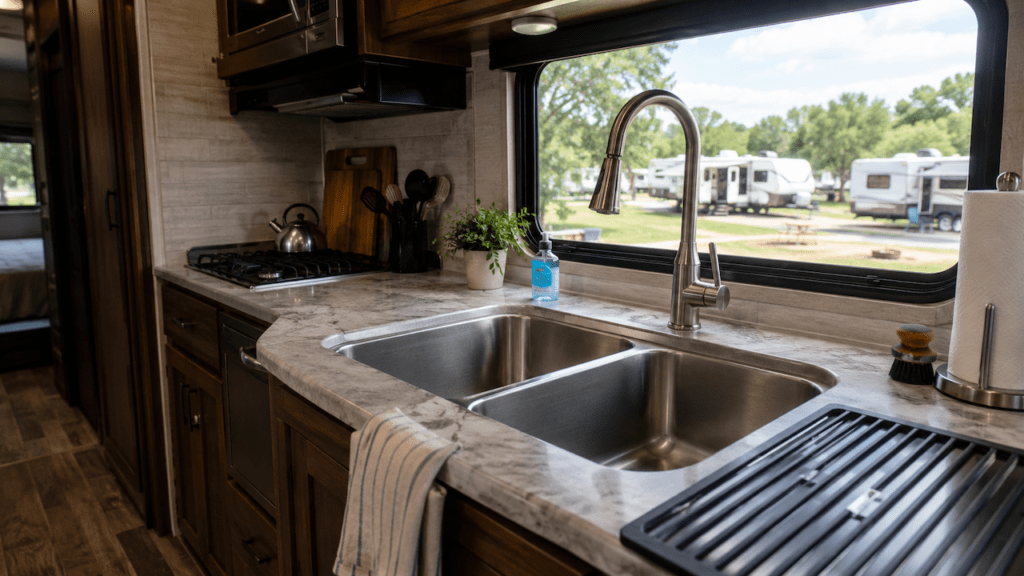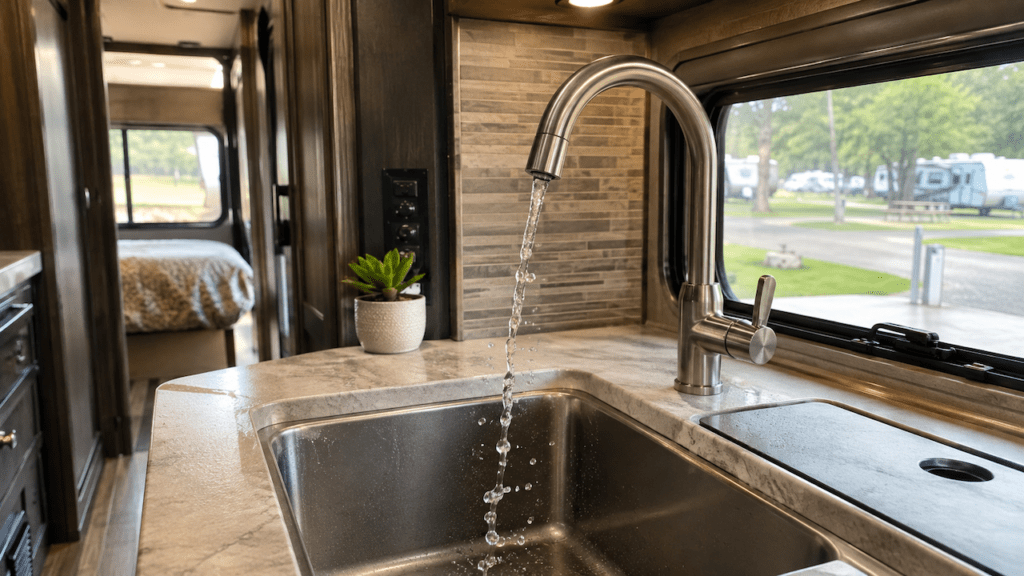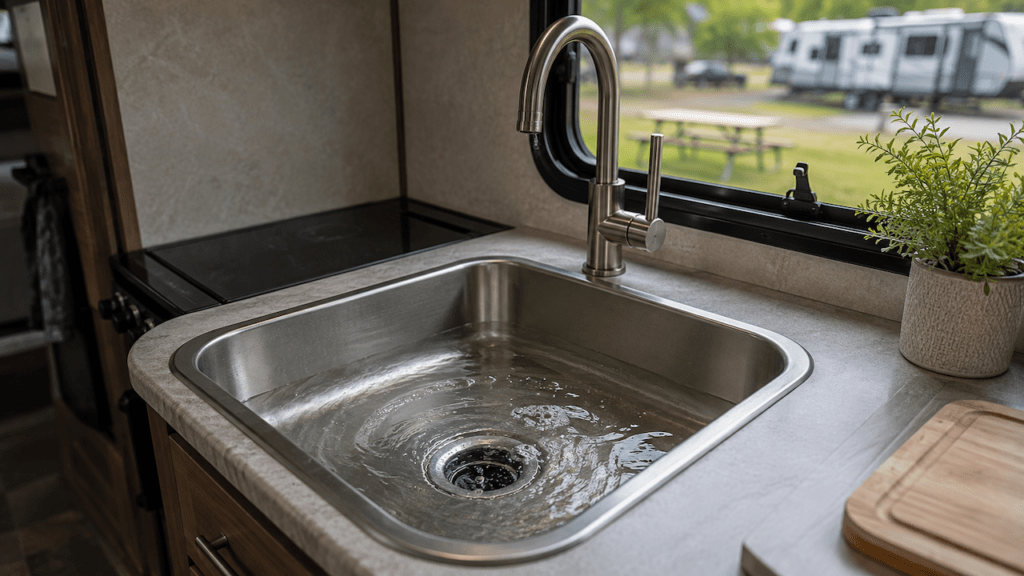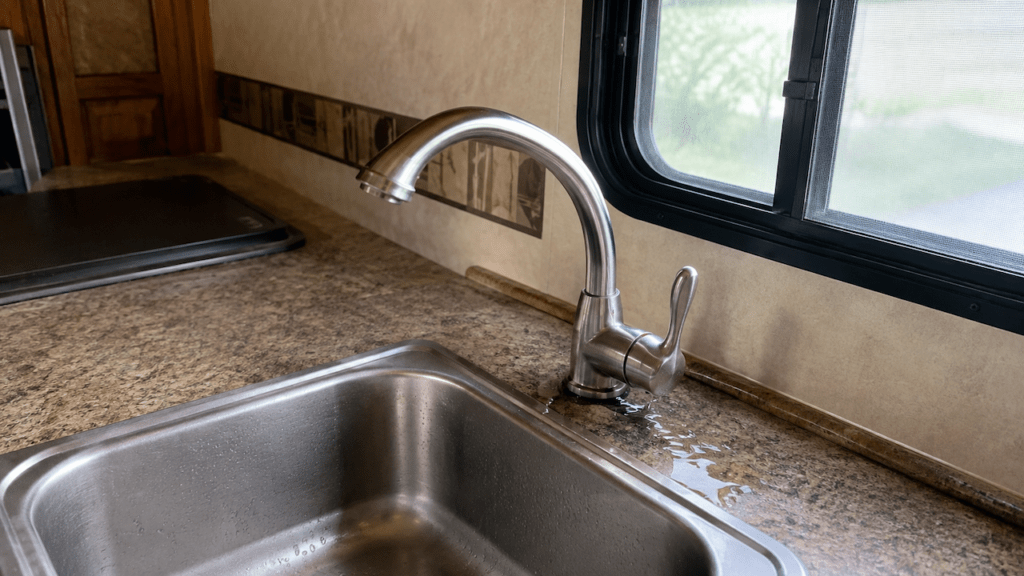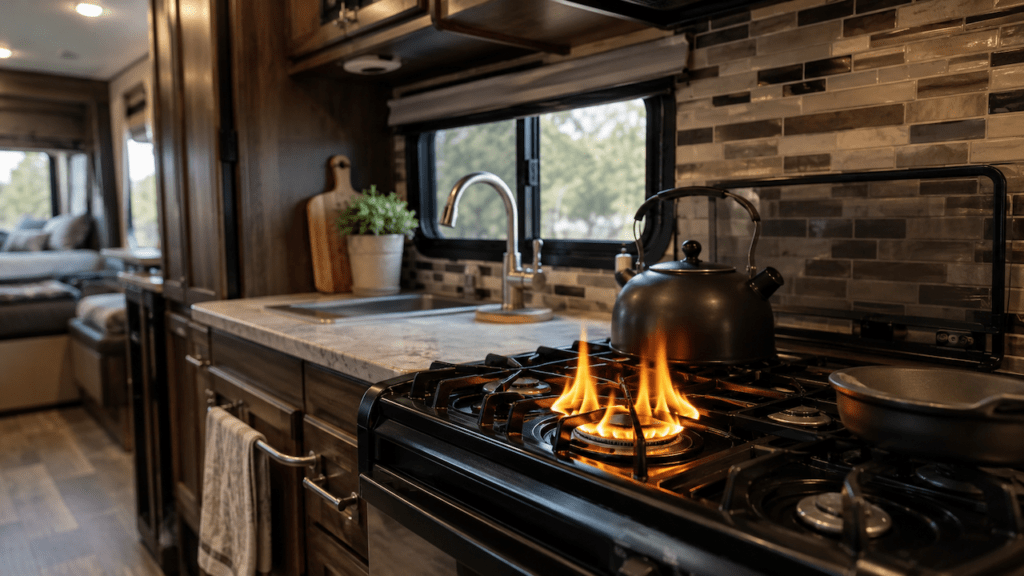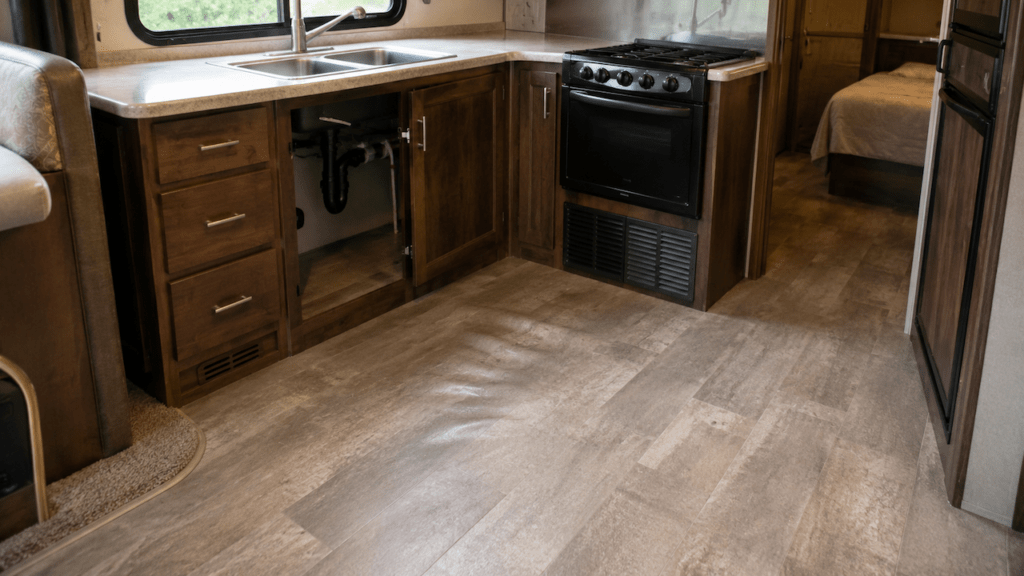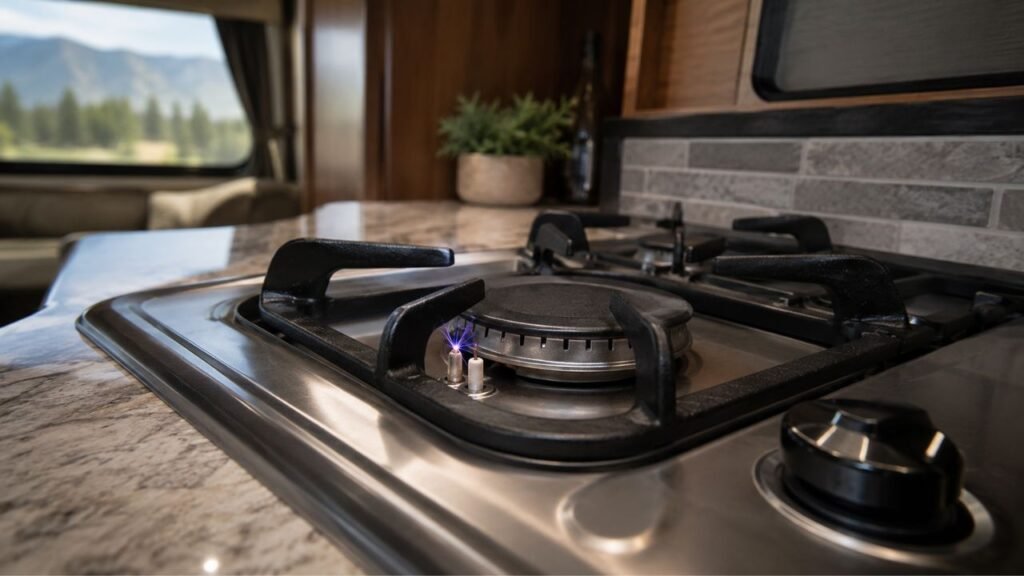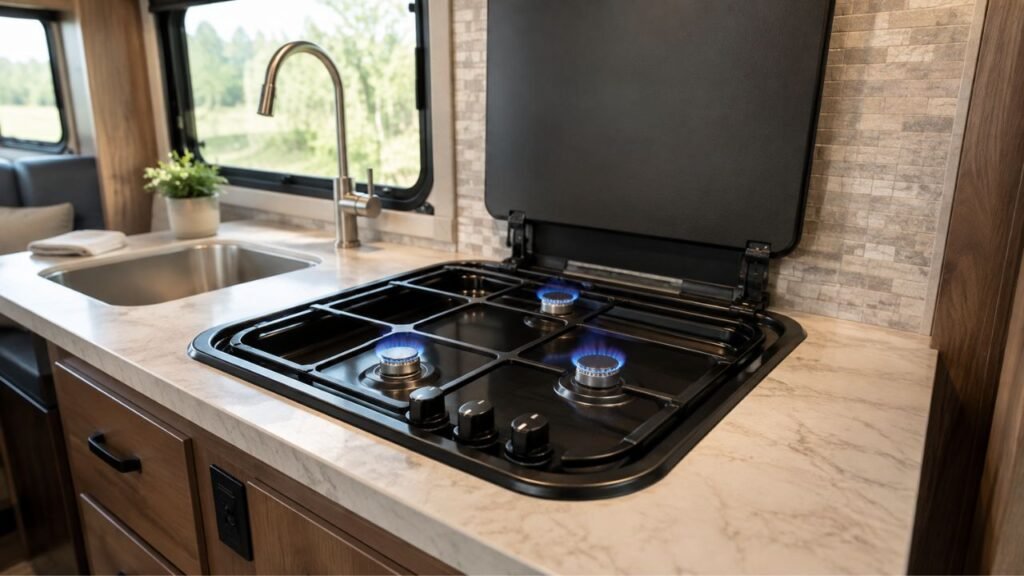
Your RV water pump usually pulses at the kitchen faucet because water flow is too restricted for the pump to run steadily. A partly opened faucet, clogged aerator, restricted sprayer, trapped air, or incorrect pump pressure settings can make the pump repeatedly start and stop.
The good news is that you usually don’t need a new pump. I’ll help you determine whether the problem is the kitchen faucet, water line, or pump itself, starting with the easiest checks first.
Key Takeaways
- Kitchen-only pulsing usually points toward restricted faucet flow.
- First, open the kitchen faucet completely and watch the pump.
- Remove the faucet aerator and test the water flow again.
- Check pull-out sprayers and hoses for kinks or restrictions.
- Air inside the plumbing can also cause irregular water delivery.
- Pulsing at every faucet suggests a broader pump-side problem.
- Cycling with all faucets closed may indicate pressure loss or leakage.
- Don’t adjust pump screws until simple faucet checks are completed.
Is It Normal for an RV Water Pump to Pulse When a Faucet Is Open?
A little cycling can be completely normal when you’re using very little water.
Most RV freshwater pumps are demand pumps. They start when plumbing pressure drops and stop once pressure reaches their shutoff point.
Imagine opening your kitchen faucet only slightly.
The faucet releases water slowly, but your pump can supply much more. The pump quickly rebuilds pressure and shuts itself off. Water continues leaving through the faucet, pressure falls again, and the pump restarts.
You may hear something like:
Brrrr… stop… brrrr… stop… brrrr…
Opening the faucet farther usually increases demand enough for continuous pump operation.
That type of pulsing doesn’t necessarily mean anything is broken.
I become more concerned when the pump:
- Pulses rapidly with the faucet completely open.
- Causes strong water surges instead of mild pressure changes.
- Suddenly starts pulsing when it previously worked smoothly.
- Pulses at several faucets throughout the RV.
- Cycles when nobody is using any water.
Those symptoms deserve some troubleshooting.
What Your RV Water Pump Pulsing Pattern Can Tell You
Before removing parts, pay attention to exactly when the pulsing happens. The pattern often tells you where to start looking.
| What You Notice | Most Likely Cause | What to Test First |
| Pulses only when faucet is partly open | Low water demand | Open faucet fully |
| Pulses with kitchen faucet fully open | Faucet restriction | Remove the aerator |
| Kitchen pulses but bathroom faucet doesn’t | Kitchen faucet or supply restriction | Compare fixtures |
| Pulsing stops when another faucet opens | Water demand was too low | Check kitchen flow |
| Pulsing began after de-winterizing | Trapped air | Purge hot and cold lines |
| Only hot water pulses | Hot-side restriction | Compare hot and cold separately |
| Every faucet pulses | Pump or supply-side issue | Inspect pump and strainer |
| Pump cycles with all faucets closed | Pressure loss | Check leaks and valves |
| Faucet pulses on city water with pump off | Faucet or city-water issue | Check aerator and regulator |
This table can save you plenty of unnecessary pump troubleshooting.
If your bathroom sink works perfectly while the kitchen faucet pulses, I would start at the kitchen faucet every time.
Why Does My RV Water Pump Pulse Only at the Kitchen Faucet?
If the problem happens only at your kitchen sink, that’s useful information. Your pump is obviously capable of supplying other fixtures normally, which makes a kitchen-side restriction much more likely.
The Kitchen Faucet Isn’t Open Far Enough
This is one of the simplest explanations.
Your pump may deliver considerably more water than a slightly opened faucet uses. Pressure therefore climbs quickly inside the plumbing.
The pressure switch shuts the pump off.
Water continues flowing through the faucet.
Pressure drops.
The pump starts again.
That cycle repeats until you increase water demand.
Try slowly opening your kitchen faucet farther.
Listen to what happens.
If the pulsing becomes faster and eventually turns into steady pump operation, the pump may simply be cycling because of low flow.
You probably don’t have a serious plumbing problem.
The Kitchen Faucet Aerator Is Partially Clogged
The aerator should be one of your first physical checks.
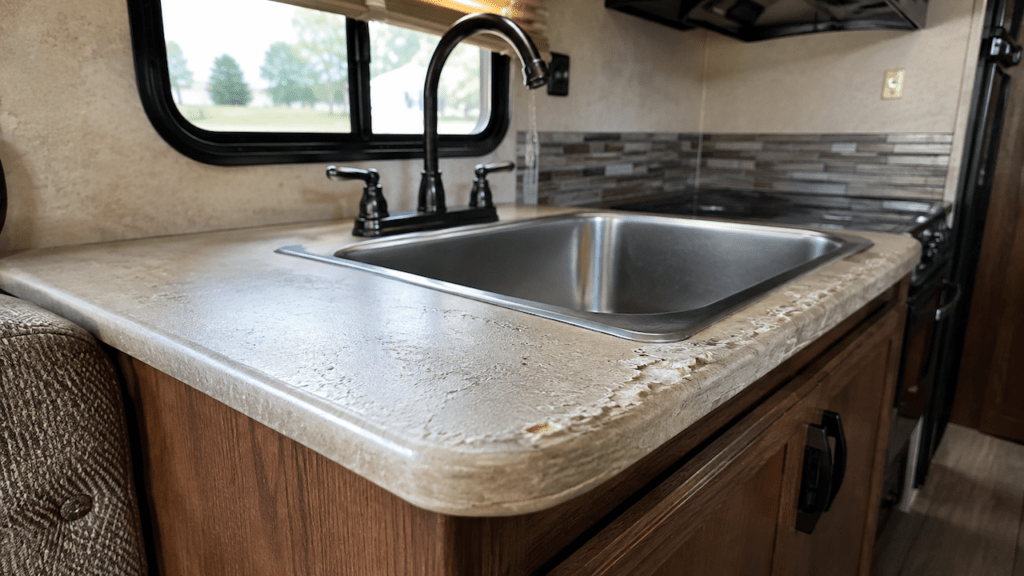
It’s the small screened fitting attached to the faucet outlet. It mixes air with the water and limits flow.
Unfortunately, it also catches debris.
Common RV aerator blockages include:
- Calcium deposits
- Hard-water scale
- Sand
- Small plastic particles
- Pipe debris
- Rubber fragments
- Sediment from the freshwater system
Even a partially blocked aerator can reduce flow considerably.
That restriction lets plumbing pressure rise quickly. The pump reaches its shutoff pressure, turns off, then restarts when pressure falls.
Here’s the easiest test.
Remove the aerator and run the faucet without it.
If water flow becomes stronger and the pump runs steadily, you’ve probably found the problem.
Clean or replace the aerator before touching anything on the pump.
The Pull-Out Sprayer or Faucet Is Restricting Water
Many newer RV kitchens use residential-style pull-down or pull-out faucets.
They look great, but they contain more potential restrictions.
Check for:
- A kinked sprayer hose
- A clogged spray head
- A restrictive internal fitting
- A damaged faucet cartridge
- Debris inside the sprayer
- A hose twisted beneath the sink
Pull the sprayer outward while the water is running.
Then watch the hose underneath the sink.
Make sure it isn’t pinched against plumbing, cabinetry, or storage items.
Also switch between spray and stream modes.
If one mode pulses noticeably more, the spray head itself may be restricted.
Air Is Trapped in the Kitchen Water Line
Air can make water pressure feel uneven or surge through the faucet.
This is especially common after:
- De-winterizing the RV
- Draining the freshwater system
- Running the freshwater tank empty
- Replacing plumbing components
- Replacing the kitchen faucet
- Servicing the water pump
- Refilling an empty water heater
Air compresses differently than water.
That can make pressure changes feel much more noticeable while the pump operates.
Start with the kitchen cold-water side.
Open it fully until water flows smoothly without sputtering.
Then repeat the process with hot water.
If you’ve recently de-winterized, purge every fixture afterward.
Don’t forget the shower and outdoor shower if equipped.
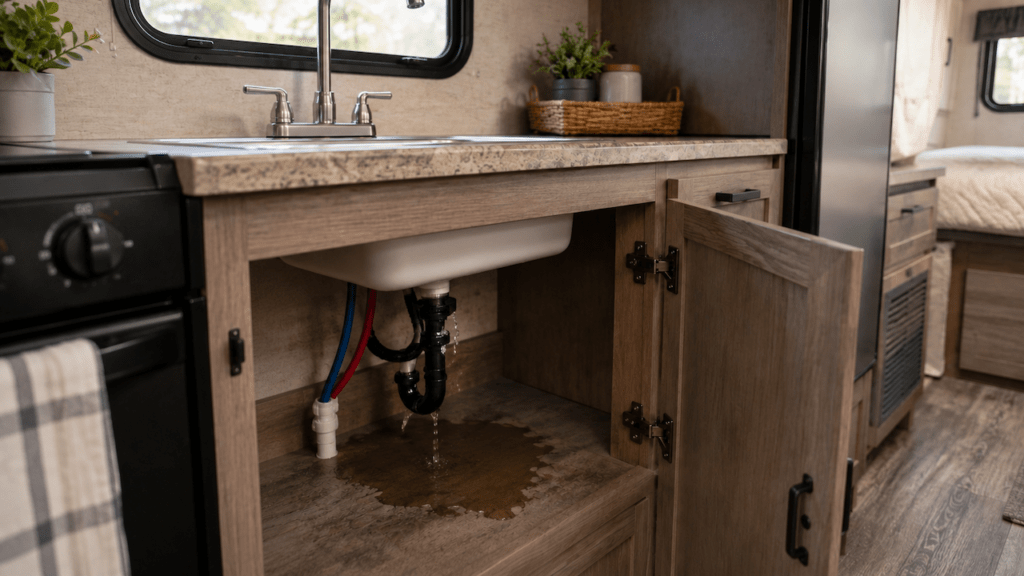
A Kitchen Supply Line Is Restricted
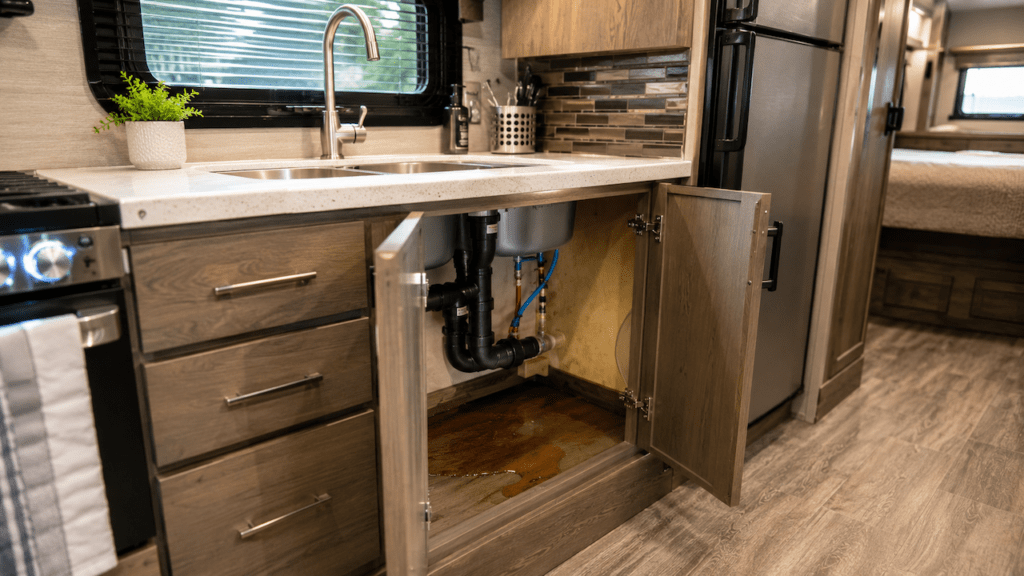
Look beneath your kitchen sink.
RV plumbing is usually packed into tight spaces.
A flexible faucet hose can become bent or pinched when items are stored underneath. A PEX fitting can also collect debris after plumbing repairs.
Check both hot and cold supply lines.
Look for:
- Sharp bends
- Pinched hoses
- Partially closed valves
- Damaged fittings
- Debris near faucet connections
If only one side pulses, compare its supply line with the good side.
That can quickly narrow your search.
The Pump Pressure Switch and Bypass Aren’t Working Well at Low Flow
Now we’re getting closer to the pump itself.
Many RV demand pumps use a pressure switch. Some also use an internal bypass system.
The pressure switch determines when the pump starts and stops.
The bypass helps manage situations where water demand is lower than full pump output.
When these settings aren’t working well together, the pump can repeatedly cycle during small water draws.
However, I wouldn’t adjust anything yet.
First make sure:
- The aerator is clean.
- The faucet isn’t restricted.
- Air is removed.
- The inlet strainer is clean.
- Other fixtures have been tested.
Pump adjustments should come after simple causes are eliminated.
Your RV Doesn’t Have an Accumulator Tank
An accumulator tank can make RV water delivery smoother.
It stores a small amount of pressurized water and absorbs pressure fluctuations between pump cycles.
Without one, you may notice:
- More frequent pump cycling
- More noticeable pressure changes
- Short pump bursts during small water draws
- Additional pump noise at night
But there’s an important distinction here.
Not having an accumulator tank doesn’t mean your RV plumbing is defective.
Many RV water systems operate perfectly well without one.
An accumulator is better viewed as a pressure-smoothing upgrade rather than an automatic repair.
How to Stop an RV Water Pump From Pulsing at the Kitchen Faucet
I recommend troubleshooting from the faucet backward toward the pump. This prevents replacing expensive parts when a five-minute cleaning job could solve everything.
1. Open the Kitchen Faucet Completely
Start with nothing more than the faucet handle.
Turn the pump on.
Open the cold side completely.
Listen to the pump and watch the water stream.
Then repeat using hot water.
Finally, run both together.
Pay attention to whether the pump:
- Stops pulsing completely
- Pulses faster
- Continues rapidly cycling
- Runs steadily but flow remains weak
- Behaves differently between hot and cold
If fully opening the faucet stops the pulsing, low-flow cycling is probably the explanation.
You may not need to repair anything.
2. Remove the Kitchen Faucet Aerator
Turn the pump off first.
Unscrew the aerator from the faucet outlet.
Keep track of the small washers and screens inside it.
Turn the pump back on and test the faucet without the aerator.
A dramatically stronger stream tells you the restriction was at the outlet.
If the pump now runs continuously, clean the aerator thoroughly.
3. Clean the Aerator and Spray Head
Rinse loose debris from the screen.
If mineral deposits are visible, soak removable parts using an appropriate descaling method.
Pay particular attention to:
- Fine mesh screens
- Small flow openings
- Rubber flow restrictors
- Spray-head passages
- Sediment trapped behind screens
Reassemble everything in the same order.
Then test the faucet again.
Don’t permanently remove important faucet components simply to increase flow.
Fixing the restriction properly gives you a better long-term result.
4. Check the Sprayer Hose and Plumbing Under the Sink
Open the cabinet beneath your kitchen sink.
Move stored items away from the plumbing.
Follow the faucet hoses from their connections upward.
Make sure nothing is crushed or tightly bent.
Pull the sprayer head outward while watching its hose.
It should move freely without folding sharply.
Also inspect supply connections for obvious restrictions or leaks.
5. Purge Air From the Hot and Cold Lines
Make sure your freshwater tank contains enough water.
Turn the pump on.
Open the kitchen cold-water faucet fully.
Let it run until the flow becomes smooth.
Close it.
Then open the hot side completely.
Hot lines may take longer if the water heater was recently drained.
Continue until sputtering disappears.
If you’re de-winterizing, repeat the process at every water fixture.
6. Open Another Faucet While the Kitchen Faucet Pulses
This is one of my favorite diagnostic tests because it’s so simple.
Leave the kitchen faucet running at the position where pulsing occurs.
Then slightly open the bathroom faucet.
Listen to the pump.
If the pump suddenly changes from:
on-off-on-off
to a steady run, increased water demand has stopped the short cycling.
That strongly suggests the pump can operate normally.
Your kitchen faucet simply wasn’t allowing enough flow.
7. Compare Every Water Fixture
Test the bathroom sink.
Test the shower.
Flush the toilet.
Test the outdoor shower if your RV has one.
Compare everything with the kitchen faucet.
Here’s the rule I want you to remember:
Kitchen only = investigate the kitchen fixture first.
Every fixture = investigate the pump and freshwater system.
That distinction can save you considerable time.
What If the Water Pump Pulses at Every Faucet?
If every fixture pulses, the kitchen faucet probably isn’t your main problem. It’s time to work backward toward the freshwater tank and pump.
Check these areas:
- Make sure the freshwater tank isn’t nearly empty.
- Inspect the pump inlet strainer for debris.
- Check suction fittings for loose connections.
- Verify the winterization valve is positioned correctly.
- Look for air entering the pump’s inlet side.
- Check for restricted or kinked pump supply hoses.
- Confirm the pump receives proper 12-volt power.
- Inspect the pump’s pressure-switch operation.
- Consider internal valve or diaphragm problems.
- Check model-specific bypass settings when applicable.
Start with the strainer.
Most RV water pumps have a small screened filter installed near their inlet.
Turn the pump off before opening it.
If the screen contains sediment, clean it carefully and reinstall it.
A restricted pump inlet can affect every fixture.
What If the Pump Pulses When No Faucets Are Running?
This is different from pulsing while washing dishes.
When every faucet is closed, the pump should pressurize the plumbing and eventually stop.
It shouldn’t repeatedly restart without water being used.
If it does, system pressure is probably disappearing somewhere.
Possible causes include:
- A dripping faucet
- A leaking toilet valve
- Loose plumbing fittings
- A hidden PEX leak
- Water-heater pressure loss
- A faulty pump check valve
- A leaking city-water inlet check valve
- Internal pump valve leakage
Start by turning every fixture off.
Let the pump pressurize the system.
Then listen.
If the pump runs for a second every few minutes, inspect visible plumbing carefully.
Check beneath sinks, around the toilet, near the water heater, and around the pump.
Don’t confuse this symptom with low-flow faucet cycling.
They have very different causes.
Should I Adjust the RV Water Pump Pressure Switch?
Pump adjustment can solve certain cycling problems, but it shouldn’t be your first move. Different pump models use different switch pressures and adjustment procedures.
Check Your Pump Model Before Adjusting Anything
Find the pump label first.
You may have a Shurflo, Flojet, SEAFLO, Remco, Lippert, or another pump.
Record:
- Model number
- Rated flow
- Voltage
- Shutoff pressure
- Any bypass information
Then follow instructions specifically written for that pump.
Don’t assume an adjustment that works on somebody else’s pump will work on yours.
What the Pressure Switch Actually Does
The pressure switch is responsible for starting and stopping your pump.
The basic sequence looks like this:
Faucet opens → pressure drops → pump starts.
Then:
Faucet closes → pressure rises → pump stops.
During very low flow, those pressure changes happen repeatedly.
The pump starts.
Pressure rises quickly.
The pump stops.
The faucet lowers pressure again.
Then the pump restarts.
That’s the pulsing you’re hearing.
Why the Internal Bypass Matters
Some pumps include an internal bypass.
The bypass helps handle situations where the pump produces more water than the fixture currently needs.
Instead of forcing the pump to switch off immediately, part of the flow can be managed internally.
If the bypass and pressure switch aren’t working well together, you may experience excessive cycling.
However, adjusting them incorrectly can create new problems.
You could cause:
- Improper shutoff
- Continuous pump operation
- Excessive plumbing pressure
- Poor low-flow performance
- Additional pump noise
That’s why I recommend cleaning the faucet first.
Will an Accumulator Tank Stop the Pump From Pulsing?
An accumulator tank can significantly reduce normal pump cycling and pressure fluctuations. However, it shouldn’t be used to hide an actual blockage or plumbing problem.
The accumulator holds a small volume of water under pressure.
When you open the faucet slightly, that stored pressure supplies some water before the pump needs to start.
This provides several benefits:
- Less frequent pump cycling
- Smoother low-flow water delivery
- Reduced pressure surging
- Quieter nighttime water use
- Fewer short pump bursts
An accumulator makes sense when your system works properly but cycling still bothers you.
It doesn’t make much sense when one clogged aerator causes the problem.
Clean the restriction first.
Then decide whether an accumulator would improve your setup.
Why Does the Kitchen Faucet Pulse on Hot Water but Not Cold?
If cold water runs normally but hot water pulses, that’s another useful clue.
Your pump is clearly capable of supplying the kitchen faucet.
The problem is probably somewhere along the hot-water path.
Check for:
- A partially positioned water-heater bypass valve
- Air trapped in the hot-water line
- A restricted hot-water supply fitting
- Debris inside the faucet’s hot-side passage
- A faucet cartridge problem
- A kinked hot-water hose
This often happens after de-winterizing.
Make sure the water heater’s valves are returned to their normal operating positions.
Then purge the hot line thoroughly.
If cold and hot behave differently, don’t start adjusting the pump.
Follow the side that has the restriction.
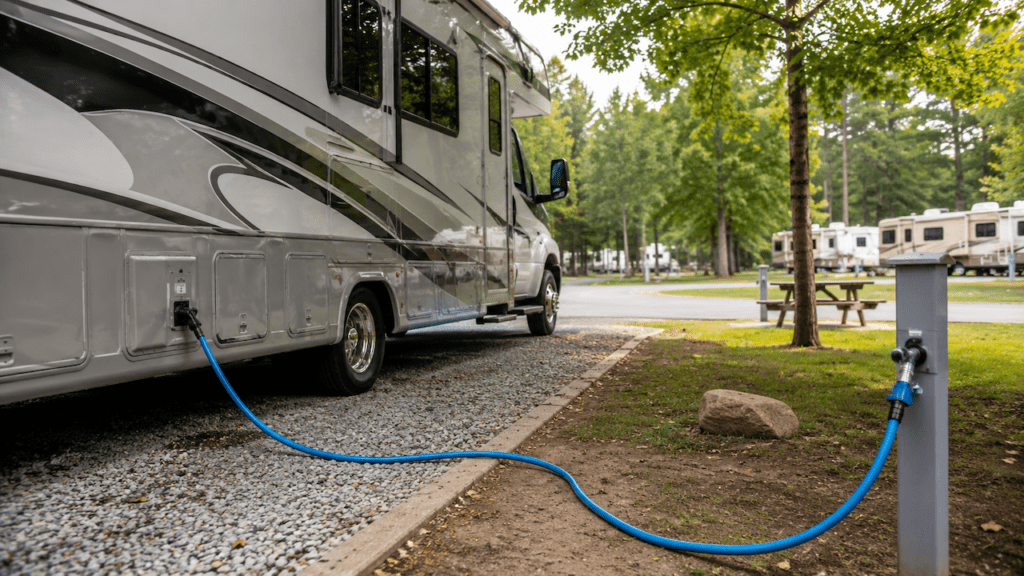
Why Does My RV Faucet Still Pulse on City Water?
If you’re connected to campground water and the freshwater pump is switched off, your pump isn’t creating that pulsation.
That changes the troubleshooting path.
Check:
- The kitchen faucet aerator
- Pull-out spray head
- Faucet cartridge
- Water-pressure regulator
- Inline water filter
- Kinked freshwater hose
- Campground pressure fluctuations
- Restricted faucet supply line
You can also compare the kitchen sink with another fixture.
If every fixture fluctuates, look toward the campground supply, regulator, or filter.
If only the kitchen faucet fluctuates, stay focused on the kitchen fixture.
Can Pump Pulsing Damage the Water Pump?
Occasional cycling during a small water draw usually isn’t an emergency.
These pumps are designed to start and stop automatically.
However, extremely rapid cycling over long periods creates unnecessary operating cycles.
That may increase wear on:
- The pressure switch
- Pump motor
- Internal diaphragm
- Electrical connections
- Pump mounting system
There’s no reason to panic because your pump cycles while barely opening a faucet.
But if it rapidly pulses during normal water use, fixing the cause is worthwhile.
When Should I Suspect the Pump Instead of the Kitchen Faucet?
Don’t replace the pump simply because you hear pulsing at one sink.
Start suspecting the pump when:
- Several faucets pulse during normal use.
- Water pressure is weak throughout the RV.
- Pulsing continues with the kitchen aerator removed.
- The pump struggles to maintain normal flow.
- The pump cannot prime consistently.
- Pump noise has suddenly changed.
- The pump won’t shut off after faucets close.
- The pump repeatedly cycles without water usage.
- Cleaning the inlet strainer doesn’t improve anything.
- Known plumbing restrictions have already been eliminated.
Even then, inspect the electrical supply and inlet plumbing before buying another pump.
A weak power connection or suction-side air leak can imitate pump failure.
Final Words
If your RV water pump pulses only at the kitchen faucet, start at the kitchen sink instead of taking the pump apart. Fully open the faucet, remove the aerator, inspect the sprayer hose, and purge trapped air before considering pump adjustments.
My preferred troubleshooting order is simple: open the faucet fully, remove the aerator, inspect the faucet hoses, bleed the lines, compare other fixtures, check the pump inlet, and only then investigate pressure-switch or bypass adjustments. That approach usually finds the problem faster while avoiding unnecessary parts replacement.
Related FAQs
Why Does My RV Water Pump Pulse When the Faucet Is Partially Open?
A partially opened faucet may use less water than your pump delivers. Pressure rises quickly, the pump shuts off, pressure falls through the open faucet, and the pump restarts. Opening the faucet farther often makes the pump run continuously.
Why Does My RV Water Pump Stop Pulsing When I Open a Second Faucet?
Opening another faucet increases total water demand. The pump can then deliver water continuously instead of repeatedly reaching its shutoff pressure, so the start-stop cycling disappears.
Can a Clogged Faucet Aerator Make an RV Water Pump Cycle On and Off?
Yes. A clogged aerator restricts water leaving the faucet, allowing plumbing pressure to rise quickly. The pump shuts off, pressure drops again, and the pump repeatedly restarts.
Should an RV Water Pump Run Continuously When the Faucet Is Open?
It depends on water demand. With a faucet fully open, many fixed-speed RV pumps run continuously. At very low flow, normal pressure-switch cycling may occur instead.
Why Does Only My RV Kitchen Faucet Make the Pump Pulse?
If every other fixture works normally, the kitchen faucet probably has lower flow or a restriction. Check its aerator, sprayer head, pull-out hose, supply lines, and faucet cartridge before investigating the pump.
Can Air in RV Water Lines Cause Pump Pulsing?
Yes. Trapped air compresses and expands as the pump builds pressure, which can create uneven water delivery and noticeable surging. Purging hot and cold lines usually removes the trapped air.
Why Did My RV Water Pump Start Pulsing After De-Winterizing?
De-winterizing can leave air inside plumbing lines or valves in incorrect positions. Purge each fixture and verify the water-heater bypass and winterization valves are returned to their normal operating positions.
Will an Accumulator Tank Stop RV Water Pump Pulsing?
An accumulator can reduce normal pressure fluctuations and frequent low-flow cycling. However, you should first correct clogged aerators, trapped air, leaks, or other restrictions instead of using an accumulator to mask them.
Should I Adjust My Shurflo Water Pump to Stop Pulsing?
Only after confirming the faucet, aerator, pump strainer, plumbing, and air are not causing the problem. Check your exact Shurflo model instructions because pressure-switch and bypass procedures aren’t universal.
Why Does My RV Water Pump Cycle With All Faucets Closed?
Cycling with every fixture closed usually means system pressure is slowly escaping. Check for dripping fixtures, plumbing leaks, toilet-valve leakage, check-valve problems, or internal pump leakage.

Gregory Allen covers outdoor RV camping, essential gear, and travel preparation. His reviews are based on real conditions, not spec sheets alone. He helps RVers choose equipment that works reliably in everyday outdoor use.