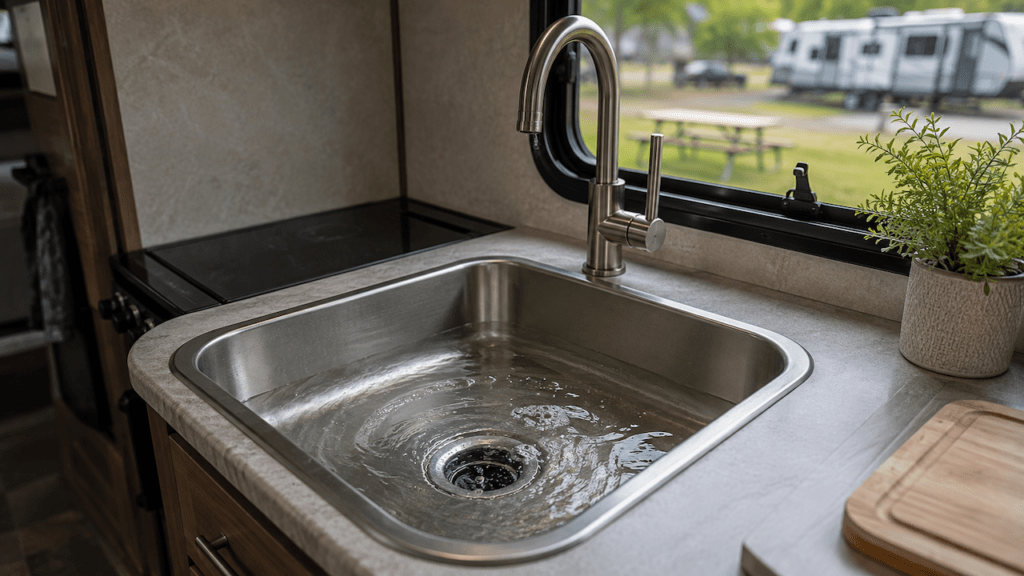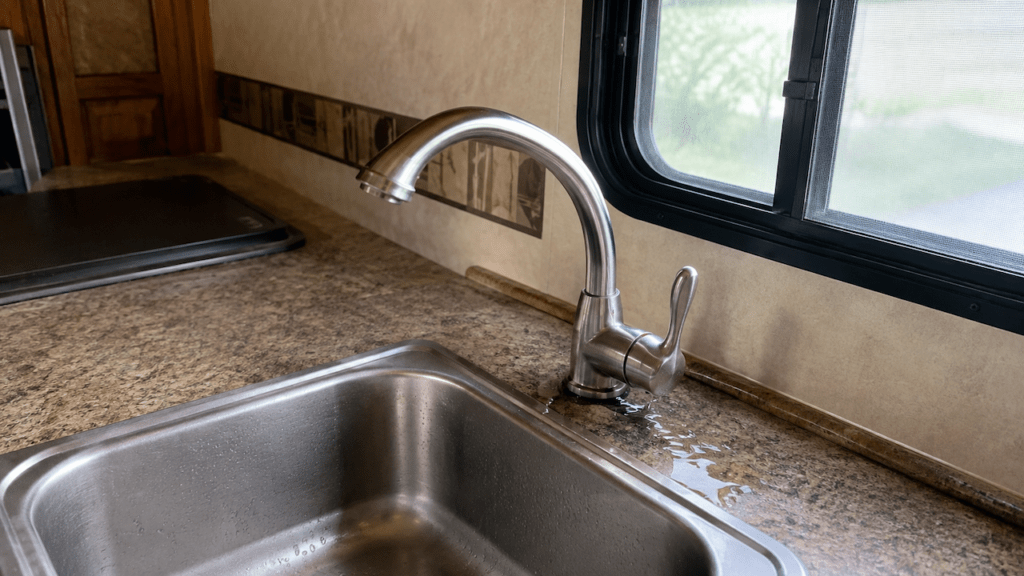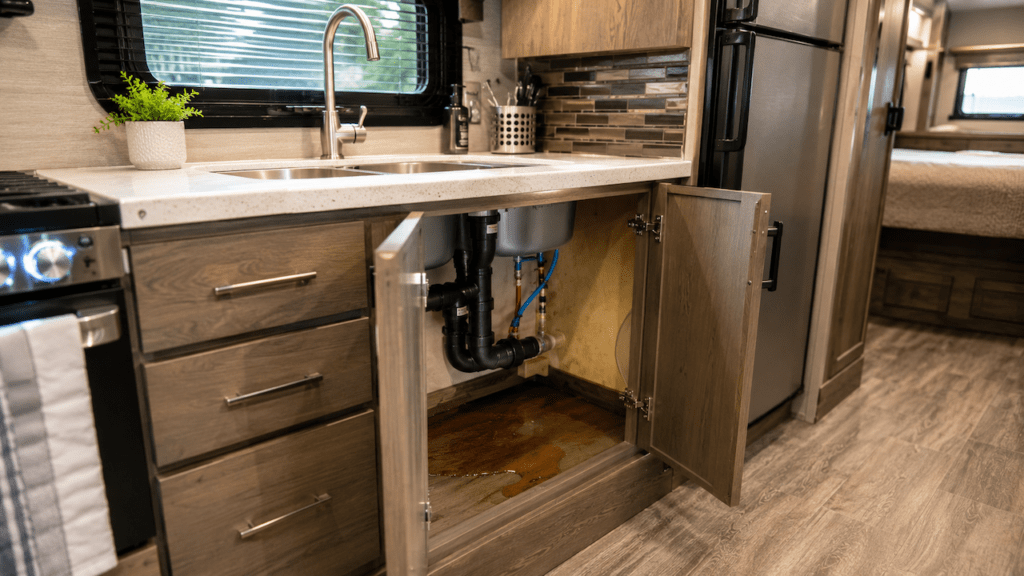
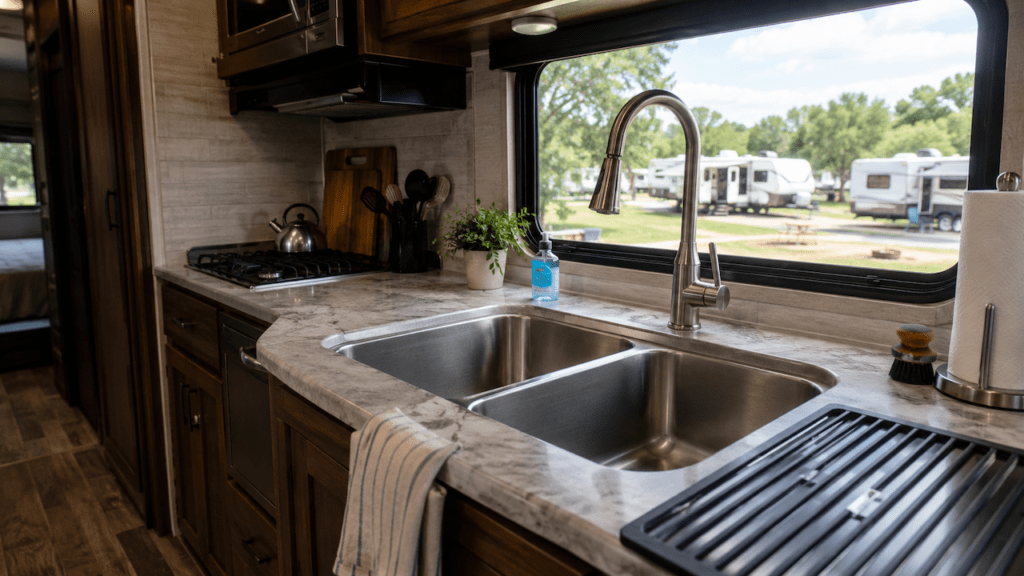
Your RV kitchen sink usually smells like sewer because gray-tank odors are getting past the plumbing barrier designed to keep them out. Common causes include a failed air admittance valve, a dry P-trap, a dirty waterless trap, food and grease buildup, gray-tank sludge, or a venting problem.
The good news is that you can usually narrow the cause down without tearing apart your plumbing. I’ll walk you through the symptoms, what to check first, and how to fix the problem safely.
Key Takeaways
- A bad air admittance valve can let gray-tank odors escape under the sink.
- A dry P-trap can no longer block gases from entering the RV.
- Some RVs use a waterless trap instead of a traditional P-trap.
- Food, grease, and soap residue can make gray water smell like sewage.
- A smell that appears only with hot water may come from the water heater.
- Slow drains and gurgling can point to venting or drainage problems.
- Cleaning the gray tank will not fix a failed AAV or damaged trap.
- Avoid harsh household drain chemicals unless your RV manufacturer approves them.
Why Does My RV Kitchen Sink Smell Like Sewer?
An RV kitchen sink can smell like sewer even when no toilet waste reaches the sink.
In most RVs, the kitchen sink drains into a gray-water or galley tank. That tank collects water from dishwashing, food residue, soap, grease, and other organic material.
After sitting for a while, that mixture can smell surprisingly bad.
Normally, you should not smell it inside the RV because several plumbing components act as odor barriers. These may include a P-trap, waterless trap, air admittance valve, and roof vent.
So when sewer-like odor reaches your kitchen, one of two things is usually happening.
Either the wastewater has become unusually smelly, or something that should contain that smell is no longer working correctly.
That distinction is important because repeatedly cleaning your tank will not help much if a valve under the sink is stuck open.
First, Find Out Where the Sewer Smell Is Coming From
Before replacing anything, try to identify exactly when and where the odor appears. A few simple observations can save you a lot of unnecessary work.
| What You Notice | What to Check First | Why It Matters |
| Smell strongest inside the sink cabinet | Air admittance valve | A failed valve may let gray-tank gases escape |
| Smell comes directly from the drain after storage | P-trap | The water seal may have dried out |
| Smell becomes worse after driving | Trap or AAV | Movement can expose weak odor barriers |
| Smell gets stronger while washing dishes | Drain buildup | Food and grease may be decomposing |
| Smell increases as gray tank fills | Gray tank, AAV, or vent | Tank gases become more noticeable |
| Sink gurgles or drains slowly | Vent or drain line | Airflow or blockage may be affecting drainage |
| Only hot water smells | Water heater | The drain may not be the actual source |
| Hot and cold water smell away from sink | Fresh-water system | The odor may be in the water itself |
| Tank was cleaned but odor returned quickly | AAV, trap, or vent | The smell may be escaping through another fault |
Start with the easiest clue.
If the smell is strongest underneath the sink rather than directly over the drain, I would inspect the air admittance valve first.
1. The Air Admittance Valve Under the Sink Has Failed
The air admittance valve is one of the most overlooked causes of RV kitchen odors. It is usually installed on a vertical section of plumbing beneath the sink.
What Does an RV Air Admittance Valve Do?
An air admittance valve, commonly called an AAV, helps your sink drain properly.
When water flows down the pipe, the plumbing system needs replacement air. The valve opens briefly and allows air into the drain system.
Once the pressure equalizes, the valve should close again.
That closed position is important because it prevents gray-tank gases from escaping into your RV.
If the internal seal becomes dirty, worn, warped, or stuck, the valve may remain slightly open.
You may then smell gray-tank odor inside the cabinet.
How Can You Tell if the AAV Is Bad?
A bad AAV often causes odor even when the sink itself appears to work normally.
Look for these clues:
- The smell is strongest under the kitchen sink.
- The P-trap still contains water.
- The gray tank has already been cleaned.
- The odor returns shortly after dumping the tank.
- The smell becomes stronger when water drains.
- You can smell odor close to the valve itself.
You can also inspect the valve for obvious cracking or damage.
Do not permanently cap the pipe as a test. The valve is there for a reason and may be necessary for proper drainage.
How Do You Fix a Bad RV Sink AAV?
In many RVs, replacing the valve is fairly straightforward.
First, identify the valve and confirm its connection type. Many screw directly onto a threaded fitting.
You can then:
- Turn off water use at the sink.
- Remove items from the cabinet.
- Inspect the valve and surrounding pipe.
- Unscrew the old valve if accessible.
- Match the replacement size and fitting.
- Install the new valve upright.
- Run water and check for odor or leaks.
Before replacing it, check your RV owner’s manual when possible.
RV plumbing layouts vary, and some manufacturers use different venting systems.
2. The P-Trap Is Dry or Has Lost Its Water Seal
A traditional P-trap holds a small amount of water after the sink drains. That water creates a simple barrier between your kitchen and the gray tank.
How Does a P-Trap Stop Gray-Tank Odors?
Look under a household sink and you will usually see a curved section of pipe.
Many RVs use the same basic design.
After water flows through the sink, some remains inside the curve. Gray-tank gases cannot easily move through that water seal.
When the water disappears, however, the gases have a direct path toward the drain opening.
That is why a sink can suddenly smell terrible after an RV sits unused.
Why Does an RV P-Trap Become Dry?
A trap may lose its water for several reasons:
- Long periods of storage
- Hot weather
- Evaporation
- RV movement
- A leaking trap connection
- Improper plumbing venting
- Siphoning inside the drain system
Storage is one of the easiest causes to test.
If your RV has been sitting for weeks or months, run some water into the sink and see whether the odor improves.
How Do You Fix a Dry RV Kitchen P-Trap?
Run enough water through the sink to refill the trap.
You do not need to flood the drain. A normal amount of water should restore the seal.
Wait a few minutes and check the smell again.
If the odor disappears, you have probably found the problem.
If the smell returns quickly, inspect the trap for leaks or cracks.
A trap that cannot hold water needs repair rather than repeated refilling.
3. Your RV May Have a Waterless Trap Instead of a P-Trap
Not every RV kitchen sink uses a traditional curved P-trap. Some manufacturers install compact waterless traps because they take up less space and handle vehicle movement differently.
What Is a Waterless RV Drain Trap?
A waterless trap uses an internal flexible membrane instead of standing water.
When wastewater flows through the pipe, the membrane opens.
After the water passes, the membrane closes again and blocks gases from moving backward.
You may see systems such as HepvO-style waterless traps in RV plumbing.
These are particularly useful where cabinet space is limited.
Can a Waterless Trap Cause Sink Odors?
Yes.
A waterless trap may leak odors if its internal membrane becomes:
- Dirty
- Damaged
- Distorted
- Stuck open
- Improperly installed
Grease and food residue can also interfere with the flexible sealing surfaces.
If your RV does not have a visible P-shaped pipe under the sink, take a closer look at your drain setup.
You may have a waterless system instead.
How Should You Clean or Inspect a Waterless Trap?
First, identify the exact trap before pushing anything through it.
Do not assume you can treat it like ordinary rigid drain pipe.
A sharp drain snake, stiff brush, or other hard object may damage the internal membrane.
If the trap can be removed according to its instructions, inspect it for buildup and rinse it appropriately.
Replace it if the membrane is torn or no longer sealing correctly.
4. Food, Grease, and Biofilm Are Making the Drain Smell
Your kitchen sink handles more organic material than your shower or bathroom sink. That makes the kitchen drain especially prone to odor-producing buildup.
Why Can Kitchen Gray Water Smell Like Sewage?
Gray water is not the same as black water, but it can still smell awful.
Think about what enters your kitchen sink:
- Grease
- Food crumbs
- Sauces
- Cooking oils
- Soap
- Coffee residue
- Milk residue
- Starchy water
- Small organic particles
Those materials sit inside damp plumbing and eventually reach the gray tank.
Bacteria begin breaking them down.
As the residue decomposes, it can produce a sour, rotten, or sewer-like smell.
That is why gray-tank odor can sometimes be mistaken for black-tank odor.
How Can You Tell if the Drain Itself Is Dirty?
The drain line may be the problem if:
- Odor is strongest directly over the drain.
- You see slime around the drain opening.
- The smell gets worse after washing dishes.
- Cleaning the visible drain improves the smell briefly.
- The tank is not especially full.
- The AAV and trap appear to be working.
You may also notice greasy buildup inside the strainer.
How Do You Clean an RV Kitchen Sink Drain Safely?
Start with the simplest cleaning.
Remove the sink strainer and wipe away visible food, grease, and slime.
Clean accessible drain surfaces with warm water and a cleaner suitable for your RV plumbing.
If removable trap sections contain buildup, clean them carefully.
Avoid pouring boiling water into unknown RV plumbing. Very hot water can damage some plastic components.
You should also avoid reaching immediately for strong household drain openers.
RV pipes, seals, tanks, and waterless traps can differ from residential plumbing.
Use products that are compatible with your particular system.
5. The Gray Tank Has Grease, Sludge, or Organic Buildup
Sometimes the smell really is coming from the gray tank itself.
A tank can look empty on the monitor while still holding grease, residue, and slime on its interior surfaces.
Why Doesn’t Dumping the Gray Tank Remove the Smell?
Dumping removes most of the liquid.
It does not necessarily remove everything stuck inside.
Residue can remain on:
- Tank walls
- Sensor surfaces
- Drain pipes
- Tank corners
- Low spots
- Internal fittings
Kitchen grease is especially troublesome because it can cling to surfaces.
Over time, organic material attaches to the grease and creates more odor.
So you may dump the tank and still notice a smell shortly afterward.
How Do You Clean a Smelly RV Gray Tank?
Start by dumping the tank at an approved location.
Then use the cleaning method recommended for your RV and tank system.
A general approach may include:
- Empty the gray tank.
- Add clean water.
- Add an RV-compatible gray-tank cleaning treatment.
- Allow the solution time to work.
- Drive the RV if the product instructions allow sloshing.
- Dump the tank again.
- Rinse according to your RV’s plumbing setup.
Do not assume more chemical means better cleaning.
Follow the product instructions carefully.
Some cleaners need a certain amount of water to work properly.
Should You Use Bleach, Drano, or Harsh Drain Cleaner?
I would not make harsh household chemicals your first choice.
RV plumbing can include plastic tanks, flexible seals, rubber membranes, and lightweight fittings.
A product that works in a residential drain may not be appropriate for every RV component.
Strong cleaners may also interfere with certain seals or tank treatments.
Check your owner’s manual and the cleaner label before using anything aggressive.
Never mix different cleaning chemicals together.
6. The Gray-Tank Roof Vent Is Blocked or Not Venting Properly
Your gray-water system also needs proper ventilation. When the vent cannot move air correctly, drainage behavior and odors can change.
What Does the Gray-Tank Vent Do?
The vent provides a path for air and gases inside the plumbing system.
As wastewater enters the tank, air needs somewhere to go.
The vent normally directs gases outside through the roof.
If that path becomes blocked, damaged, or restricted, pressure changes may affect drainage.
Odor may then appear around sinks or other fixtures.
What Are the Signs of a Plumbing Vent Problem?
Look for symptoms such as:
- Sink gurgling
- Slow drainage
- Multiple drains acting strangely
- Odor from more than one fixture
- Smell returning despite a full P-trap
- Odor changing when exhaust fans are running
- Problems that continue after AAV replacement
These signs do not automatically prove a blocked roof vent.
They simply make the vent system worth checking.
What Should You Check?
Inspect the visible roof vent only if you can access the roof safely.
Look for:
- Leaves
- Insect nests
- Dirt
- Damaged vent caps
- Cracks
- Loose vent components
Do not put yourself at risk climbing onto an RV roof.
If access is difficult, let an RV technician handle the inspection.
7. The Smell May Actually Be Coming From the Water
Before spending hours cleaning drains, make sure the odor is truly coming from the plumbing waste side. Water odor can easily seem like drain odor when you are standing over the sink.
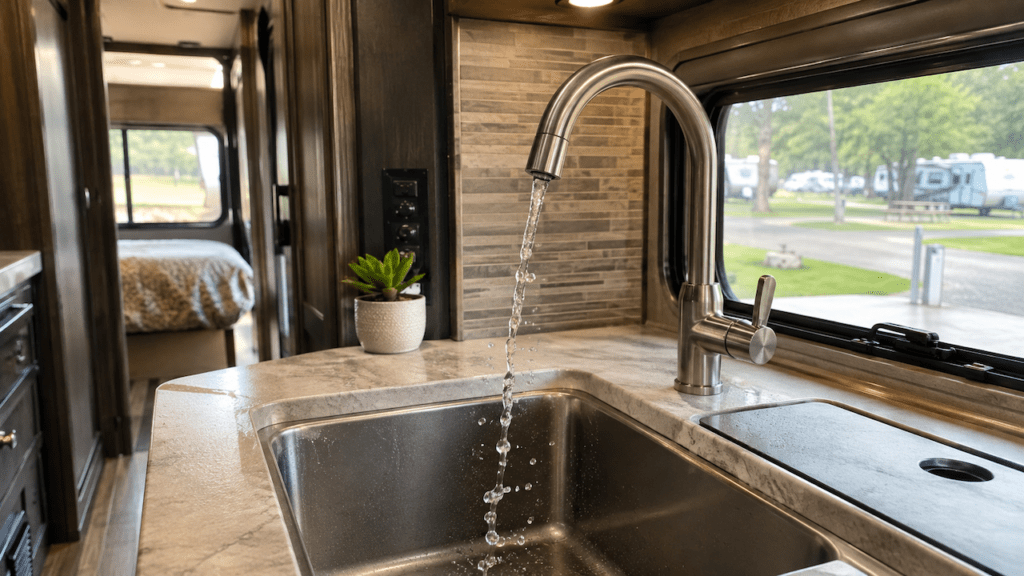
How Do You Test Whether the Water Smells?
Fill a clean glass with cold water.
Move away from the sink and smell the water.
Then repeat the test using hot water.
This simple test helps separate drain odor from water odor.
If the glass smells fine away from the sink, the drain system is more likely responsible.
If the water itself smells, investigate your freshwater system instead.
What If Only the Hot Water Smells Like Rotten Eggs?
If cold water smells normal but hot water smells like rotten eggs, the water heater becomes a more likely suspect.
Certain water conditions can create sulfur-like odors inside a water heater.
Stagnant water can also become unpleasant after storage.
In that situation, cleaning the gray tank may accomplish nothing because the smell is reaching the sink through the faucet rather than coming up through the drain.
Follow the water heater manufacturer’s cleaning and sanitizing procedure.
8. There Is a Leak, Loose Drain Connection, or Cracked Plumbing Part
Odors can sometimes escape through damaged plumbing rather than the drain opening itself. This is worth checking when other fixes do not solve the problem.
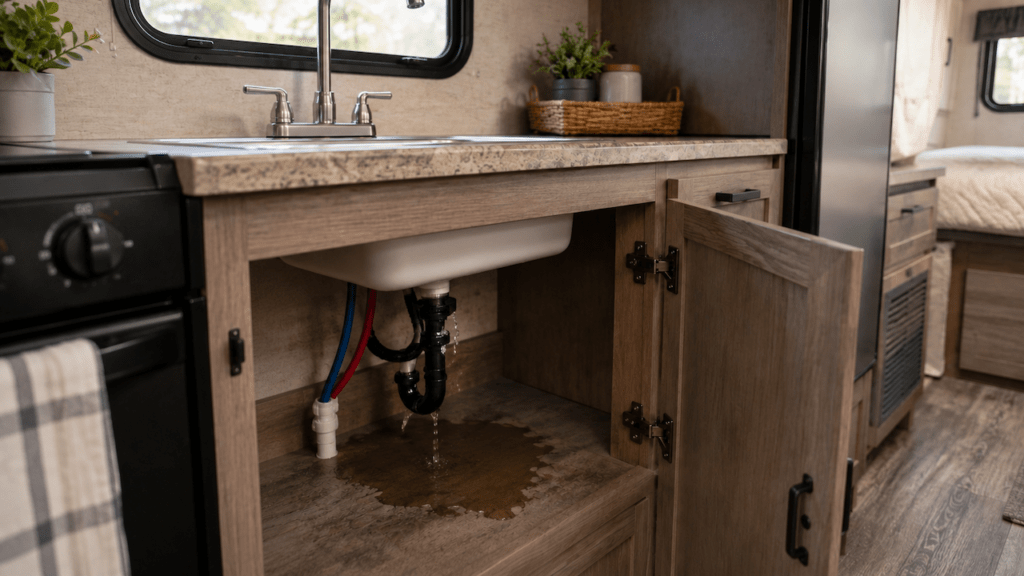
What Should You Inspect Under the Sink?
Use a flashlight and look carefully for:
- Loose slip-joint fittings
- Cracked plastic pipe
- Damaged P-trap sections
- Loose AAV connections
- Damp cabinet flooring
- Water stains
- Unusual plumbing modifications
- Cracks around drain fittings
Also run water while you inspect the connections.
A very small leak may only appear when the sink drains.
When Should an RV Technician Inspect the Plumbing?
Consider professional help if the odor continues after you have checked the obvious causes.
An RV technician may be the better choice when:
- Plumbing disappears behind walls.
- You suspect a vent-line problem.
- There is water damage.
- A fitting is cracked.
- You cannot identify the trap system.
- The odor remains after replacing a failed AAV.
- More than one fixture has the same problem.
At that point, guessing and replacing random parts can cost more than proper diagnosis.
Why Does My RV Sink Smell Worse After Driving?
An odor that appears mainly after driving deserves special attention.
Road movement can affect water inside a traditional trap. If the trap already has a low water level, enough movement may weaken the seal.
Vibration can also make loose fittings or marginal valves more noticeable.
If the smell appears after travel but disappears after running water, inspect the trap first.
If the smell is strongest under the sink, check the AAV.
And if your RV uses a waterless trap, inspect its membrane rather than trying to refill it.
Why Does the Kitchen Sink Smell When the Gray Tank Gets Full?
A fuller gray tank can produce stronger odors because more wastewater and organic material are sitting inside it.
However, you should not simply accept sewer smell inside the RV as normal.
A working trap and venting system should still keep most tank gases away from the living area.
If smell consistently increases as the tank fills, check the tank condition, AAV, trap, and venting system.
Dumping earlier may reduce the smell temporarily, but you should still investigate why odors are getting inside.
What Should I Check First? A 10-Minute Troubleshooting Order
If you want to avoid replacing random parts, work through the problem in a simple order. Start with the easiest checks and move toward deeper plumbing issues.
- Test the hot and cold water away from the sink: This confirms whether the smell comes from the drain or water supply.
- Open the cabinet and smell around the plumbing: Strong odor underneath the sink can point toward the AAV.
- Identify your trap type: Look for a P-trap or compact waterless trap.
- Run water through a conventional P-trap: This quickly restores a dry water seal.
- Inspect the AAV: Look for damage or odor concentrated around the valve.
- Clean the sink strainer and accessible drain: Remove food, grease, and slime.
- Check the gray-tank level: Dump the tank if it is near full.
- Clean the gray tank if needed: Use an RV-compatible treatment.
- Consider a venting issue: Pay attention to slow drainage and gurgling.
- Inspect for leaks or damaged plumbing: Call a technician if the problem remains unclear.
Working in this order usually prevents you from spending money before ruling out simple causes.
How to Prevent Your RV Kitchen Sink From Smelling Again
Once you eliminate the odor, a few habits can reduce the chance of it returning.
- Scrape leftover food into the trash before washing dishes.
- Wipe greasy pans with a paper towel first.
- Use a sink strainer to catch small food particles.
- Avoid pouring cooking oil down the sink.
- Dump the gray tank regularly.
- Clean the gray tank periodically.
- Keep conventional P-traps from drying out.
- Inspect waterless traps when odor develops.
- Check the AAV if smell appears under the cabinet.
- Investigate slow drains instead of ignoring them.
- Use RV-compatible plumbing products.
- Follow your owner’s manual during winterization.
- Do not use fragrance alone to cover recurring tank odors.
The main goal is to keep organic material out of the tank whenever possible.
Less food and grease means less odor-producing buildup later.
Final Thoughts
If your RV kitchen sink smells like sewer, don’t immediately assume your black tank is leaking into the kitchen.
In many cases, the smell is coming from normal gray-water waste that is escaping through a failed AAV, dry P-trap, dirty waterless trap, clogged vent, or contaminated drain.
I would start by determining whether the odor comes from the drain, under the cabinet, or the water itself.
Then work through the easy checks before deep-cleaning tanks or replacing plumbing.
Once you find the actual escape path, these odors are usually much easier to control.
Related FAQs
Can an RV Gray Tank Smell Like Sewer?
Yes. Food, grease, soap residue, and bacteria can create extremely foul odors inside an RV gray tank. The smell may closely resemble sewage even though the tank does not normally contain toilet waste.
Why Does My RV Kitchen Sink Smell Like Rotten Eggs?
A rotten-egg smell can come from dirty gray-water plumbing, but test the water itself before assuming the drain is responsible. If only the hot water smells, the water heater may be the source.
Why Does My RV Sink Smell Only After Driving?
Driving can disturb water inside a conventional P-trap and expose weak seals or loose plumbing. If the smell appears after travel, refill the trap and inspect the AAV and drain connections.
Why Does My RV Sink Smell When the Gray Tank Is Full?
A fuller gray tank may produce stronger odors, but those gases should still remain contained. Repeated odor when the tank fills can point toward an AAV, trap, vent, or tank-cleanliness problem.
Can a Bad Air Admittance Valve Make an RV Smell Like Sewer?
Yes. A failed air admittance valve can remain partially open and allow gray-tank gases to enter the RV. Odor strongest underneath the sink is a common clue.
Where Is the Air Admittance Valve in an RV?
When installed, the AAV is usually attached to a vertical section of drain plumbing under a sink. It often sits higher than the horizontal drain pipe and may look like a small plastic cap or valve.
How Do I Know if My RV AAV Is Bad?
A strong odor around the valve, despite having water in the P-trap, is one clue. If the smell disappears after replacing the valve, the old AAV was likely failing to seal correctly.
Does Every RV Kitchen Sink Have a P-Trap?
No. Some RVs use compact waterless traps instead of conventional P-traps. These use a flexible internal membrane rather than standing water to block tank gases.
Can I Pour Bleach Down My RV Kitchen Sink?
Only use bleach when your RV or component manufacturer allows it and provides the correct dilution procedure. Concentrated bleach or improper use may damage certain seals and plumbing components.
Can I Use Drano in an RV Kitchen Sink?
It is generally safer to avoid strong household drain openers unless the product is specifically approved for your RV plumbing. RV systems may contain materials and valves that differ from residential drains.
Why Does My RV Sink Still Smell After Cleaning the Gray Tank?
If cleaning the tank does not stop the odor, inspect the AAV, P-trap, waterless trap, drain line, vent system, and plumbing connections. The odor source may be the tank, but the real problem may be how that odor escapes.

Gregory Allen covers outdoor RV camping, essential gear, and travel preparation. His reviews are based on real conditions, not spec sheets alone. He helps RVers choose equipment that works reliably in everyday outdoor use.