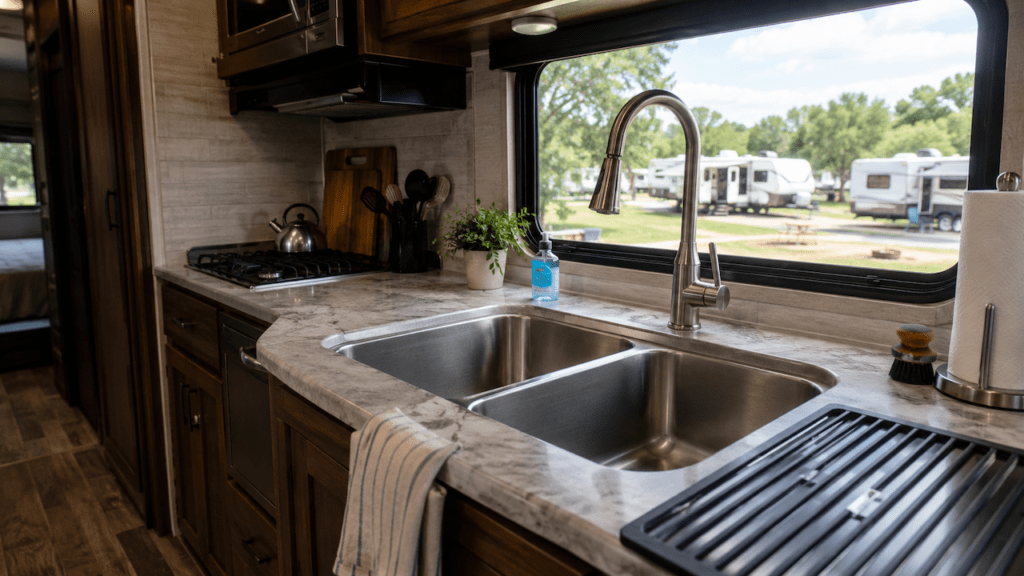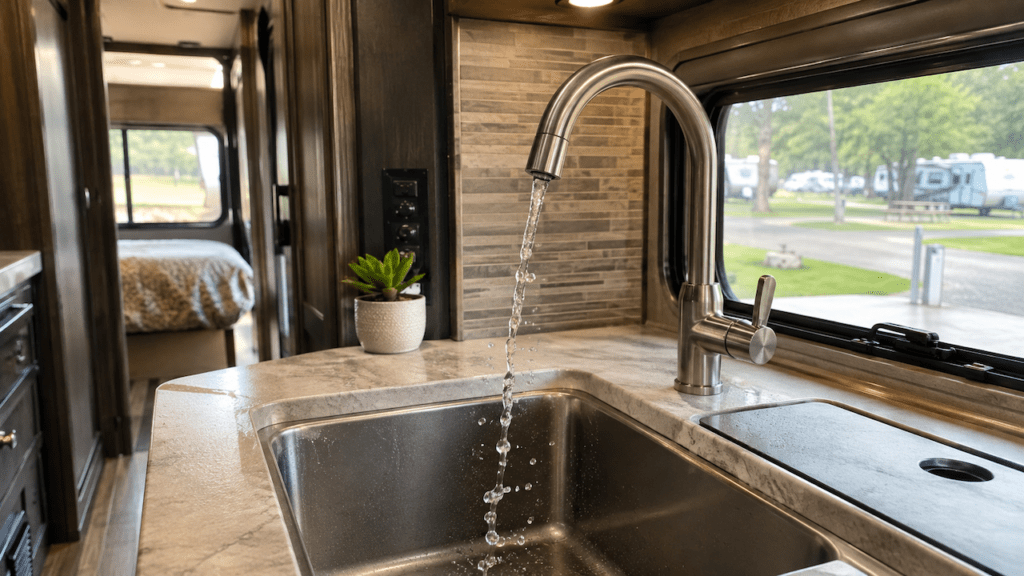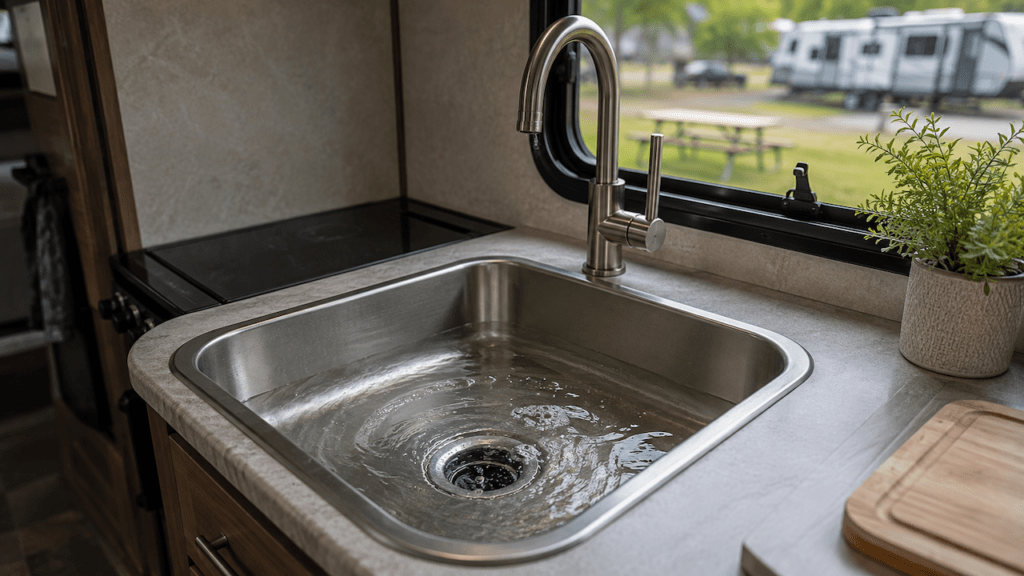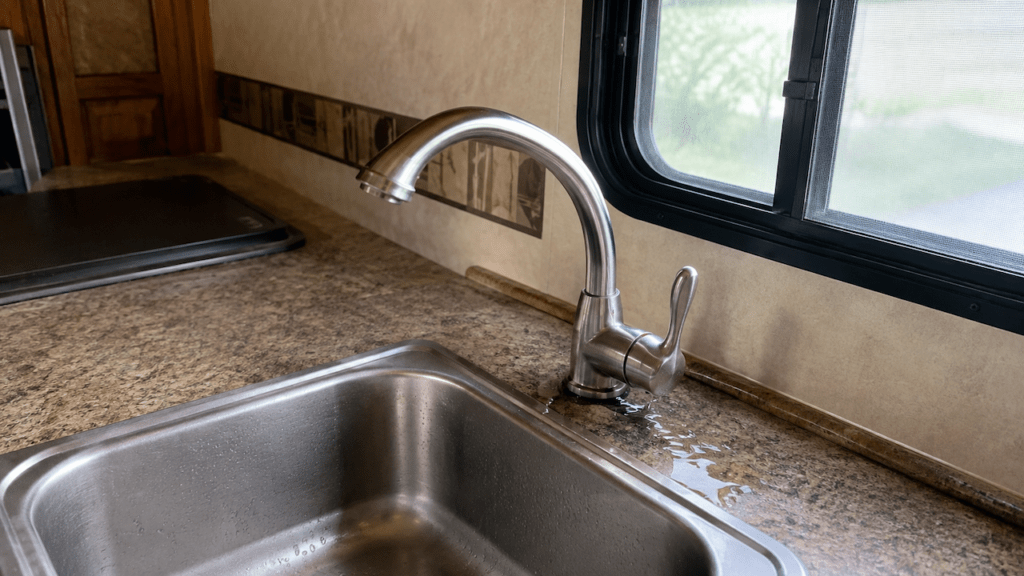
Low water pressure at only your RV kitchen faucet usually means there is a restriction somewhere in that fixture. A clogged aerator, blocked spray head, kinked pull-down hose, dirty check valve, or restricted cartridge are common causes. If every faucet feels weak, the problem may instead involve your RV water filter, pressure regulator, city-water connection, or water pump.
The good news is that most kitchen faucet flow problems are fairly easy to isolate. I’ll help you start with the simplest checks, work backward through the faucet, and determine when the problem is actually elsewhere in your RV plumbing.
Key Takeaways
- Start at the kitchen faucet if other RV fixtures work normally.
- A clogged aerator or spray head causes many low-flow problems.
- Pull-down faucet hoses can become twisted, pinched, or kinked.
- Some pull-down faucets contain check valves that collect debris.
- Low hot-water flow alone usually points toward the hot-water side.
- Weak flow throughout the RV requires system-level troubleshooting.
- Test the faucet before replacing your RV water pump.
- Always shut off city water and the pump before disconnecting plumbing.
Is It Really Low Water Pressure or Just Low Water Flow?
Low pressure and low flow can feel almost identical at the sink. However, they are not necessarily the same problem.
Water pressure describes how strongly water is being pushed through your plumbing. Water flow describes how much water can actually pass through the faucet.
This difference matters when troubleshooting an RV.
Suppose your shower has strong water flow. Your bathroom faucet works normally too. However, your kitchen faucet barely produces a steady stream.
Your RV probably has adequate water pressure in that situation. Something near the kitchen faucet is simply restricting the available flow.
That restriction could be incredibly small. A little sediment trapped behind an aerator screen can make the faucet feel surprisingly weak.
Before adjusting your regulator or blaming your pump, compare several fixtures first. This one step can save you considerable troubleshooting time.
What Does Your RV Kitchen Faucet’s Low Pressure Tell You?
The pattern of the problem often points toward the cause. Before taking anything apart, check which fixtures and water sources are affected.
| What You Notice | Most Likely Problem Area | Check First |
| Only kitchen faucet is weak | Kitchen faucet restriction | Aerator or spray head |
| Both hot and cold are weak | Common faucet restriction | Spray head, hose, cartridge |
| Only hot water is weak | Hot-side restriction | Hot supply connection |
| Only cold water is weak | Cold-side restriction | Cold supply connection |
| Flow improves without spray head | Spray-head restriction | Screen, aerator, check valve |
| Flow changes while moving sprayer | Pull-down hose problem | Kink or twist |
| Kitchen is weak on pump and city water | Local faucet problem | Faucet components |
| Every fixture is weak on city water | Incoming supply problem | Regulator, filter, hose |
| Every fixture is weak on water pump | Pump-side problem | Strainer, tank supply, pump |
| Pump pulses mainly at kitchen sink | Faucet may restrict flow | Spray head or flow path |
Use this table as your starting point.
If only the kitchen faucet is affected, stay focused there first. If every fixture suffers, move farther upstream through the RV water system.
Why Does My RV Kitchen Faucet Have Low Water Pressure?
When only one fixture feels weak, start at the faucet outlet. Small faucet passages collect sediment and scale faster than larger RV plumbing lines.
The Aerator or Spray Head Is Clogged
The aerator is usually the first component I would inspect.
It sits at the end of a standard faucet spout. On pull-down faucets, similar screens may sit inside the spray head.
These tiny openings can collect:
- Calcium and mineral deposits
- Sand from campground water
- Rust particles
- Small pieces of plastic
- Sediment from plumbing work
A clogged aerator often creates an uneven or sideways spray. You may also notice that filling a pot suddenly takes much longer.
Remove the aerator or spray head and test the faucet again. If the flow immediately improves, you have already narrowed down the problem.
Debris Is Trapped Inside the Faucet
RV plumbing can occasionally contain tiny pieces of construction debris.
Plastic shavings, loose sediment, or particles from plumbing repairs may move through the water lines. They often stop when they reach narrow faucet passages.
This can happen even in a relatively new RV.
You may notice the faucet worked correctly at first. Then the flow suddenly became weak after traveling, flushing plumbing, or reconnecting water.
If cleaning the aerator does not help, inspect other accessible faucet screens and connections.
The Pull-Down Faucet Hose Is Kinked or Pinched
Pull-down faucets are convenient, but their flexible hoses create another restriction point.
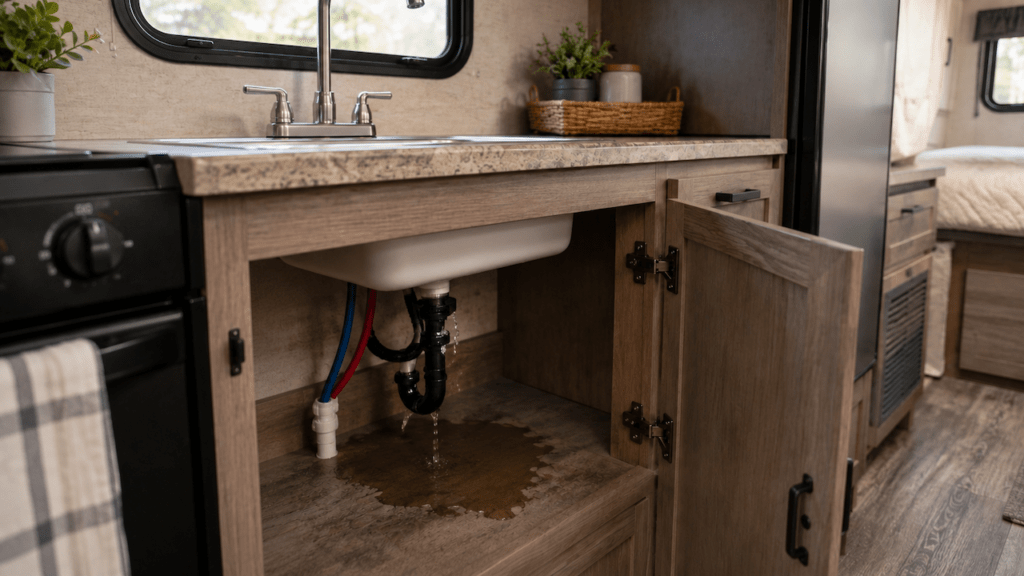
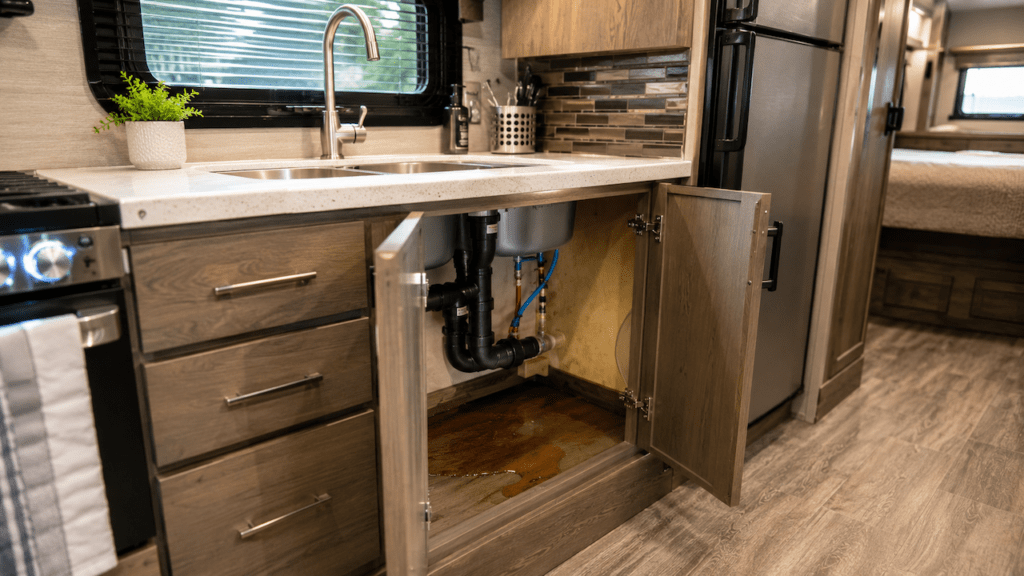
Look underneath your RV kitchen sink.
The hose should hang and move freely. It should not be trapped between the cabinet wall and plumbing.
Check whether the hose is:
- Twisted around another water line
- Pinched behind the drain pipe
- Bent sharply near a connection
- Caught beneath stored items
- Restricted by the counterweight
Move the spray head while watching the hose underneath.
If water flow changes as the hose moves, you may have found the restriction.
A Check Valve Inside the Faucet Is Clogged
Some pull-down and pull-out RV faucets contain internal check valves.
These valves help control water movement through the spray hose. They can also collect calcium, sediment, or small debris.
Not every faucet uses the same check-valve arrangement. That is important.
Do not start pulling random inserts from your faucet. First identify your faucet model whenever possible.
A useful test is removing the spray head first. If strong water comes directly from the hose, the restriction is probably near the head or an upper valve.
If the hose itself still has weak flow, look farther upstream.
The Faucet Cartridge Is Partially Blocked
The cartridge controls water flow and temperature inside many faucets.
Sediment can enter its small internal passages. Mineral deposits can also build up gradually.
A restricted cartridge may cause:
- Weak hot and cold flow
- Uneven temperature control
- Flow that changes while moving the handle
- A faucet that never reaches normal output
Cartridge work is more involved than aerator cleaning. I recommend checking the easier components first.
If the supply entering the faucet is strong, the cartridge becomes a stronger suspect.
A Hot or Cold Supply Line Is Restricted
Sometimes the faucet itself is fine.
The flexible connector or PEX line feeding it may be bent or partially blocked.
Look underneath the sink for sharp bends. Also check where each supply line attaches to the faucet.
Some RVs have individual shutoff valves beneath the kitchen sink. Others do not.
If yours has them, make sure they are fully open.
Do not force an old valve that feels stuck. RV plumbing fittings can be easier to damage than residential hardware.
An Under-Sink Water Filter Is Restricting Flow
Some RV kitchens have additional filtration near the sink.
That filter might serve the main kitchen faucet. It might instead serve a separate drinking-water faucet.
A dirty filter slowly reduces water flow as sediment accumulates inside it.
Think about when you last changed the filter.
If your faucet pressure gradually became weaker instead of changing suddenly, filtration is worth checking.
You may also notice normal pressure elsewhere because those fixtures bypass that particular filter.
The Faucet Is Designed for a Lower Flow Rate
Not every weak-feeling faucet is actually malfunctioning.
Some RV faucets naturally deliver less water than larger residential faucets. Smaller internal passages and water-saving components may limit flow.
However, the faucet should still produce a useful, consistent stream.
If the flow suddenly becomes worse than before, something has probably changed.
That is when cleaning and inspection make more sense than assuming the faucet was always restrictive.
How Do You Fix Low Water Pressure at an RV Kitchen Faucet?
I recommend working from the faucet outlet backward. This keeps you from unnecessarily disconnecting plumbing or replacing expensive components.
Step 1: Compare the Kitchen Faucet With Other Fixtures
Turn on your bathroom faucet and shower.
Then test the kitchen faucet.
Compare hot and cold water separately.
You are trying to answer one important question:
Is the problem isolated to the kitchen?
If yes, keep troubleshooting the kitchen faucet.
If every fixture feels weak, skip ahead to the RV-wide pressure section.
Step 2: Remove the Aerator or Spray Head
Turn the faucet off first.
Unscrew the aerator or pull-down spray head carefully.
With the outlet removed, point the hose safely into the sink. Briefly turn the water back on.
Watch the flow.
If the water is noticeably stronger, the restriction is probably inside the removed component.
If the water remains weak, continue working backward.
Step 3: Clean the Aerator and Spray Head
Take the aerator apart carefully.
Pay attention to the order of washers, screens, and plastic inserts.
Then:
- Rinse loose sediment away.
- Inspect the small screen openings.
- Remove visible debris with a soft brush.
- Soak mineral-coated pieces in white vinegar.
- Rinse everything with clean water.
- Reassemble the components correctly.
- Test the faucet again.
Avoid forcing a needle into delicate plastic passages. You can permanently enlarge or damage them.
Step 4: Inspect the Pull-Down Hose
Pull the spray head outward while watching the hose beneath the sink.
Make sure the hose travels smoothly.
Straighten any gentle twists or kinks.
Also check the counterweight.
The weight should help retract the hose without squeezing it against plumbing or cabinet hardware.
If stored items are pressing against the hose, reorganize that space.
Step 5: Inspect the Check Valve and Quick Connect
If your faucet has check valves or a quick-connect assembly, inspect them next.
Turn off the RV water pump first.
Disconnect city water too.
Open the faucet briefly to relieve remaining pressure.
Then follow the faucet manufacturer’s service instructions for accessing those components.
Remove visible sediment carefully.
Do not permanently remove a valve just because it appears restrictive. It may be part of the faucet’s intended operation.
Step 6: Check the Hot and Cold Supply Connections
Look closely at both water lines feeding the faucet.
You are checking for:
- Kinked flexible lines
- Partially closed valves
- Debris at connection points
- Damaged fittings
- Sharp bends in PEX
Again, shut off the water before disconnecting anything.
Have a towel and small container ready because residual water will remain inside the lines.
Step 7: Test the Supply Flow
This test helps separate a faucet problem from an upstream plumbing problem.
With the water safely shut off, disconnect an accessible supply connection.
Aim the line into a bucket.
Turn the water supply on briefly and observe the flow.
Use caution because the line may move when pressure returns.
If the supply flow looks strong, the restriction is probably inside the faucet.
If the supply itself is weak, continue upstream through the RV plumbing.
Step 8: Clean or Replace the Faucet Cartridge
Only move to the cartridge after simpler checks fail.
Turn off every water source.
Remove the faucet handle according to its design.
Take a photo before removing the cartridge. That makes correct reassembly much easier.
Inspect the cartridge for deposits or debris.
Clean it only if the manufacturer allows cleaning.
Replace the cartridge if seals are damaged or internal parts are worn.
Step 9: Replace the Faucet if Necessary
You should not need a new faucet for every low-pressure problem.
Replacement becomes reasonable when:
- Good water reaches the faucet.
- The spray head is clear.
- The hose is unrestricted.
- The cartridge has been serviced.
- Internal faucet passages remain blocked.
- Replacement parts are unavailable.
Confirm your connection sizes before buying another faucet.
Also check countertop clearance and installation space underneath the sink.
Why Is Only the Hot or Cold Side of My RV Kitchen Faucet Weak?
Testing hot and cold separately can reveal where the restriction begins. One weak side usually points toward that individual supply path.
Low Hot Water Pressure Only
If cold water flows normally but hot water is weak, concentrate on the hot-water side.
Possible causes include:
- Debris inside the hot faucet inlet
- A kinked hot-water line
- A partially closed hot-side valve
- Cartridge blockage affecting the hot passage
- Debris somewhere upstream in the hot supply
Do not immediately blame the RV water heater.
Check another hot-water fixture first.
If the bathroom also has weak hot water, then the problem likely extends beyond the kitchen faucet.
Low Cold Water Pressure Only
Weak cold water with normal hot flow usually points toward the cold supply path.
Inspect the cold inlet connection first.
Then check for:
- Bent tubing
- Sediment
- Restricted fittings
- A cartridge problem
- A partially closed valve, if equipped
Again, comparing another cold-water fixture helps narrow the problem quickly.
Both Hot and Cold Have Low Flow
When both sides are weak, look for a shared restriction.
That commonly means something after the two water paths meet.
Possible areas include:
- Faucet cartridge
- Common pull-down hose
- Check valve
- Spray head
- Aerator
This pattern makes individual hot or cold supply problems less likely.
What If Every Faucet in the RV Has Low Water Pressure?
If the kitchen, bathroom, and shower all have weak flow, stop focusing on the kitchen fixture. Your RV water system needs the next round of checks.
Campground Water Pressure Is Low
Campground water pressure varies considerably between locations.
If the problem began immediately after arriving somewhere new, test the incoming supply.
Ask yourself whether nearby campers have noticed the same problem.
You can also compare performance using your freshwater tank and pump.
If pump pressure feels normal, the campground supply becomes a stronger suspect.
Your RV Water Pressure Regulator Is Restricting Flow
A pressure regulator protects your RV plumbing from excessive campground pressure.
However, a failing or heavily restricted regulator can also reduce usable flow.
Check whether the regulator is clogged or damaged.
If you use an adjustable regulator, verify the setting correctly.
Do not permanently remove pressure protection simply to get a stronger faucet stream.
The RV Water Filter Is Clogged
A water filter can collect a surprising amount of sediment.
As the filter loads up, every downstream fixture may become weaker.
If pressure improved when the filter was new, inspect it now.
Replace the cartridge if it has exceeded its service interval or looks heavily contaminated.
Campground water quality can shorten filter life considerably.
The Freshwater Hose or City-Water Inlet Is Restricted
Walk outside and inspect the hose.
Make sure it is not:
- Kinked
- Flattened
- Pinched under equipment
- Partially frozen in cold conditions
- Restricted by a damaged fitting
Also inspect the city-water inlet screen.
A small amount of debris there can restrict the entire RV.
The RV Water Pump Is Not Delivering Enough Flow
If the problem appears only while using the freshwater tank, inspect the pump system.
Check the pump inlet strainer first.
Then verify:
- Freshwater tank has enough water
- Pump receives proper electrical power
- Suction line is not kinked
- Pump is not drawing air
- Strainer is clean
- Pump output has not noticeably weakened
Avoid replacing the pump based only on weak kitchen flow.
First confirm other fixtures are also affected.
Why Does My RV Water Pump Pulse When I Use the Kitchen Faucet?
A heavily restricted kitchen faucet can sometimes make your demand pump cycle or pulse noticeably.
Your RV pump responds to pressure changes.
When the faucet allows only a small amount of water through, system pressure may rise quickly. The pump then shuts off and restarts as pressure changes again.
Try opening another faucet more fully.
If the pump runs smoothly there but pulses at the kitchen sink, inspect the kitchen faucet before adjusting the pump.
Start with the spray head, aerator, hose, and internal restrictions.
A faucet restriction is usually much simpler to correct than a pump problem.
Why Did My RV Kitchen Faucet Pressure Suddenly Drop?
A sudden change usually means debris moved, something became restricted, or a component shifted.
Common triggers include:
- Moving to a different campground
- Connecting to sediment-heavy water
- Changing or clogging a water filter
- Flushing the water heater
- Completing plumbing repairs
- De-winterizing the RV
- Replacing the faucet
- Leaving the RV unused
- Moving items beneath the sink
- Twisting a pull-down hose
- Loosening mineral scale inside plumbing
Think about what happened immediately before the flow changed.
That clue often points toward the correct component faster than random troubleshooting.
Should You Remove the Flow Restrictor From an RV Kitchen Faucet?
I would not make flow-restrictor removal your first solution.
A faucet can feel restrictive because the flow-control component is clogged rather than because its design is wrong.
Start by cleaning the aerator and spray head.
Then inspect the hose, check valves, supply connections, and cartridge.
If your faucet uses a removable factory flow-control component, check its service documentation before changing anything.
Removing components can create excessive splashing or alter faucet performance.
You may also end up masking another restriction that still needs attention.
The better approach is restoring the faucet to its intended clean condition first.
When Should You Replace the RV Kitchen Faucet?
Replacing the faucet makes sense when good water reaches it but weak flow continues.
Consider replacement if:
- Internal components remain blocked.
- The cartridge cannot be serviced.
- The pull-down hose is damaged.
- Replacement parts are unavailable.
- The faucet body leaks.
- The original faucet has consistently poor performance.
Do not replace the faucet before checking supply flow.
Otherwise, you could install a new faucet and discover the same weak stream.
How Can You Prevent Low RV Kitchen Faucet Pressure?
Regular inspection can prevent most small restrictions from becoming frustrating problems.
- Clean the aerator when flow begins changing.
- Inspect pull-down hoses for free movement.
- Replace water filters when they become restricted.
- Flush plumbing debris after repairs.
- Check faucet screens after de-winterization.
- Use appropriate filtration with sediment-heavy campground water.
- Correct hose kinks instead of increasing water pressure.
- Inspect city-water inlet screens periodically.
- Address gradual flow changes before they become severe.
You do not need to dismantle the faucet routinely.
Just respond early when the stream stops behaving normally.
Final Words
If only your RV kitchen faucet has low water pressure, start close to the faucet.
Check the aerator, spray head, pull-down hose, check valve, and cartridge before moving farther into the plumbing.
When every RV fixture feels weak, change your troubleshooting direction.
Look at the water filter, pressure regulator, campground supply, city-water inlet, freshwater pump, and related plumbing.
Working in that order prevents unnecessary parts replacement.
More importantly, it helps you find the actual restriction without turning a simple faucet problem into a much larger repair project.
Related FAQs
Why Is My RV Kitchen Faucet the Only Faucet With Low Pressure?
If every other fixture works normally, the restriction is probably inside or immediately around the kitchen faucet. Start with the aerator, spray head, pull-down hose, check valve, cartridge, and local supply connections.
Why Does My RV Kitchen Faucet Have Low Hot Water Pressure?
Low hot-water flow usually points toward the hot faucet inlet, hot supply line, or cartridge. Check another hot-water fixture first before assuming the RV water heater is causing the problem.
Can a Clogged Aerator Cause Very Low RV Faucet Pressure?
Yes. A badly clogged aerator can reduce faucet flow dramatically even when your RV has normal water pressure. Sediment, calcium deposits, and small plastic particles commonly collect inside the aerator screen.
Why Does My RV Kitchen Faucet Work Better With the Spray Head Removed?
Stronger flow without the spray head usually means the restriction is inside that head or a nearby internal component. Clean the screen, aerator, spray passages, and accessible check valve before replacing the faucet.
Can an RV Pull-Down Faucet Hose Reduce Water Pressure?
Yes. A pull-down hose can become kinked, twisted, pinched, or trapped beneath the sink. Even a partial restriction can noticeably reduce water flow through the kitchen faucet.
Can a Water Filter Cause Low Pressure at an RV Kitchen Sink?
Yes. A clogged filter can restrict water reaching the kitchen faucet. If the filter serves the whole RV, you will usually notice reduced flow at several fixtures rather than only the kitchen.
Why Is My RV Kitchen Faucet Weak on City Water but Fine on the Pump?
If pump pressure is normal, check the campground supply, pressure regulator, freshwater hose, city-water inlet screen, and external filter. The faucet itself is less likely when it performs correctly on the pump.
Why Is My RV Kitchen Faucet Weak on the Water Pump but Fine on City Water?
This pattern points toward the freshwater pump side. Check the pump strainer, freshwater level, suction line, electrical supply, and pump condition before changing the kitchen faucet.
Why Does My RV Water Pump Pulse When the Kitchen Faucet Is Running?
A restrictive kitchen faucet may allow too little flow, causing a demand pump to cycle repeatedly. Clean the aerator, spray head, hose, and internal flow path before adjusting the pump.
Should I Remove the Flow Restrictor From My RV Kitchen Faucet?
Usually not as your first fix. Clean the faucet components and confirm proper supply flow first. Removing factory flow-control parts may increase splashing or hide another restriction that still needs repair.

Gregory Allen covers outdoor RV camping, essential gear, and travel preparation. His reviews are based on real conditions, not spec sheets alone. He helps RVers choose equipment that works reliably in everyday outdoor use.