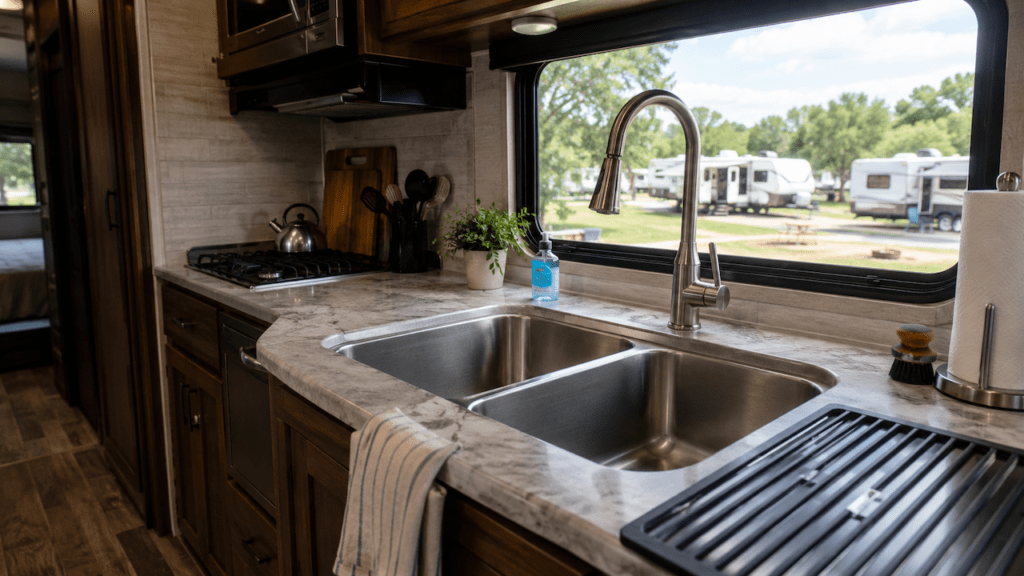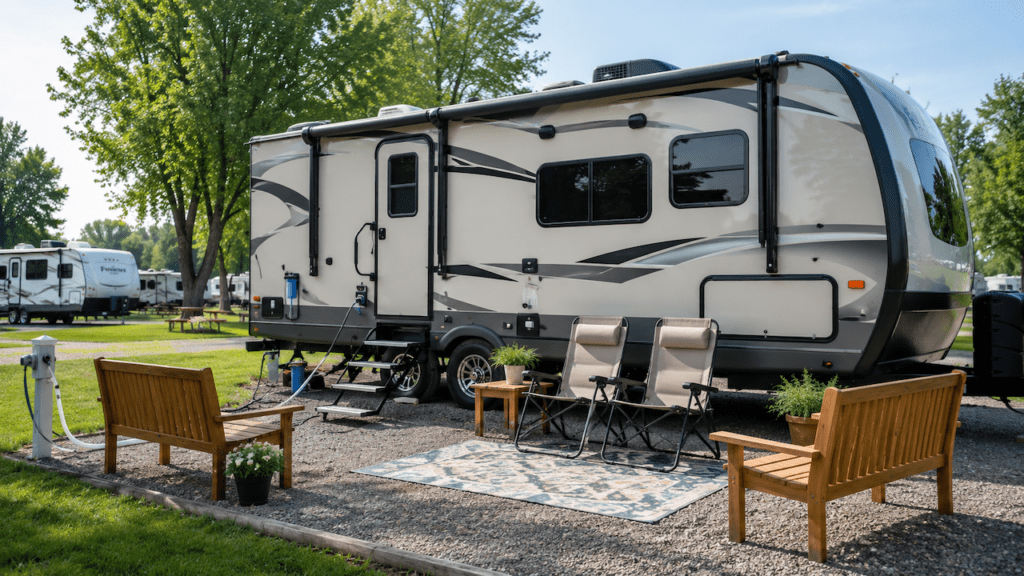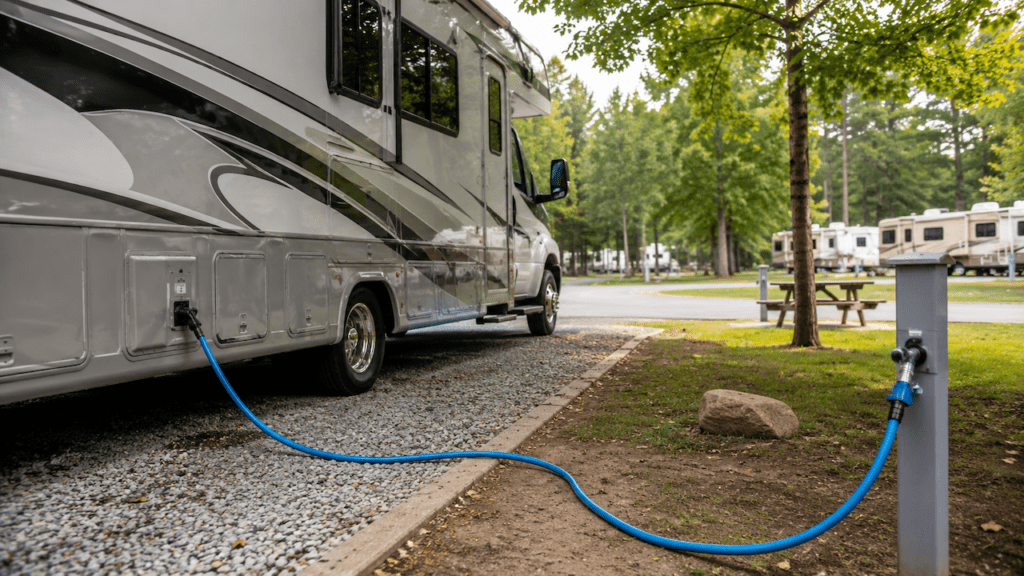
Every month, inspect your RV tires, batteries, safety detectors, GFCI outlets, roof seals, plumbing, AC filters, slide-outs, generator, and signs of moisture or pests. Motorhome owners should also inspect engine fluids, hoses, and visible leaks.
A simple monthly routine can catch small problems before they become expensive repairs. Below, I’ll walk you through what I recommend checking, what only applies to certain RVs, and which maintenance jobs should follow the manufacturer’s schedule instead.
Key Takeaways
- Check RV tires for pressure, cracks, bulges, and uneven wear monthly.
- Test smoke, carbon monoxide, propane detectors, and GFCI outlets.
- Inspect batteries, terminals, cables, and charging condition every month.
- Add distilled water only to flooded lead-acid batteries when needed.
- Exercise an onboard generator according to its manufacturer’s instructions.
- Inspect roof seams, exterior seals, plumbing, slide-outs, and moisture-prone areas.
- Clean or inspect RV air conditioner filters based on their condition.
- Monthly inspection does not mean every component needs monthly servicing.
Monthly RV Maintenance Checklist at a Glance
You do not need to dismantle your RV every 30 days. Most monthly maintenance involves inspecting, testing, cleaning, and catching changes early.
| Maintenance Area | What to Check Every Month | Applies To |
| Tires | Pressure, tread, cracks, bulges, uneven wear | All RVs |
| Safety detectors | Smoke, CO, and propane detector operation | Equipped RVs |
| GFCI outlets | TEST and RESET functions | Equipped RVs |
| House batteries | Charge, terminals, cables, corrosion | Most RVs |
| Battery water | Electrolyte level and distilled water | Flooded batteries only |
| Generator | Exercise and basic condition | Generator-equipped RVs |
| Roof and seals | Cracks, gaps, lifting, water entry | All RVs |
| Plumbing | Fittings, pump, toilet, visible leaks | All RVs |
| Air conditioner | Return-air filter and airflow | AC-equipped RVs |
| Slide-outs | Seals, tracks, debris, unusual operation | RVs with slides |
| Pests and moisture | Droppings, nests, dampness, odors | All RVs |
| Engine bay | Fluids, hoses, belts, visible leaks | Motorhomes only |
Check Your RV Tires and Wheels Every Month
Your tires carry the entire RV, so they deserve regular attention. A quick monthly tire inspection can reveal problems before highway speeds make them dangerous.
Check Tire Pressure When the Tires Are Cold
Use an accurate tire-pressure gauge before the tires heat up.
Inflation pressure should follow the appropriate tire, vehicle, and load guidance. Avoid judging pressure simply by looking at the sidewall.
An RV tire can appear perfectly normal while being underinflated.
Monthly pressure checks are helpful when your RV sits for long periods. However, you should also check pressure before traveling.
Temperature changes can noticeably affect tire pressure between trips.
Inspect Tread, Sidewalls, and Valve Stems
Walk around every tire and look closely at its condition.
Watch for:
- Cracking or dry rot
- Cuts in the sidewall
- Bulges or unusual swelling
- Nails or objects in the tread
- Uneven tread wear
- Damaged valve stems
- Missing valve caps
- Signs of rubbing
Do not ignore small sidewall bulges or deep cracks. Tire damage can become much worse once the RV is moving.
Look for Uneven Tire Wear
Uneven wear often tells you something else needs attention.
One-sided wear may point toward alignment or suspension problems. Wear near both tread edges may suggest low inflation.
Center wear can sometimes indicate excessive inflation for the actual load.
The wear pattern alone does not diagnose the problem. However, it gives you a reason to investigate further.
Test Your RV’s Safety Equipment
Safety equipment is easy to forget because you rarely use it. Testing it monthly confirms it is ready when you actually need it.
Test Smoke and Carbon Monoxide Alarms
Press the test button on each detector.
Make sure the alarm sounds properly and its indicator behaves normally.
Also inspect the detector for:
- Low-battery warnings
- End-of-life warnings
- Physical damage
- Excessive dust
- Missing batteries
Some detectors have a limited service life. Check their replacement dates rather than assuming they last forever.
Test the LP Gas Detector
Your propane detector protects you from potentially dangerous gas accumulation.
Use the detector’s built-in test procedure according to its instructions.
Do not deliberately release propane inside the RV to test it.
Also watch for warning lights or end-of-life indicators. Many RV propane detectors eventually require complete replacement.
Check the Fire Extinguisher
Make sure your fire extinguisher remains accessible and secured.
Check its pressure indicator if it has one. Also inspect the safety pin, hose, handle, and body.
Replace or service an extinguisher showing damage or abnormal pressure.
Test the RV’s GFCI Outlets
GFCI protection is especially important around water and outdoor electrical connections.
Find the GFCI receptacles in your RV and press the TEST button. Power should shut off to the protected circuit.
Then press RESET and confirm normal power returns.
One GFCI receptacle may protect several downstream outlets. That means an exterior or bathroom outlet may stop working when another GFCI trips.
If the GFCI will not test, reset, or remain powered, investigate the problem before relying on that circuit.
Electrical protection devices should not be ignored simply because appliances still work.
Check Your RV Batteries
Battery problems can create confusing symptoms throughout an RV. Low voltage may affect lights, pumps, furnaces, refrigerators, slides, and control boards.
Check Battery State of Charge
Check the battery’s state of charge using an appropriate meter or monitoring system.
The correct voltage reading depends on battery chemistry and charging conditions. Avoid using one voltage number for every battery type.
More importantly, watch for changes from the battery’s normal behavior.
A battery that repeatedly drops low may have:
- A charging problem
- Excessive parasitic draw
- A damaged cell
- Loose connections
- Reduced capacity
Do not repeatedly allow a battery to remain deeply discharged.
Inspect Battery Terminals and Cables
Look closely at the battery compartment and wiring.
Check for:
- Corroded terminals
- Loose cable connections
- Frayed wiring
- Heat-damaged insulation
- Swollen battery cases
- Cracks
- Fluid leakage
- Damaged hold-downs
Loose or corroded connections can cause voltage problems even when the battery itself is healthy.
Clean and repair questionable connections before they become unreliable.
Check Water Only in Flooded Lead-Acid Batteries
This is one monthly maintenance job that does not apply universally.
Flooded lead-acid batteries may require electrolyte checks and distilled water. Follow the battery manufacturer’s filling procedure carefully.
Never use tap water when distilled water is required.
AGM batteries do not require water additions.
Lithium or LiFePO4 RV batteries also do not need electrolyte watering.
Do not remove covers or add liquid simply because a checklist says “check battery water.”
Know which battery you actually own first.
Run Your RV Generator Every Month
A generator that sits unused for long periods can develop problems. Regular exercise also gives you a chance to confirm it starts and handles electrical loads correctly.
If your generator manufacturer recommends monthly exercise, follow that schedule.
Some Cummins Onan gasoline RV generators are commonly exercised for approximately two continuous hours at a substantial load. However, that recommendation should not automatically be applied to every generator.
Diesel, propane, portable, and other generators may have different procedures.
Check your generator manual for:
- Recommended exercise frequency
- Minimum operating time
- Required electrical load
- Fuel requirements
- Oil-change intervals
- Filter service intervals
Generator exercise and generator servicing are not the same thing.
Running the generator monthly does not mean changing its oil monthly.
Oil and filter changes are normally based on operating hours, time, and manufacturer requirements.
Inspect the Roof, Seams, and Exterior Seals
Water intrusion can remain hidden until serious damage appears. Monthly visual inspections give you a better chance of catching seal problems early.
Inspect Roof Penetrations and Seams
If your roof can be safely accessed, inspect common leak points.
Pay particular attention around:
- Roof vents
- Skylights
- Air conditioner openings
- Plumbing vents
- Antennas
- Roof accessories
- Front roof transitions
- Rear roof transitions
Look for sealant that is cracking, separating, lifting, shrinking, or missing.
Avoid automatically spreading new sealant over everything.
First determine whether the existing material actually needs repair. Use products compatible with your RV roof and existing sealant.
If your roof is not designed for walking, inspect it using a safer method.
Check Windows, Doors, and Exterior Compartments
Inspect seals around windows, doors, storage compartments, exterior lights, and mounted accessories.
You are looking for places where water could move behind the exterior surface.
Small seal gaps can allow surprisingly large amounts of water inside during heavy rain.
Look Inside for Early Water-Intrusion Signs
Exterior inspection is only half the job.
Inside the RV, check:
- Ceiling corners
- Window frames
- Upper cabinets
- Slide corners
- Under mattresses
- Around vents
- Storage compartments
- Exterior-wall cabinets
Watch for discoloration, bubbling surfaces, softness, dampness, or musty smells.
A musty odor may appear before visible water damage becomes obvious.
Check the RV Plumbing for Leaks
Small plumbing leaks can damage cabinets, walls, floors, and insulation. A monthly inspection usually takes only a few minutes.
Look Under Sinks and Around Plumbing Connections
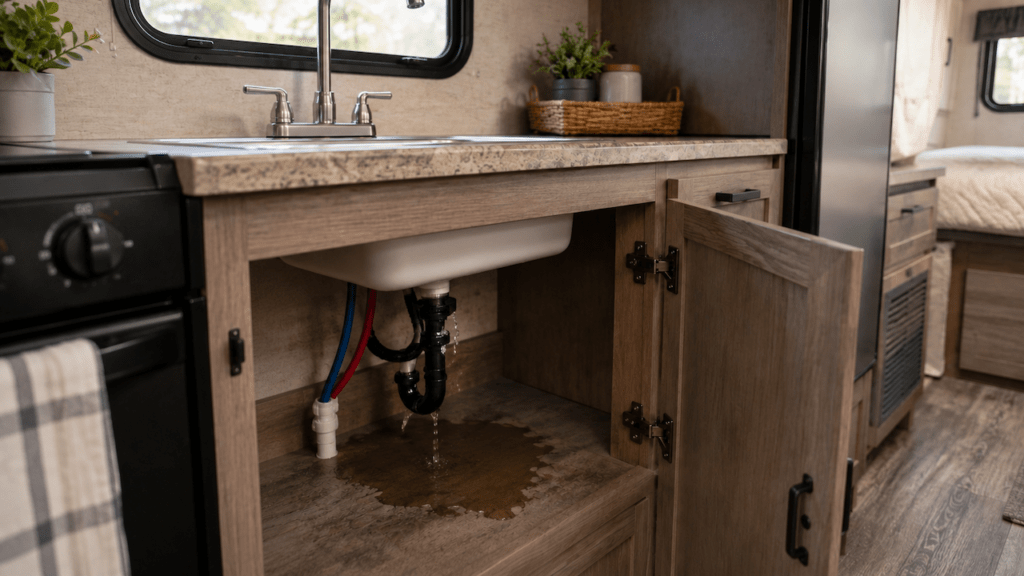
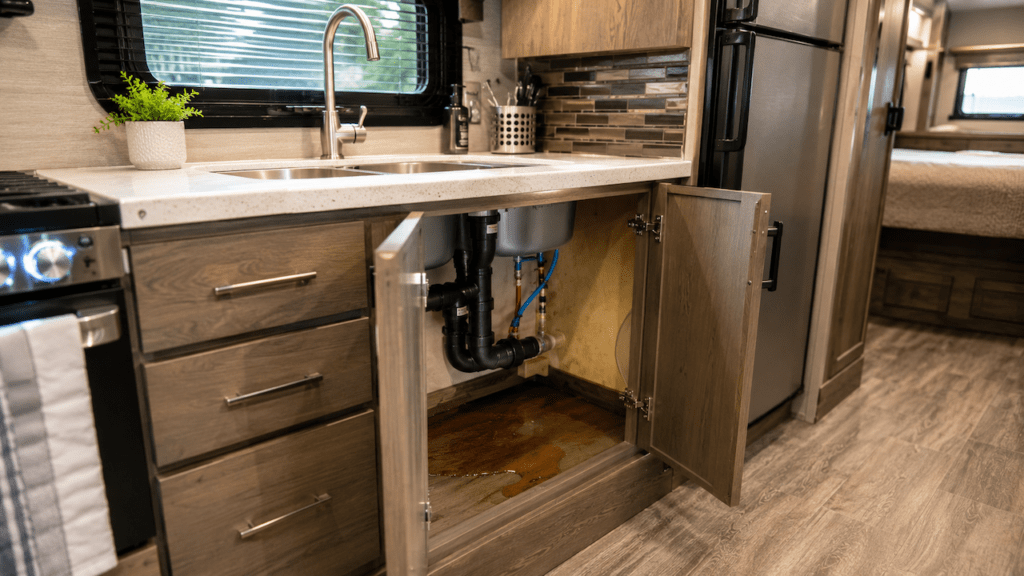
Open the cabinet beneath each sink and use a flashlight.
Inspect:
- Faucet connections
- PEX fittings
- Drain traps
- Flexible hoses
- Shutoff valves
- Pump connections
Run water briefly and watch the fittings while they are pressurized.
A fitting may remain dry while unused but leak during operation.
Check the Water Pump and Toilet
Listen to the water pump after every faucet is closed.
If the pump keeps cycling occasionally, water pressure may be escaping somewhere.
Possible causes include a dripping fixture, leaking connection, toilet valve, pump issue, or another plumbing leak.
Inspect around the toilet base and water connection for moisture.
Check Around the Water Heater
Inspect visible water-heater connections and the exterior compartment.
Look for dripping fittings, corrosion, staining, or evidence of previous leaks.
Do not dismantle gas components during a routine monthly inspection.
If you find propane-system damage or suspicious burner behavior, use qualified service.
Clean and Inspect the RV Air Conditioner Filter
Your RV air conditioner needs unrestricted airflow to work properly.
Remove the interior return-air filter and inspect it for dust, pet hair, and debris.
Clean reusable filters according to their instructions. Replace disposable filters when necessary.
During heavy summer use, filters may need attention more often than monthly.
Also pay attention to weak airflow or unusual icing.
These symptoms may indicate a dirty filter or another HVAC problem.
Monthly filter inspection does not mean the rooftop condenser needs deep cleaning every month.
Coil cleaning and deeper servicing should follow the air conditioner manufacturer’s maintenance schedule.
Inspect Your RV Slide-Outs
Slide-outs contain moving parts, seals, motors, gears, tracks, cables, or hydraulic components. Monthly inspection helps you catch unusual behavior before a slide stops moving properly.
Remove Dirt and Debris
Inspect the slide roof and exposed mechanism before operating it.
Leaves, twigs, grit, and road debris can damage seals or interfere with movement.
Remove debris carefully and keep the area clean.
Inspect Slide Seals
Look around the perimeter of each slide.
Check for:
- Torn seals
- Folded seals
- Hardened rubber
- Dirt buildup
- Gaps
- Loose sections
- Water staining
- Damage around corners
Also watch the slide while it extends and retracts.
Jerking, grinding, uneven movement, or one side lagging deserves attention.
Do Not Automatically Lubricate Every Slide Mechanism
Not every RV slide system should receive monthly lubrication.
Some slide mechanisms require lubricant at specific points. Others need very little maintenance.
Applying the wrong lubricant can collect dirt or interfere with components.
Identify your exact slide system before spraying grease or lubricant onto tracks, gears, rails, or seals.
The manufacturer’s instructions should decide what gets lubricated and how often.
Check Appliance and Exterior Vents for Obstructions
RV appliances rely on clean airflow and unobstructed vents. A quick monthly inspection can catch nests and debris before they create performance problems.
Check around:
- Refrigerator exterior vents
- Furnace intake and exhaust
- Water-heater compartment
- Roof vents
- Range hood exhaust
- Generator ventilation areas
- Exterior appliance openings
Look for spider webs, insects, mud-dauber nests, leaves, and other debris.
Avoid inserting objects deep inside appliance burners or propane components.
If something requires disassembly, professional service may be safer.
Check the RV for Pests and Moisture
RVs provide plenty of small hiding places for insects and rodents. Checking regularly is especially important when your rig sits between trips.
Inspect:
- Under beds
- Inside cabinets
- Behind drawers
- Food-storage areas
- Exterior compartments
- Plumbing openings
- Wiring entry points
- Slide-out corners
- Furnace areas
- Refrigerator areas
- Under kitchen and bathroom sinks
Look for droppings, nesting material, chewed wires, insect activity, condensation, or damp surfaces.
Pay attention to musty smells too.
Finding one small entry point now is much easier than repairing wiring later.
Monthly Maintenance for Motorhomes
Motorhomes have drivetrain components that towable RVs do not have. Your monthly routine should therefore include several basic chassis checks.
Check Engine Fluids
Check owner-accessible fluids according to the chassis manufacturer’s instructions.
These may include:
- Engine oil
- Coolant
- Brake fluid
- Windshield washer fluid
- Power steering fluid on applicable chassis
Look beneath the motorhome for fresh drips as well.
A monthly fluid inspection helps you catch changes between scheduled services.
Inspect Hoses, Belts, and the Engine Bay
Open the engine compartment and perform a visual inspection.
Look for cracked hoses, loose clamps, damaged belts, leaks, or unusual residue.
You do not need to dismantle anything during this inspection.
The goal is simply to notice something that looks different.
Remember That Service Intervals Are Not Necessarily Monthly
Checking engine oil monthly does not mean changing it monthly.
Engine oil changes usually depend on mileage, time, engine type, and manufacturer recommendations.
The same applies to transmission fluid, coolant, filters, chassis lubrication, and other drivetrain services.
Your chassis manual should determine those intervals.
What RV Maintenance Does Not Automatically Need to Be Done Monthly?
Some maintenance jobs are important but should not be forced into a 30-day schedule. Follow operating hours, mileage, seasons, condition, and manufacturer guidance instead.
Tasks that are not automatically monthly include:
- Engine oil changes
- Generator oil changes
- Generator filter replacement
- Wheel-bearing repacking
- Full brake servicing
- Complete freshwater-system sanitizing
- Water-heater flushing
- Anode-rod replacement
- Rooftop AC condenser cleaning
- Propane pressure testing
- Professional propane inspections
- Complete roof resealing
- Slide mechanism lubrication
- Transmission servicing
- Coolant replacement
A maintenance checklist works best when it respects the correct interval.
Over-maintaining something incorrectly can be just as problematic as neglecting it.
Monthly Maintenance vs. Pre-Trip Maintenance
Monthly maintenance does not replace your pre-trip inspection.
Some safety items should be checked every time you travel, even if you inspected them last week.
Before departure, I recommend checking appropriate items such as tire pressure, lights, hitch components, trailer connections, breakaway equipment, and visible fluid leaks.
Motorhome owners should also check basic road-readiness items before driving.
Think of monthly maintenance as your deeper health check.
Think of the pre-trip inspection as your final safety check.
Does a Stored RV Still Need Monthly Maintenance?
Yes. An RV can develop problems even while parked.
In fact, storage creates its own maintenance risks.
Batteries can discharge, pests can enter, seals can deteriorate, and unnoticed leaks can spread.
For a stored RV, pay special attention to:
- Battery charge
- Roof and exterior seals
- Tire condition
- Moisture
- Condensation
- Rodent activity
- Insect nests
- Generator exercise when required
If the RV has been winterized, avoid operating plumbing in ways that compromise the winterization.
You can still inspect accessible areas without filling the system.
A Simple Monthly RV Maintenance Routine
You do not need a complicated maintenance day. Working through the RV in the same order each month keeps the process manageable.
- Check tire pressure and tire condition.
- Inspect wheels and visible suspension components.
- Walk around the exterior and inspect seals.
- Check the roof and roof penetrations safely.
- Look inside for water intrusion.
- Inspect visible plumbing connections.
- Test smoke, CO, and propane detectors.
- Test the GFCI outlets.
- Inspect batteries and charging condition.
- Check AC filters and airflow.
- Inspect slide-outs and seals.
- Check appliance and exterior vents.
- Look for insects, rodents, and moisture.
- Exercise the generator if your manufacturer recommends it.
- Check engine fluids if you own a motorhome.
- Record any repairs or problems you find.
You can spread these jobs over several days if needed.
Consistency matters more than trying to finish everything at once.
Keep a Monthly RV Maintenance Log
A maintenance log makes recurring problems easier to recognize. It can also help you remember when service was last performed.
Record:
- Inspection date
- RV mileage
- Generator hours
- Tire pressures
- Battery condition
- Repairs completed
- Parts replaced
- Sealant repairs
- Fluid changes
- Problems noticed
- Professional service completed
- Next recommended service date
Photos can also be useful.
For example, photographing a roof seal each month can reveal gradual cracking or separation.
Good maintenance records may also help when selling your RV later.
When Should You Stop DIY Maintenance and Call an RV Technician?
Many monthly checks are simple enough for an RV owner. However, some warning signs should not be treated as routine DIY jobs.
Consider professional service when you find:
- A propane odor
- A suspected propane leak
- Electrical overheating
- Burned wiring
- A GFCI that will not operate properly
- Structural roof softness
- Significant wall or floor softness
- Severe tire damage
- A swollen battery
- An overheating battery
- Major slide-out misalignment
- Hydraulic leaks
- Brake problems
- Suspension damage
- Generator electrical-output problems
Also seek help whenever the repair requires skills or equipment you do not have.
Finding a problem during inspection does not mean you must personally fix it.
Final Words
Monthly RV maintenance is mostly about catching changes early. You are checking for leaks, wear, low voltage, damaged seals, restricted airflow, tire problems, and anything behaving differently than normal.
You also do not need to service every RV component every 30 days. Some jobs belong on pre-trip, seasonal, mileage-based, operating-hour, or annual schedules.
Use this checklist as a practical monthly routine, then compare it with your RV, chassis, appliance, generator, battery, and slide-out manuals. That combination gives you a maintenance schedule that actually fits your rig.
Related FAQs
What RV Maintenance Should Be Done Every Month?
Every month, check tires, batteries, safety detectors, GFCIs, roof seals, plumbing, AC filters, slide-outs, generator condition, moisture, and pests. Motorhomes should also receive basic engine-fluid and hose inspections.
Is Checking RV Tire Pressure Once a Month Enough?
No. A monthly pressure check is useful during storage, but tire pressure should also be checked before travel when the tires are cold.
How Often Should I Check My RV Roof for Leaks?
A monthly visual inspection is a practical routine, especially around roof penetrations and seams. You should also inspect after severe weather or whenever you notice interior moisture.
Should I Run My RV Generator Every Month?
Many onboard RV generators benefit from monthly exercise, especially during periods of limited use. Follow the exercise interval and load requirements listed by your generator manufacturer.
How Long Should I Run My RV Generator Each Month?
The correct duration depends on the generator. Some Cummins Onan gasoline models are commonly exercised for about two continuous hours under substantial load, while other generators may require different procedures.
Should I Sanitize My RV Fresh Water Tank Every Month?
Not usually as a universal rule. Freshwater sanitizing normally depends on storage, contamination risk, usage, and manufacturer guidance rather than automatically happening every 30 days.
Do RV Batteries Need Maintenance Every Month?
Monthly battery inspection is useful for checking charge, connections, corrosion, damage, and abnormal behavior. The exact maintenance depends heavily on battery chemistry.
Do Lithium RV Batteries Need Water Added?
No. Lithium and LiFePO4 RV batteries do not require electrolyte watering. Distilled-water maintenance applies to certain flooded lead-acid batteries.
Should RV Slide-Outs Be Lubricated Every Month?
Not necessarily. Different slide systems have different lubrication requirements, and some mechanisms should not receive routine grease or spray lubricant. Follow your slide manufacturer’s instructions.
How Often Should RV GFCI Outlets Be Tested?
Testing GFCI protection monthly is a sensible safety practice. Use the built-in TEST button, confirm protected power shuts off, then press RESET.
Should I Clean My RV Air Conditioner Every Month?
Inspecting the interior filter monthly is useful, especially during frequent use. Deep rooftop coil cleaning usually follows a different interval based on manufacturer recommendations and operating conditions.
Does an RV Need Monthly Maintenance While in Storage?
Yes. Stored RVs still need attention because batteries discharge, tires lose pressure, pests enter, seals deteriorate, and water intrusion can occur without anyone noticing.

Gregory Allen covers outdoor RV camping, essential gear, and travel preparation. His reviews are based on real conditions, not spec sheets alone. He helps RVers choose equipment that works reliably in everyday outdoor use.