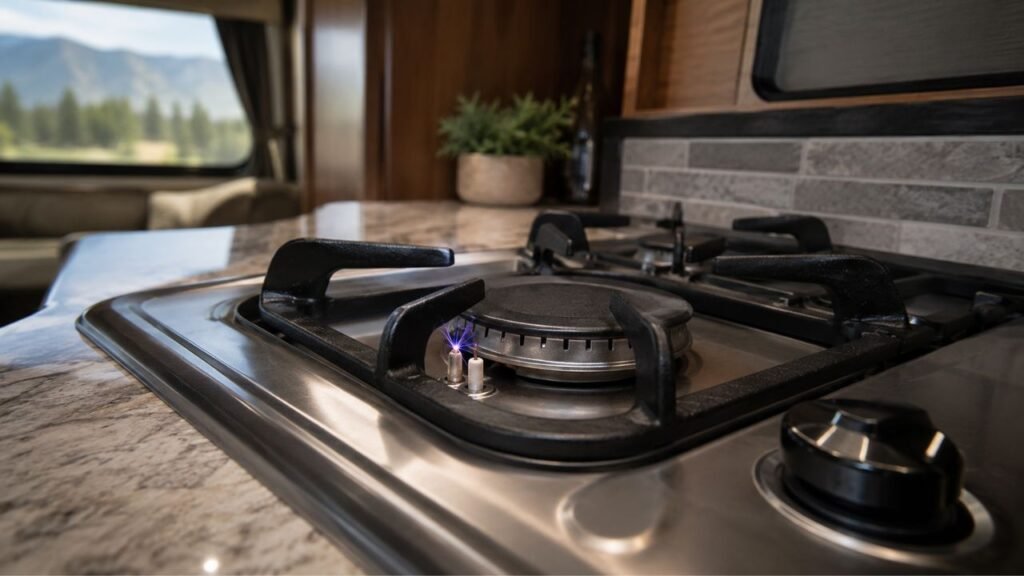

If you smell propane in an RV kitchen, stop using the stove, avoid anything that could create a flame or electrical spark, get everyone outside, and shut off the main propane supply only if you can reach it safely. Call for professional help from a safe location and do not use the propane system again until the leak has been checked.
In this guide, I’ll walk you through what to do first, what you should avoid touching, why propane may smell strongest around the kitchen, and what could cause the problem. I’ll also explain when basic inspection is reasonable and when you should leave the diagnosis to a qualified RV propane technician.
Key Takeaways
- Treat any unexplained propane smell inside your RV as a safety issue.
- Get people and pets outside before trying to find the leak.
- Avoid lights, switches, fans, igniters, generators, and other spark sources.
- Shut off the propane tank or cylinder only when you can do so safely.
- Do not assume the RV is safe because the smell disappears.
- A stove problem is not the only possible source of kitchen propane odor.
- Do not turn the propane back on just to search for a leak.
- Have the system checked before using the stove again after a confirmed or suspected leak.
What Should You Do Immediately When You Smell Propane in the RV Kitchen?
Your first job is not finding the bad fitting or figuring out which burner caused the smell. Your first job is getting everyone away from a potentially flammable atmosphere without creating an ignition source.
Stop Any Open Flame Without Delaying Your Exit
If a burner, cigarette, candle, or another open flame is already burning and you can extinguish it immediately without delaying your exit, do so.
Do not stay inside trying to inspect the stove afterward.
If the propane odor is strong, the safest choice is to get everyone outside quickly rather than spending extra time checking appliances.
Do Not Touch Electrical Switches or Appliances
A tiny electrical spark can be enough to ignite the right concentration of propane and air.
Once you suspect a propane leak, avoid operating electrical equipment inside the RV.
Do not:
- Turn lights on or off.
- Start an electric exhaust fan.
- Operate a powered roof vent.
- Keep clicking the stove igniter.
- Unplug appliances.
- Start the generator.
- Start the motorhome engine near the suspected leak.
- Use your phone while standing inside the RV.
Use your phone only after you have moved to a safe location outside.
Get Everyone and Every Pet Outside
Get everyone out of the RV as soon as possible.
Take children and pets with you and move into fresh air away from the vehicle. Do not leave someone inside while you inspect cabinets, test burners, or search for the source.
Propane safety comes before troubleshooting.
Shut Off the Propane Supply Only If It Is Safe
If you can safely reach the propane tank or cylinder without entering a dangerous area, close the main propane valve.
Most RV propane cylinder valves close by turning them clockwise.
However, do not approach the tank just to close the valve if you see flames, heavy frost, obvious damage, or a major leak around the tank, regulator, or hose.
In that situation, move farther away and contact emergency services.
Call for Help From a Safe Location
Once you are safely outside, contact someone qualified to handle the problem.
Depending on the situation, that may include:
- Your propane supplier.
- A qualified RV service technician.
- An RV propane specialist.
- The local fire department.
- 911 if there is a strong leak, fire, serious exposure, or immediate danger.
Explain that you smelled propane inside the RV so they understand the urgency.
Stay Out Until the RV Is Considered Safe
Do not walk back inside simply because you can no longer smell propane.
The odor may have dispersed, but a leak may still exist.
Do not reopen the propane tank and relight the stove until the problem has been inspected and the system is considered safe to use again.
Should You Open the Windows and Roof Vents?
Opening an easily reachable door or window while you are leaving can help gas escape, but evacuation should come first. Do not spend several minutes walking through the RV opening every window.
Never turn on an electric exhaust fan or powered roof vent to clear propane.
If windows can be opened manually without delaying your exit or operating electrical equipment, ventilation may help. Otherwise, leave the RV and let trained personnel deal with the situation.
Why Does Propane Smell Like Rotten Eggs Inside an RV?
Propane itself does not naturally have the strong rotten-egg smell most RVers recognize. An odorant is added so escaping propane is easier to notice.
People describe the smell differently. You may notice something similar to:
- Rotten eggs.
- Sulfur.
- Skunk spray.
- A strong unpleasant chemical odor.
Propane vapor is also heavier than air. That means leaked gas can settle into lower areas, including floor-level spaces, cabinets, and openings around appliances.
This is why you should never put your face close to a fitting or cabinet and deliberately sniff around trying to locate a leak.
Why Would Propane Smell Be Strongest Around the RV Kitchen?
The kitchen contains several propane components close together, so an odor there naturally makes the stove a suspect. However, the smell does not always mean the cooktop itself is leaking.
A Stove Burner Is On but Did Not Ignite
One common situation happens when you turn a burner knob but the flame does not light.
Gas may begin flowing before ignition occurs. If you keep clicking the igniter repeatedly, unburned propane can accumulate around the cooktop.
If a burner does not light quickly, turn the control off rather than continuing to release gas.
And, if you then notice a strong or persistent propane smell, follow the emergency steps and leave the RV.
A Burner Flame Went Out While Cooking
A flame can sometimes go out while the burner control remains open.
This may happen because of:
- A boil-over.
- A strong draft.
- Air movement through an open door.
- Improper burner operation.
- A burner that is dirty or poorly positioned.
If the flame goes out but propane continues flowing, gas can build up quickly.
Turn the burner off if you can do so immediately and safely. If the odor remains, get outside.
A Stove Valve or Control Is Not Closing Properly
The burner valve behind a control knob should stop gas flow when turned off.
A worn or damaged valve may not seal correctly.
This is not something I recommend disassembling yourself unless you are properly trained to service propane appliances.
If you smell gas with all burner controls fully off, shut down the propane supply and have the stove inspected.
The Propane Connection Behind the Stove Is Leaking
The appliance receives propane through tubing and fittings behind or below the stove.
Travel vibration, age, repairs, or previous appliance removal can affect these connections.
A small leak behind the stove may make the kitchen smell strongly even though every burner knob appears to be off.
Do not pull the stove apart while propane is still supplied to the RV. Have the connection inspected after the system has been made safe.
A Hose, Fitting, or Main Propane Line Is Leaking Elsewhere
Smelling propane around the kitchen does not prove the stove is responsible.
Gas can move through:
- Lower cabinets.
- Plumbing openings.
- Floor penetrations.
- Appliance compartments.
- Wall cavities.
You may notice the smell where the gas collects rather than where it originally escaped.
The Propane Regulator Has a Problem
Your RV propane regulator controls the pressure supplied to the appliances.
A failing regulator, damaged connection, cracked hose, or another problem near the propane system can cause an odor that eventually makes its way inside the RV.
If you have weak stove flames, unusual regulator behavior, or propane odors together, the regulator and complete LP system deserve inspection.
The Tank Was Recently Refilled or Is Nearly Empty
Sometimes RV owners notice a stronger propane-like odor after changing cylinders or when a cylinder gets very low.
A recently disturbed connection may be leaking. A nearly empty cylinder can also make the added odorant seem more noticeable in some situations.
However, never assume that is harmless.
If you smell propane inside the RV and cannot clearly explain why, treat it as a potential leak until the system has been checked.
What Does the Timing of the Propane Smell Tell You?
When you notice the smell can provide clues later, once the immediate danger has passed. Use these clues to explain the situation to your technician rather than staying inside to investigate during an active leak.
| When You Notice the Smell | Possible Cause | What to Do |
| Burner will not ignite | Gas released before ignition | Turn burner off and leave if the smell persists |
| Flame suddenly goes out | Gas may continue flowing | Turn burner off if safe and evacuate |
| All burners are off | Valve, fitting, line, regulator, or another appliance | Shut off propane and arrange inspection |
| Smell is strongest in a lower cabinet | Nearby fitting or gas settling low | Do not search cabinets during an active leak |
| Smell starts after a cylinder change | Connection, pigtail, regulator, or disturbed fitting | Treat it as a possible leak |
| Smell appears near an almost-empty tank | Odorant may seem stronger | Never assume it is harmless |
| LP detector alarms without obvious odor | Gas may still be present | Follow normal propane emergency procedures |
Is a Small Propane Smell When Lighting an RV Stove Normal?
You might occasionally notice a very brief propane odor when a burner takes an extra moment to ignite. This can happen if there is air in the line after the propane supply has been turned off or a cylinder has been changed.
However, repeated delayed ignition is not something I would ignore.
A persistent smell, a strong burst of propane, or an odor that remains after turning the control off can indicate a problem that needs attention.
Do not get into the habit of clicking the igniter repeatedly while gas continues flowing.
If the burner does not light, turn it off and let any small amount of released gas disperse before trying again. If the smell becomes strong or continues, leave the RV and treat it as a suspected leak.
What Should You Never Do When You Smell Propane?
A propane leak is one of those situations where a few simple mistakes can create a much larger emergency.
Do not:
- Keep cooking because the burner still works.
- Continue clicking the stove igniter.
- Light a match or lighter to search for the leak.
- Turn an electric fan on.
- Flip light switches.
- Start the RV generator.
- Start the motorhome engine beside a suspected leak.
- Plug or unplug electrical equipment.
- Assume the propane alarm is false.
- Put your face close to fittings to smell for gas.
- Reopen the propane valve because the odor disappeared.
- Take propane fittings apart during an active leak.
- Continue sleeping inside an RV with an unexplained propane odor.
When in doubt, leave and have the system checked.
Can You Use Soapy Water to Find an RV Propane Leak?
Soapy water or an approved leak-detection solution can help identify leaks at accessible propane fittings during controlled maintenance. Bubbles forming at a connection can indicate escaping gas.
The important word here is controlled.
I would not turn the propane back on inside an RV you just evacuated simply so you can crawl around looking for bubbles.
If you experienced a strong indoor propane smell, let a qualified technician perform the appropriate system checks.
A technician can inspect the appliance connections, regulator, hoses, valves, and supply lines and determine whether the propane system can safely hold pressure.
When Is It Safe to Turn the Propane Back On?
The propane smell disappearing does not automatically mean the leak has stopped.
Propane can disperse through ventilation while the underlying fitting, valve, hose, regulator, or appliance problem remains.
After a suspected leak, the safest approach is to keep the propane supply off until the source has been identified and corrected.
The propane system should then be checked before you return the appliances to normal use.
Do not use the stove as your leak test.
What If Your RV Propane Detector Is Going Off?
An LP-gas detector gives you another warning layer when propane may be present. Treat the alarm seriously first, then investigate possible detector problems only after the RV has been made safe.
Treat the Alarm Like a Real Leak First
If the propane detector sounds, do not wait until you personally smell gas.
Get everyone outside and follow the same emergency precautions you would use for an obvious propane odor.
Your nose should not be the only thing deciding whether a leak is real.
Do Not Silence the Alarm and Keep Using the Stove
Detectors can occasionally react to other fumes, but you should not assume that while the alarm is sounding.
Do not disconnect it or silence it just so you can continue cooking.
First make sure propane is not leaking.
Check the Detector’s Age and Instructions Afterward
RV propane detectors do not last forever.
Once the RV has been confirmed safe, check the manufacturer’s label or manual for:
- Test procedures.
- Replacement date.
- Power requirements.
- End-of-life warnings.
Follow the instructions for your specific detector rather than assuming every model has the same lifespan.
Do Not Confuse an LP Alarm With a Carbon Monoxide Alarm
Some RVs use separate propane and carbon monoxide alarms. Others use combination units.
Check the alarm label so you know what triggered.
Either way, an unexplained fuel-gas odor or active safety alarm deserves immediate attention.
Propane Leak vs Carbon Monoxide: What Is the Difference?
Both hazards can occur around fuel-burning RV appliances, but they are very different problems. Knowing the difference helps you understand why propane detectors and carbon monoxide alarms both matter.
| Hazard | Propane Leak | Carbon Monoxide |
| Can you usually smell it? | Propane fuel is odorized | No |
| Typical cause | Unburned gas escaping | Incomplete combustion |
| Main danger | Fire, explosion, oxygen displacement | Poisoning and oxygen deprivation |
| Typical alarm | LP-gas detector | CO alarm |
| Immediate response | Leave and avoid ignition sources | Move into fresh air and respond to the alarm |
A propane smell should never be used as proof that carbon monoxide is not present.
Carbon monoxide has no useful warning smell.
What Symptoms Can Propane Exposure Cause?
Heavy propane exposure can reduce the amount of oxygen available to breathe. If someone has been inside an RV with a significant leak, move them into fresh air immediately.
Possible symptoms can include:
- Dizziness.
- Headache.
- Confusion.
- Drowsiness.
- Breathing difficulty.
- Weakness.
- Loss of consciousness.
Call 911 if someone has trouble breathing, loses consciousness, develops severe symptoms, or may have experienced significant exposure.
Do not send another person back inside to rescue belongings while gas may still be present.
When Should You Call 911 for an RV Propane Smell?
Not every minor stove issue turns into an emergency response, but certain warning signs should push you toward emergency help rather than ordinary troubleshooting.
Call 911 or the local fire department when:
- The propane smell is extremely strong.
- You hear a large amount of gas escaping.
- The leak cannot safely be shut off.
- The propane tank, regulator, hose, or RV is on fire.
- You see severe frosting around damaged propane equipment.
- Someone is dizzy, confused, unconscious, or struggling to breathe.
- You cannot tell whether it is safe to remain near the RV.
- You suspect a major leak and cannot reach a propane professional promptly.
When calling, move away from the RV first.
How Can You Prevent Propane Smells and Leaks in the RV Kitchen?
A little preventive attention can catch many propane problems before they turn into a frightening smell inside the RV. Focus on the complete system rather than just the burners.
Check the Stove Before Every Trip
Look over the cooktop before using it.
Make sure:
- Burner caps are positioned correctly.
- Control knobs turn normally.
- Burner openings are not heavily clogged.
- The stove is clean and dry.
- Nothing appears loose or damaged.
If something seems wrong, address it before cooking.
Have the Propane System Inspected Periodically
An RV moves, vibrates, flexes, and experiences temperature changes.
That means propane components deserve routine inspection.
Follow your RV and appliance manufacturer’s maintenance guidance, and have a qualified technician inspect the system whenever you notice unexplained odors, abnormal flames, damaged hoses, or recurring ignition problems.
Watch for Damaged Pigtails, Hoses, and Regulators
Look at accessible propane components whenever you inspect your tanks.
Watch for:
- Cracks.
- Abrasion.
- Hardened hoses.
- Loose connections.
- Corrosion.
- Regulator damage.
Do not wait for a propane smell to become your first maintenance reminder.
Test Your LP-Gas Detector Regularly
Use the test button according to the detector manufacturer’s instructions.
Pay attention to end-of-life indicators and replacement dates.
A detector that is disconnected because it was annoying cannot protect you when you actually need it.
Keep the Cooktop Clean and Burners Properly Positioned
Food debris and boil-over residue can interfere with burner performance.
Clean the cooktop after it cools and make sure burners are seated correctly.
If flames begin lifting, burning unusually, going out repeatedly, or failing to ignite properly, stop using the stove until the cause is addressed.
Never Use the RV Stove as a Space Heater
An RV cooktop is built for cooking, not heating the interior.
Using burners to warm the RV can create dangerous combustion conditions and increases the risk of burns, fire, and carbon monoxide exposure.
Use the RV’s approved heating system instead.
Know Where Your Main Propane Shutoff Is Before an Emergency
Do this before your next camping trip.
Locate the tank or cylinder valve and make sure you understand how your RV’s propane supply is shut off.
It is much easier to respond calmly when you already know where the valve is.
Final Words
If you smell propane in your RV kitchen, don’t make finding the exact leak your first priority. Get outside, avoid anything that could produce a spark, and shut the propane supply off only when it is safe to reach.
Once everyone is safe, the cause can be investigated properly. It may be something simple like a burner that failed to light, or it may involve a valve, fitting, regulator, hose, or propane line.
Either way, persistent propane odor deserves respect. Do not restore propane service until you are confident the leak has been corrected and the system is safe to use.
Related FAQs
Why Does My RV Smell Like Propane When the Stove Is Off?
If every stove control is off but you still smell propane, the source could be a burner valve, appliance fitting, propane line, regulator, hose, or another propane appliance. Shut off the propane supply if it is safe to do so, get outside, and have the system inspected before using it again.
Why Do I Smell Propane Only When Lighting the RV Stove?
A brief odor can occur if gas flows for a moment before the burner ignites, especially after the propane supply has been interrupted. However, repeated delayed ignition, a strong smell, or odor that continues after the burner is off should be treated as a possible problem.
Is It Normal to Smell Propane After Changing an RV Tank?
You should not ignore propane odor after changing a cylinder. The connection, pigtail, regulator, or valve may have been disturbed. If the smell persists or enters the RV, shut the propane supply off and have the connection checked before using the appliances.
Can a Bad RV Propane Regulator Cause a Gas Smell Inside?
Yes. A damaged regulator, leaking connection, bad pigtail, or other regulator-area problem can release propane outside the RV, and the odor may eventually enter through openings or appliance compartments. Have the regulator and surrounding fittings inspected if you suspect a problem.
Can an RV Propane Leak Come From Behind the Stove?
Yes. The propane supply tubing and fittings behind the stove can leak even when every burner control is off. Because these connections may be difficult to reach safely, shut the propane supply down and have the appliance connection inspected rather than pulling the stove apart during an active leak.
Will an RV Propane Detector Detect a Small Leak?
A working LP-gas detector is designed to warn you when propane reaches its alarm threshold, but you should not rely on it as your only leak-detection method. If you smell propane even without an alarm, treat the odor seriously and investigate the system safely.
Can I Sleep in My RV After Smelling Propane?
Do not sleep inside an RV with an unexplained propane odor or suspected leak. Keep the propane supply off, remain outside or stay elsewhere, and return only after the problem has been located, corrected, and the RV is considered safe.
How Long Does Propane Take to Clear Out of an RV?
There is no reliable fixed time because it depends on how much propane escaped, the RV’s size, airflow, and where the gas collected. Do not decide the RV is safe only because a certain number of minutes passed or because you can no longer smell propane.

Gregory Allen covers outdoor RV camping, essential gear, and travel preparation. His reviews are based on real conditions, not spec sheets alone. He helps RVers choose equipment that works reliably in everyday outdoor use.