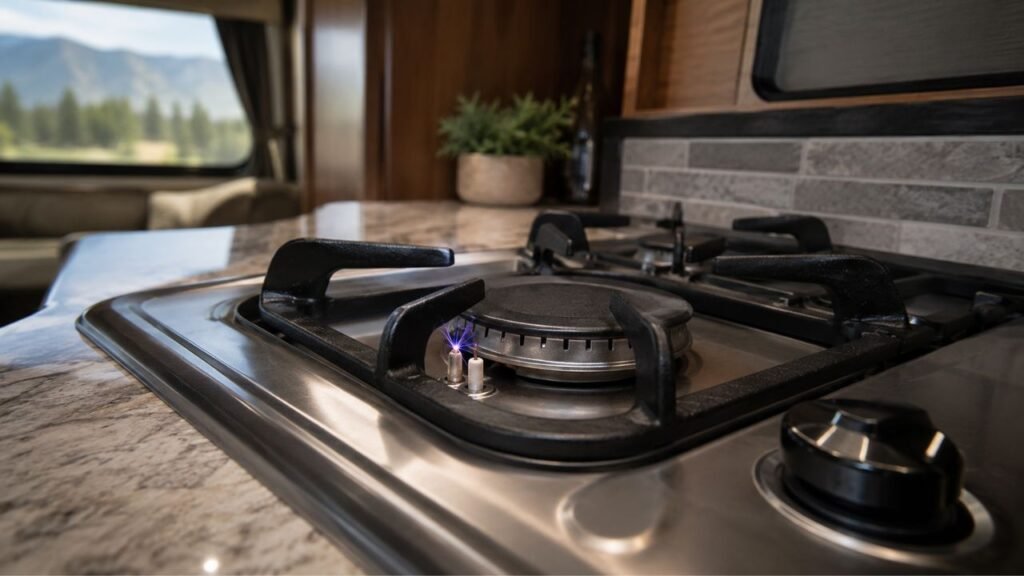
Yes, a bad RV propane regulator can affect your kitchen stove. It can cause weak flames, unstable burning, delayed ignition, burners that go out, or no propane flow at all. A regulator problem becomes more likely when every stove burner, or several propane appliances, starts acting up at the same time.
In this guide, I’ll help you separate a bad regulator from burner problems, an empty tank, a restricted pigtail, or an excess-flow issue. We’ll also look at safe checks you can make before calling an RV technician.
Key Takeaways
- A bad RV propane regulator can cause weak or unstable stove flames.
- All weak burners usually point toward a propane supply problem.
- One weak burner usually points toward that burner itself.
- Furnace or water-heater problems can support a regulator diagnosis.
- Yellow or orange flames do not automatically mean regulator failure.
- Most RV propane systems operate near 11 inches of water column.
- An excess-flow restriction can imitate a failed propane regulator.
- Do not adjust propane regulator pressure without proper test equipment.
- Shut the propane off if you smell gas or see dangerous flames.
Yes, a Bad RV Propane Regulator Can Affect the Kitchen Stove
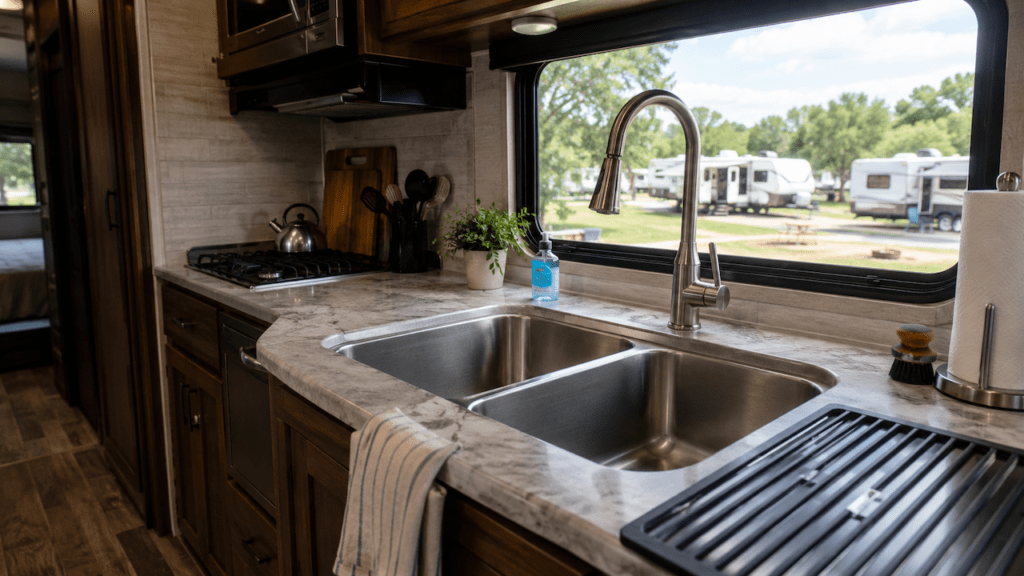
Your RV stove depends on the propane regulator for steady gas pressure. Propane leaves the cylinder at very high pressure, which is far too strong for the stove to use directly.
The regulator reduces that pressure before propane reaches your appliances.
If the regulator cannot maintain the correct pressure, the stove may receive too little propane. The flames may become weak, unstable, or difficult to light.
A regulator can also fail in a way that allows incorrect pressure. That can produce unusually large flames or other unsafe burner behavior.
The biggest clue is usually the pattern of the problem.
If one burner looks weak while the other burners work normally, I would inspect that burner first.
If every burner becomes weak at once, I would start looking farther upstream at the propane supply.
And if the stove, furnace, and water heater all act weak together, the regulator becomes a much stronger suspect.
How Does the RV Propane Regulator Control Stove Performance?
Your RV propane regulator works between the propane cylinder and the appliances. Its job is to reduce high tank pressure to a much lower, controlled pressure.
Most RVs use a two-stage regulator. The first stage reduces the high cylinder pressure substantially. The second stage reduces it again to the low pressure needed by RV appliances.
Many RV propane systems operate around 11 inches of water column, often written as 11″ WC.
That sounds like an odd measurement, but it is simply a way of measuring very low gas pressure.
Your stove depends on that pressure remaining reasonably steady.
If the pressure falls too low, the burners may not receive enough propane. If the regulator cannot keep up when several appliances run together, the stove flame may shrink.
Some RV ranges and cooktops may also have an appliance regulator built into the stove. That means there can occasionally be another pressure-control component after the main RV regulator.
What Stove Symptoms Can a Bad RV Propane Regulator Cause?
A regulator problem does not always look the same. Some failures restrict propane constantly, while others become noticeable only when gas demand increases.
Here are the stove symptoms I would pay attention to.
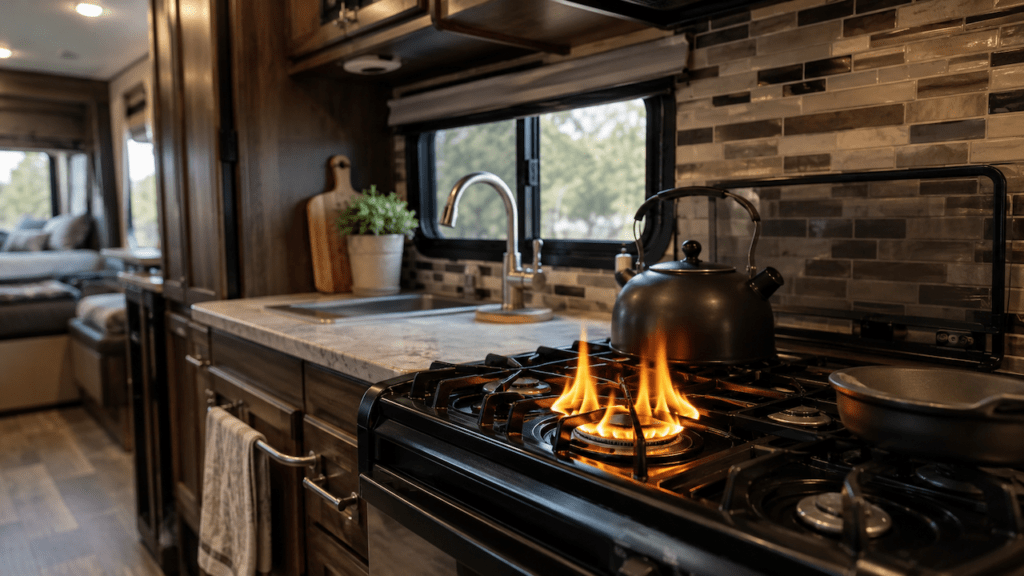
Weak Flames on Every Burner
Weak flames across every burner are one of the strongest stove-related signs of a supply problem.
You might turn the knob to high but see only a small blue flame. Cooking takes longer, and increasing the burner setting makes little difference.
If all burners are equally weak, the problem is probably not three clogged burners appearing at exactly the same time.
Check the propane tank, pigtail, regulator, and main supply system.
Flames Get Smaller When Another Propane Appliance Starts
This is one of the most useful troubleshooting clues.
Light a stove burner and watch the flame. If the flame looks normal until the furnace or water heater starts, the propane system may be struggling under higher demand.
The regulator could be unable to maintain sufficient pressure.
A restriction in the pigtail or propane line can create a similar symptom.
This type of problem may not appear when only one small stove burner is running.
Stove Flames Pulse, Flutter, or Sputter
A healthy stove flame should normally remain relatively steady.
If the flame repeatedly rises, falls, pulses, or sputters, unstable propane delivery may be involved.
Regulator problems can cause pressure fluctuations.
However, do not blame the regulator immediately.
Dirty burner ports, debris, moisture, or airflow around the burner can also make a flame unstable.
Look at whether one burner or every burner behaves the same way.
The Stove Lights but the Flame Goes Out
A burner that lights and then dies may not be receiving enough propane.
Low gas pressure is one possibility.
A restricted propane supply, nearly empty tank, pigtail problem, or excess-flow restriction can also cause this behavior.
If all burners struggle to stay lit, check the main propane supply.
If only one burner goes out, inspect that burner first.
None of the Burners Receive Propane
A completely failed regulator can stop propane from reaching the stove.
But several simpler problems can create the same symptom.
The propane cylinder could be empty. The valve could be closed. A pigtail may not be connected correctly. An excess-flow device may also be restricting gas.
On a dual-cylinder RV, the automatic changeover regulator may also be positioned incorrectly.
Do not replace the regulator simply because no burners light.
Check the basic propane supply first.
Flames Are Too Large or Roaring
Regulator problems are usually associated with low pressure, but excessive pressure can also be dangerous.
If your stove suddenly produces unusually tall, aggressive, or roaring flames, stop using it.
Do not try to correct the problem by adjusting the regulator yourself.
Shut off the propane and have the system pressure checked.
Yellow or Orange Flames and Soot Appear
A mostly blue propane flame is generally what you want to see.
Yellow tipping, orange burning, or black soot can indicate incomplete combustion.
Incorrect gas pressure may contribute to the problem.
However, burner contamination is also common.
A dirty or restricted burner, blocked venturi, misaligned component, or airflow problem can change the flame color.
The location of the symptom matters.
One yellow burner suggests a stove problem more strongly.
Every burner suddenly burning poorly makes propane pressure worth checking.
Does a Yellow or Orange RV Stove Flame Always Mean a Bad Regulator?
No. A yellow or orange RV stove flame does not automatically mean the propane regulator is bad.
Flame color depends on the way propane mixes with air before and during combustion.
A burner may burn yellow because its ports are dirty. Grease, food residue, insects, rust, or other debris can interfere with the air-fuel mixture.
The burner may also be misaligned.
A restricted orifice or venturi can create similar combustion problems.
Before blaming the regulator, compare the burners.
If only one burner has a yellow flame, clean and inspect that burner.
If every burner suddenly changes color together, propane pressure becomes a stronger possibility.
Also pay attention to other appliances.
If your furnace and water heater are struggling too, I would investigate the propane supply system rather than focusing only on the stove.
Bad RV Propane Regulator vs. Stove Problem: How Can You Tell?
The quickest way to narrow down the problem is to look at how many burners and appliances are affected.
| What You Notice | More Likely Cause | What to Check First |
| One burner has a weak flame | Burner or orifice problem | Burner ports and burner assembly |
| Every stove burner is weak | Main propane supply problem | Tank, pigtail and regulator |
| Stove and furnace both struggle | System-wide propane problem | Regulator and propane supply |
| Flame shrinks when furnace starts | Low flow under load | Regulator, pigtail and pressure |
| No propane after changing tanks | Excess-flow restriction possible | Tank connection and valve |
| One burner burns yellow | Burner or airflow problem | Ports, venturi and alignment |
| Every burner burns abnormally | Gas pressure becomes more likely | Propane system pressure |
| Flames are tall or roaring | Excessive pressure possible | Stop use and have system tested |
| Propane smell near regulator | Leak or regulator problem | Shut propane off immediately |
| Flames look normal until demand rises | Supply restriction | Professional load-pressure test |
This pattern-based approach can save you from replacing perfectly good parts.
How Can You Check Whether the RV Propane Regulator Is the Problem?
You can make several useful observations without opening or adjusting the propane regulator.
Start with simple checks and work toward the more technical ones.
Check That You Actually Have Propane
Start with the obvious because it is easy to overlook.
Make sure the propane cylinder is not empty or nearly empty.
If your RV has two cylinders, check both.
Also look at the automatic changeover regulator indicator if your system has one.
A cylinder can sometimes feel like it still contains propane even when the usable supply is almost gone.
Make Sure the Propane Cylinder Valve Is Open
Confirm that the cylinder valve is fully open.
However, when opening a closed propane cylinder, turn the valve slowly.
Opening it very quickly can trigger an excess-flow safety device.
That restriction can reduce gas flow enough to make the stove look like it has a bad regulator.
Compare All the Stove Burners
Light each burner separately.
Watch the flame height and stability.
If one burner looks different from the others, concentrate on that burner.
If all burners are equally weak, move upstream toward the propane supply.
This simple comparison is one of the easiest ways to separate a stove problem from a system problem.
Test Another Propane Appliance
Try another propane appliance, such as the furnace or water heater.
You are not looking for perfect performance testing here.
You simply want to know whether the problem extends beyond the stove.
If the stove is weak but everything else works normally, the stove itself becomes more likely.
If several propane appliances struggle, the regulator, pigtail, cylinder supply, or main propane piping becomes more suspicious.
Watch What Happens When Propane Demand Increases
This is especially useful when the stove works but feels weaker than normal.
Run a stove burner and watch the flame.
Then allow another propane appliance to operate.
If the stove flame suddenly becomes noticeably smaller, the propane system may not be maintaining pressure under load.
A regulator can sometimes look fine under light demand and fail when several appliances need propane together.
Inspect the Regulator and Pigtails
You can visually inspect the regulator without taking it apart.
Look for:
- Corrosion
- Cracked or damaged hoses
- Bent fittings
- Loose connections
- Physical regulator damage
- Blocked regulator vent
- Dirt or insect debris
- Unusual oily residue
- Heavy icing
- Damaged pigtails
The regulator vent should remain clear.
Do not poke tools inside the regulator or attempt internal cleaning.
Have the Propane Pressure Tested With a Manometer
A manometer is the proper tool for checking low-pressure propane systems.
RV propane pressure is commonly around 11 inches WC, but the correct specification depends on your appliance and RV.
More importantly, pressure should remain within the proper range while appliances are operating.
This is called testing under load.
A system can show acceptable pressure with everything turned off and still fail when the furnace, stove, and water heater demand propane together.
That is why a professional pressure test is much more reliable than guessing from flame appearance alone.
Could the Excess-Flow Valve Be Causing Weak Stove Flames Instead?
Yes. An excess-flow restriction can easily look like a bad RV propane regulator.
Propane cylinders and pigtails commonly include safety devices designed to restrict gas flow if propane appears to be escaping too quickly.
Sometimes that safety feature activates simply because the propane cylinder valve was opened too fast.
When that happens, you may notice:
- Very small stove flames
- Furnace ignition failure
- Weak water-heater flame
- Appliances that start and stop
- Very little propane flow
If this happened immediately after changing or reconnecting a propane cylinder, suspect an excess-flow restriction before buying a new regulator.
Turn propane appliances off and close the cylinder valve.
Allow the system to sit briefly, then reopen the propane valve slowly according to your RV or regulator instructions.
If normal propane flow returns, the regulator may not have been the problem.
If the restriction repeatedly returns, have the system inspected for an actual leak or flow problem.
What Else Can Mimic a Bad RV Propane Regulator?
Several problems can create the same symptoms as regulator failure.
Check these possibilities before replacing parts:
- Empty or nearly empty propane cylinder
- Excess-flow safety device restricting propane
- Damaged propane pigtail
- Kinked hose or propane line
- Partially closed cylinder valve
- Incorrect automatic changeover position
- Air remaining in the line after cylinder replacement
- Dirty stove burner ports
- Restricted burner orifice
- Debris or insects inside the venturi
- Misaligned burner assembly
- Appliance-specific regulator problem
- Propane line restriction
- Excessive total appliance demand
- Very cold weather reducing propane vaporization
You do not need to diagnose all of these yourself.
The goal is simply to avoid assuming the regulator is bad based on one symptom.
What Does 11 Inches of Water Column Mean for an RV Stove?
You will often hear technicians mention 11 inches of water column when discussing RV propane pressure.
It is simply a unit used for measuring very low gas pressure.
In many RV propane systems, the main regulator supplies propane at roughly 11 inches WC.
Your stove is designed to operate with a specific pressure range.
If pressure falls too far below that range, the flame can become weak.
If pressure is too high, the burner may become aggressive or unsafe.
Some appliances also contain their own regulator, which may reduce the incoming pressure slightly further.
You do not need to convert inches WC into PSI while troubleshooting.
What matters is whether the propane system delivers the pressure specified by the appliance manufacturer.
That is best checked with a manometer.
When Is a Propane Regulator Problem Dangerous?
Some propane problems should not be treated as normal RV troubleshooting.
Stop using the propane system if you notice:
- Propane odor inside or around the RV
- Hissing when appliances are turned off
- Damaged propane hoses or fittings
- Heavy black soot around the stove
- Large or roaring burner flames
- Visible regulator damage
- Propane escaping near the regulator
- Burners repeatedly going out unexpectedly
- Flames appearing where they should not
If you smell propane inside the RV, do not keep trying to light the stove.
Shut the propane supply off if you can do so safely.
Avoid flames, sparks, and electrical switches that could ignite accumulated gas.
Ventilate the RV and have the propane system inspected before using it again.
Should You Reset, Adjust, or Replace an RV Propane Regulator?
Resetting, adjusting, and replacing are three very different things. Knowing the difference can prevent unnecessary repairs and unsafe DIY adjustments.
When a Reset May Help
People often refer to resetting an RV propane regulator.
In many cases, what they are really doing is resetting an excess-flow restriction.
Turn propane appliances off, close the cylinder valve, and allow the system to depressurize.
Then reopen the propane cylinder slowly.
If normal gas flow returns, you may have triggered the safety restriction rather than experienced regulator failure.
Why You Should Not Adjust the Regulator Yourself
A propane regulator may have an adjustment point, but that does not make it a normal homeowner adjustment.
Changing regulator pressure without measuring it can create dangerous appliance operation.
You could accidentally supply too much propane or leave appliances under-supplied.
If pressure needs adjustment or verification, have it done using a manometer and the correct service procedure.
When Replacement Makes More Sense
Replacement may be appropriate when testing confirms that the regulator cannot maintain proper pressure.
Other reasons can include:
- Gas leaking from the regulator
- Physical regulator damage
- Severe corrosion
- Internal diaphragm failure
- Persistent pressure instability
- Pressure that remains too high
- Automatic changeover failure
- Contamination inside the regulator
- Regulator that repeatedly fails under load
Use a regulator designed for the RV propane system.
Do not substitute a barbecue or high-pressure regulator because it looks similar.
When Should You Have an RV Technician Check the Propane System?
Basic observations are useful, but propane pressure problems deserve professional testing when the cause is unclear.
I would call an RV technician if several appliances remain weak after checking the tank and valve.
You should also get professional help if you suspect a propane leak, see abnormal high flames, or think the regulator is delivering incorrect pressure.
A technician can perform tests that are difficult to duplicate safely at home.
These may include a static-pressure test, operating-pressure test, regulator lockup test, propane leak test, and inspection of the piping and pigtails.
This is particularly helpful when the stove works under light demand but fails when other propane appliances start.
That type of problem can be difficult to diagnose from flame appearance alone.
Final Verdict
A bad RV propane regulator can absolutely affect your kitchen stove. Weak flames across every burner, unstable gas flow, burners that go out, or stove flames that shrink when another propane appliance starts can all point toward a regulator or main propane supply problem.
The key is not to diagnose the regulator from one symptom.
If only one burner is weak, inspect that burner first. If every burner is weak, start checking the propane supply. If the furnace and water heater are also affected, the regulator becomes much more likely.
And if anything about the flame looks unsafe, or you smell propane, shut the system down and have it inspected rather than experimenting with regulator adjustments.
Related FAQs
Can a Bad RV Propane Regulator Cause Weak Stove Flames?
Yes. A regulator that cannot maintain enough propane pressure can make every stove burner produce a smaller flame, especially when other propane appliances are running.
Why Are All My RV Stove Burners Weak at the Same Time?
If every burner becomes weak together, check the propane tank, pigtail, excess-flow device, regulator, and main propane supply before focusing on individual burner parts.
What Pressure Should an RV Propane Regulator Deliver?
Many RV propane systems operate at approximately 11 inches of water column, although you should always confirm the required pressure in your RV and appliance documentation.
Can a Bad Propane Regulator Cause a Yellow Stove Flame?
It can contribute to abnormal combustion, but yellow flames are also commonly caused by dirty burners, blocked ports, venturi restrictions, or incorrect air and fuel mixing.
Why Do My Stove Flames Get Smaller When the Furnace Starts?
The propane system may be struggling to maintain enough gas flow under increased demand. A weak regulator, restricted pigtail, or propane-line problem could be responsible.
Can an Excess-Flow Valve Look Like a Bad Propane Regulator?
Yes. An excess-flow restriction can reduce propane enough to cause tiny stove flames and failed appliances, making it easy to mistake for regulator failure.
Can a Bad Regulator Stop Propane From Reaching the Stove Completely?
Yes. A severely failed or blocked regulator can stop gas flow, although an empty cylinder, closed valve, pigtail issue, or excess-flow restriction can do the same.
Is the Regulator Bad if Only One RV Stove Burner Has a Weak Flame?
Probably not. One weak burner usually points toward clogged burner ports, a restricted orifice, burner misalignment, or another problem specific to that burner.
Can a Propane Regulator Cause Flames That Are Too High?
Yes. Incorrectly high gas pressure can cause unusually large or aggressive flames. Stop using the stove and have the propane pressure professionally checked.
Should I Replace My RV Propane Regulator or Have It Tested First?
Testing is usually the better approach when possible. A proper pressure test can show whether the regulator is actually failing before you spend money replacing a good component.

Gregory Allen covers outdoor RV camping, essential gear, and travel preparation. His reviews are based on real conditions, not spec sheets alone. He helps RVers choose equipment that works reliably in everyday outdoor use.