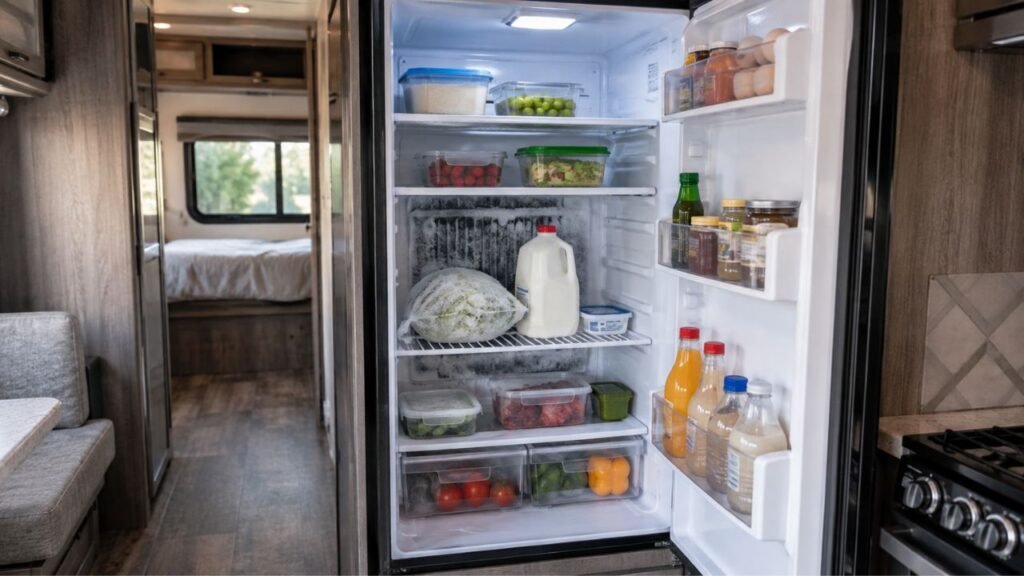
Your RV refrigerator may freeze food on one shelf because that shelf sits in a colder zone. Food placed near cooling fins, blocked airflow, heavy frost, or poor thermistor placement can create localized freezing. If only one shelf freezes while others stay normal, start with food placement and airflow before replacing parts.
In this guide, I’ll help you find the cold spot, test temperatures, check the thermistor, and fix the problem without unnecessary repairs.
Key Takeaways
- One frozen shelf usually points to a localized cooling problem.
- Food touching cooling fins can freeze surprisingly quickly.
- Poor airflow can make one shelf colder than others.
- Thermistor placement matters, but instructions vary by refrigerator model.
- Keep your RV refrigerator at 40°F or below.
- Temperatures below 32°F will freeze many high-moisture foods.
- If several shelves freeze, check the sensor and controls.
Why Is My RV Refrigerator Freezing Food on Only One Shelf?
When only one shelf freezes food, your refrigerator probably has an uneven temperature pattern. That does not automatically mean the refrigerator itself is failing.
Most RV refrigerators do not maintain identical temperatures everywhere inside. Absorption refrigerators especially tend to have colder areas around their cooling fins.
Food sitting directly below those fins may get much colder. The same thing can happen along the rear wall.
Cold air can also settle toward lower shelves. That makes bottom areas colder than shelves closer to the door.
Another common problem is restricted airflow. Large containers or tightly packed groceries can trap cold air.
This creates one refrigerated pocket that reaches freezing temperatures. Meanwhile, food only a few inches away stays perfectly normal.
Here is the easiest way to think about it:
One shelf freezing usually means a local cold spot.
Several shelves freezing usually suggests an overall temperature-control problem.
That distinction can save you from replacing unnecessary refrigerator parts.
What Does the Location of the Frozen Food Tell You?
Where the freezing happens gives you useful diagnostic information. Before changing controls, look carefully at the affected shelf.
| Where Food Freezes | Most Likely Cause | What to Check First |
| Back of one shelf | Food too close to cooling fins | Move containers forward |
| Shelf below cooling fins | Naturally colder refrigerator zone | Relocate sensitive foods |
| Bottom shelf | Cold air settling downward | Check loading and airflow |
| One corner | Uneven air circulation | Rearrange large containers |
| Entire single shelf | Restricted airflow or cold fins | Check spacing and frost |
| Several shelves | Refrigerator running too cold | Check setting and thermistor |
| Entire refrigerator | Sensor or control problem | Start deeper troubleshooting |
Use this table as your starting point. The location often reveals more than the temperature control itself.
The Most Common Reasons One RV Refrigerator Shelf Freezes Food
Several different issues can create one unusually cold shelf. Start with the simplest causes before testing electrical components.
Food Is Too Close to the Cooling Fins
The metal cooling fins along the rear wall become very cold. Food touching those fins can freeze even when temperatures elsewhere remain normal.
This happens often with milk cartons, vegetables, yogurt, and bottled drinks. Their high moisture content makes freezing easier to notice.
Try moving everything forward by about one or two inches. Then watch the shelf temperature over the next several hours.
If freezing stops, you probably found the problem.
Cold Air Is Settling Around the Lower Shelf
Cold air naturally moves downward inside the refrigerator compartment. That can make lower shelves noticeably colder.
This effect becomes stronger when airflow inside the refrigerator is limited. Large containers can trap cold air close to the bottom.
If your bottom shelf keeps freezing produce, move sensitive foods higher. Use the colder shelf for less delicate packaged foods instead.
The Refrigerator Is Packed Too Tightly
Packing an RV refrigerator tightly may seem efficient during travel. Unfortunately, it can create very uneven temperatures.
Cold air needs small pathways between containers and food packages. Without those gaps, colder pockets develop around certain shelves.
Avoid pressing food tightly from wall to wall. Leave a little space between larger items whenever possible.
You do not need huge empty spaces inside. You simply need enough room for air movement.
Large Containers Are Blocking Air Movement
Sometimes the refrigerator is not technically overloaded. One large container can still cause trouble.
Tall drink jugs, storage bins, casserole dishes, or boxes may block airflow. Cold air then becomes trapped behind or underneath them.
Look at the frozen shelf from the front. Check whether one large item divides the refrigerator compartment.
Move that container and monitor temperatures again.
Frost Has Built Up on the Cooling Fins
A light frost coating on absorption refrigerator fins can be normal. Heavy frost buildup can interfere with proper air movement.
Once frost becomes thick, cold distribution becomes less predictable. One shelf may freeze while another feels warmer.
Defrost the refrigerator if the fins have substantial ice buildup. Turn the refrigerator off and let the ice melt naturally.
Never chip ice away with knives or sharp tools. You could damage the cooling system or interior surfaces.
The Refrigerator Temperature Is Set Too Cold
A colder setting can push one already-cold shelf below freezing. Other areas may still stay within an acceptable refrigerator range.
Try reducing the cooling level by one small step. Then allow plenty of stabilization time before changing it again.
RV refrigerators react slower than many residential refrigerators. Repeated adjustments can make troubleshooting harder.
The Thermistor Is Misplaced
The thermistor is the small temperature sensor used by many RV refrigerators. It tells the control system how cold the compartment has become.
On many absorption units, the thermistor attaches near cooling fins. Its exact location depends on the refrigerator model.
If the sensor slips away from its specified position, temperature regulation may change. The refrigerator may continue cooling longer than necessary.
However, do not randomly slide the thermistor around. Correct placement varies between Dometic, Norcold, and other refrigerator models.
Check your exact model instructions before repositioning the sensor.
The Thermistor Is Starting to Fail
A failing thermistor can send inaccurate temperature information to the refrigerator controls. The refrigerator may then cool longer than necessary.
Thermistor failure becomes more likely when multiple areas begin freezing. It is also suspicious when temperature adjustments stop making noticeable changes.
A thermistor issue is less likely when only one container freezes. Start with shelf placement and airflow first.
The Door Seal Is Leaking
A damaged door gasket is usually not my first suspect here. Still, it can contribute to inconsistent refrigerator temperatures.
Warm humid air entering the compartment encourages frost buildup. That frost can eventually affect airflow and temperature distribution.
Inspect the gasket for dirt, tears, hardened sections, or gaps. Clean it gently before assuming replacement is necessary.
Does the Thermistor Cause One Shelf to Freeze?
Yes, a thermistor problem can contribute to freezing. However, it usually affects more than one small location.
If only food pressed against the rear wall freezes, check placement first. The thermistor may be working perfectly.
The thermistor becomes more suspicious when the entire refrigerator runs cold. It also deserves attention when temperature adjustments have little effect.
Try measuring temperatures on two different shelves. If both remain below 32°F, overall temperature control is likely involved.
If one shelf stays around 31°F while another reaches 38°F, airflow is more likely.
Where Should the RV Refrigerator Thermistor Be Positioned?
Thermistor location matters, but there is no universal position. Always identify your refrigerator model before adjusting anything.
Dometic Thermistor Placement
Many Dometic absorption refrigerators place the thermistor against an evaporator fin. The specified fin and bracket position depend on the exact model.
Some Dometic Americana models position the thermistor toward the right-side fin area. Other refrigerator families may use different arrangements.
Do not rely only on generic advice found online. Look at your exact model number and manufacturer instructions.
Norcold Thermistor Placement
Norcold refrigerators also use model-specific thermistor positions and testing procedures. Placement can differ between refrigerator families and production generations.
A thermistor that looks incorrectly positioned may actually be correct. Compare it with the instructions for your specific refrigerator.
Why You Should Not Follow a Universal Move-Up-or-Down Rule
You may hear that moving a thermistor upward makes things warmer. You may also hear the exact opposite advice.
That confusion happens because refrigerator designs and control systems differ. One instruction cannot accurately cover every RV refrigerator.
Before moving the sensor, identify your exact refrigerator model. Then use the recommended position for that particular unit.
Absorption vs. 12V Compressor RV Refrigerator: Does It Change the Diagnosis?
Yes, refrigerator design changes what you should check first. Modern RVs use both absorption and compressor-based refrigerators.
Absorption RV Refrigerator
Absorption refrigerators commonly have metal cooling fins inside the fresh-food compartment. Those fins can create obvious colder zones near the rear wall.
They also rely heavily on natural convection inside the refrigerator. That makes food arrangement especially important.
Common issues include:
- Food touching cooling fins
- Poor interior airflow
- Thermistor placement problems
- Excessive frost
- Temperature differences between shelves
If you have this refrigerator type, inspect those areas first.
12V Compressor RV Refrigerator
A 12V compressor refrigerator works more like a residential refrigerator. It uses a compressor instead of an absorption cooling process.
These models may use fans, evaporator surfaces, ducts, and electronic sensors. Cold spots can still develop, but the diagnosis may differ.
Look for blocked internal vents, failed circulation fans, sensor problems, or poor loading.
Do not apply absorption-fridge thermistor advice automatically to compressor refrigerators.
How to Fix an RV Refrigerator That Freezes Food on One Shelf
Start with simple changes before replacing sensors or electronics. This troubleshooting order helps you isolate the real cause.
- Move food away from the rear wall: Leave one or two inches near the cooling fins.
- Create small gaps between containers: This gives cold air room to circulate.
- Move sensitive food to another shelf: Keep lettuce, milk, and yogurt away from cold zones.
- Measure temperatures on two different shelves: Compare the frozen shelf with a normal shelf.
- Reduce the cooling setting slightly: Do this only if temperatures are low everywhere.
- Check the fins for excessive frost: Defrost if ice buildup has become heavy.
- Inspect the thermistor position: Compare its location with your refrigerator manual.
- Check thermistor wiring and connections: Look for loose plugs or damaged wiring.
- Inspect and clean the door gasket: Make sure the refrigerator closes completely.
- Try an internal circulation fan: A small fan can reduce stubborn temperature pockets.
Change only one thing at a time when possible. Otherwise, you may never know what actually fixed the problem.
How Do You Know Whether the Shelf Is Actually Too Cold?
A quick thermometer reading can sometimes give misleading results. Refrigerator air temperature changes whenever you open the door.
For better results, measure temperature over several hours. A refrigerator-safe thermometer placed in water gives a steadier reading.
Place one thermometer near the problem shelf. Put another on a shelf that seems normal.
Suppose the problem shelf stays around 31°F. The other shelf might remain around 38°F.
That difference strongly suggests a localized cold spot.
Now imagine both locations remain around 31°F. That points toward an overall cooling or sensor problem.
Temperature comparison is one of the best troubleshooting tools available. It costs little and prevents guesswork.
What Temperature Should an RV Refrigerator Be?
Your RV refrigerator should keep perishable food at 40°F or below. However, you also want to avoid sustained temperatures below freezing.
Water freezes at 32°F. Many vegetables, dairy products, and drinks suffer damage near that point.
A practical target is usually somewhere in the upper 30s. That gives you useful distance from both freezing and 40°F.
Do not obsess over one exact number throughout the entire refrigerator. Small differences between shelves are completely normal.
What matters is keeping food safely cold without creating frozen zones.
Should I Use an RV Refrigerator Fan to Stop One Shelf From Freezing?
A small refrigerator fan can help reduce uneven temperatures. It moves cold air around instead of letting it collect.
Fans work best when the refrigerator otherwise operates normally. They are especially useful when one shelf consistently stays colder.
A fan may help when:
- Your refrigerator has obvious temperature differences between shelves.
- Food is already spaced properly.
- The refrigerator setting is reasonable.
- Cooling fins are not heavily iced.
- No sensor fault appears present.
However, a fan cannot repair a failed thermistor. It should improve circulation, not hide a control-system problem.
Does the Problem Change on Propane Versus Shore Power?
Operating mode can provide useful clues with absorption refrigerators. Compare temperatures when conditions allow safe testing.
It Freezes on Both Propane and AC Power
If freezing happens on both energy sources, look at shared components. Food placement, airflow, thermistor behavior, and controls move higher on the list.
The propane burner and electric heating element are separate heat sources. Shared symptoms usually point somewhere else.
It Freezes Only on Propane
If freezing appears only during propane operation, investigate LP-side performance. Burner condition or model-specific operating behavior may deserve attention.
Do not adjust propane pressure or burner components without proper knowledge. Gas-system problems should be handled carefully.
It Freezes Only on Electric Power
If freezing occurs only on shore power, electrical-side operation deserves closer inspection. The heating element or control system may behave differently.
Again, verify temperatures before assuming a component has failed.
Which Foods Should Stay Away From the Coldest Shelf?
Some foods tolerate cold zones much worse than others. Keep these items away from cooling fins and freezing shelves:
- Leafy vegetables
- Fresh herbs
- Milk
- Yogurt
- Eggs
- Soft fruits
- Tomatoes
- Fresh berries
- Water-heavy leftovers
- Bottled drinks
- Foods stored in glass containers
Once you identify your refrigerator’s coldest shelf, use it strategically. Pack less-sensitive food there instead.
When Does One Frozen Shelf Indicate a Bigger Refrigerator Problem?
One frozen shelf often has a simple explanation. However, these symptoms deserve closer inspection:
- Freezing starts spreading to multiple shelves.
- Refrigerator temperatures stay below 32°F.
- Temperature-control changes produce no improvement.
- The thermistor appears damaged or disconnected.
- Heavy frost returns quickly after defrosting.
- The refrigerator runs unusually long.
- Temperatures swing widely throughout the day.
- Food freezes regardless of where you place it.
- The refrigerator shows a temperature-related fault code.
At that point, stop rearranging groceries and start testing components.
When Should You Test or Replace the Thermistor?
Thermistor replacement should follow diagnosis, not guesswork. Start with simple visual and connection checks first.
Check the Thermistor Connection First
Look at the thermistor wire and its connector. Loose or damaged connections can create inaccurate temperature readings.
Also check whether the thermistor clip has slipped. Secure it only in the model-specified location.
Test the Thermistor Using Model-Specific Specifications
Thermistors change resistance as temperature changes. The correct readings depend on the refrigerator manufacturer and model.
Do not use one resistance number from an unrelated refrigerator. That could lead you toward an unnecessary replacement.
Use a multimeter only if you understand the procedure. Follow the service specification for your exact model.
Replace It When Testing Confirms Failure
If testing confirms the thermistor is faulty, replace it correctly. Use the refrigerator model number when ordering parts.
Generic thermistors may not match the required resistance characteristics. The wrong sensor can create new temperature problems.
Could the Refrigerator Control Board Be Causing the Freezing?
Yes, but the control board is not my first suspect. Control problems usually affect refrigerator operation more broadly.
If the thermistor tests correctly but everything remains too cold, electronics become more suspicious.
Before replacing the board, verify:
- Refrigerator temperatures
- Thermistor condition
- Thermistor placement
- Wiring connections
- Temperature settings
- Door seal condition
- Airflow inside the compartment
Control boards can be expensive. Rule out simpler causes first.
What Not to Do When One RV Fridge Shelf Freezes
Avoid these common troubleshooting mistakes:
- Do not replace the entire refrigerator immediately.
- Do not randomly reposition the thermistor.
- Do not assume every thermistor adjusts identically.
- Do not push food against cooling fins.
- Do not completely block shelves with solid liners.
- Do not change temperature settings every few hours.
- Do not chip frost away using sharp tools.
- Do not replace control boards before basic testing.
- Do not ignore repeated temperatures below 32°F.
- Do not assume one frozen item proves component failure.
Careful troubleshooting usually saves both time and money.
How to Prevent One Shelf From Freezing Again
Once you fix the immediate issue, a few habits help prevent recurrence:
- Keep food slightly away from cooling fins.
- Leave small airflow gaps between containers.
- Monitor refrigerator temperatures regularly.
- Keep the thermistor securely positioned.
- Defrost excessive frost before it becomes heavy.
- Keep door gaskets clean and flexible.
- Avoid packing shelves completely full.
- Recheck temperatures during major weather changes.
- Learn which shelf naturally runs coldest.
- Use an interior fan when airflow remains uneven.
Every RV refrigerator develops its own temperature pattern. Learning yours makes food storage much easier.
Final Words
If your RV refrigerator freezes food on one shelf, start simple. Move food away from the cooling fins and improve airflow first.
Then compare temperatures on different shelves before touching the thermistor. That small test can quickly separate a cold spot from overcooling.
If freezing spreads throughout the refrigerator, investigate temperature controls and sensors. Model-specific troubleshooting becomes much more important at that stage.
Related FAQs
Why Does Food Freeze at the Back of My RV Refrigerator?
Food freezes at the back because cooling fins create a very cold zone there. Containers sitting against the fins can drop below 32°F even when the rest of the refrigerator stays normal.
Why Does the Bottom Shelf of My RV Refrigerator Freeze Food?
Cold air naturally settles toward the bottom of the refrigerator. Poor airflow or heavy loading can make this effect stronger and create a freezing zone.
Which Shelf Is Coldest in an RV Refrigerator?
The coldest shelf depends on refrigerator design and airflow. In many absorption refrigerators, areas near the rear cooling fins and lower shelves tend to run colder.
Can Food Touch the Cooling Fins in an RV Refrigerator?
It is better to keep food slightly away from cooling fins. Direct contact can create very cold spots and freeze vegetables, drinks, dairy products, and other moisture-rich foods.
Where Should the Thermistor Be on an RV Refrigerator?
Thermistor placement depends on your refrigerator model. Check the manufacturer instructions before moving it because Dometic, Norcold, and other brands may use different positions.
Does Moving an RV Fridge Thermistor Change the Temperature?
Moving the thermistor can affect temperature regulation on some refrigerators. However, there is no universal adjustment direction, so follow the instructions for your exact model.
How Do I Know If My RV Refrigerator Thermistor Is Bad?
A failing thermistor may cause widespread freezing, unstable temperatures, or little response to control adjustments. Model-specific resistance testing can confirm whether the thermistor has actually failed.
Will an RV Refrigerator Fan Stop Food From Freezing?
A small interior fan can reduce localized cold spots by improving airflow. It helps most when the refrigerator controls and thermistor are already working correctly.
Why Does My RV Fridge Freeze Food Even on the Lowest Setting?
If your refrigerator still freezes food on its warmest setting, check temperatures throughout the compartment. A misplaced thermistor, failed sensor, or control problem may be causing excessive cooling.
Why Does My RV Refrigerator Freeze Food on Propane but Not Electric?
Different behavior between propane and electric operation may point toward mode-specific performance problems. Confirm temperatures first, then follow troubleshooting procedures for your refrigerator model.
Can Cold Weather Make an RV Refrigerator Freeze Food?
Yes, very cold outdoor temperatures can affect some RV refrigerators. Temperature regulation may become less predictable, especially when the refrigerator sits against a cold exterior wall.
What Temperature Should My RV Refrigerator Stay At?
Keep your RV refrigerator at 40°F or below for food safety. Aim for the upper 30s when possible to reduce the chance of food freezing.

Gregory Allen covers outdoor RV camping, essential gear, and travel preparation. His reviews are based on real conditions, not spec sheets alone. He helps RVers choose equipment that works reliably in everyday outdoor use.