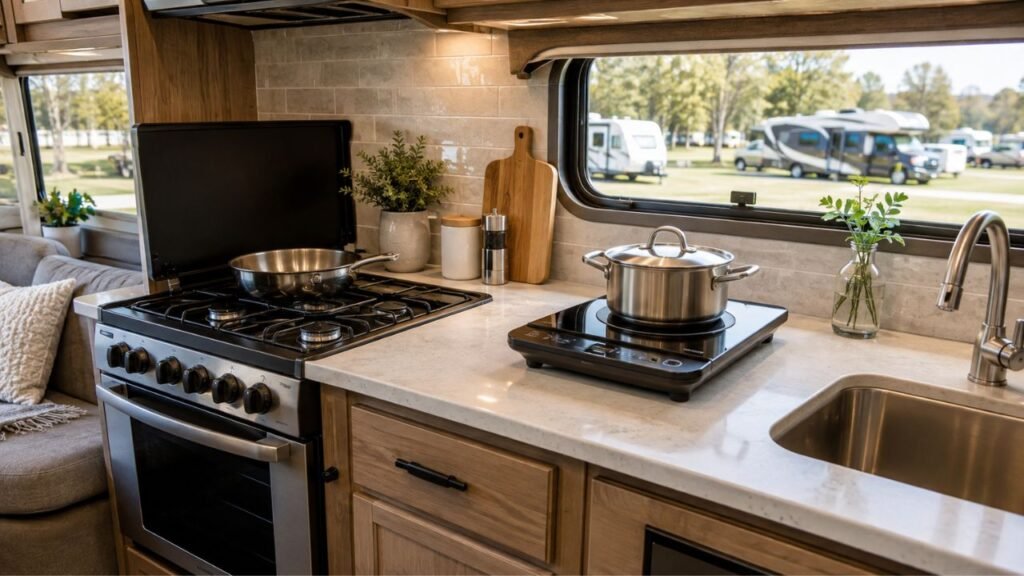
An RV induction cooktop is usually better for fast, clean cooking when you have reliable shore power or a capable lithium battery and inverter system. A propane stove is better for frequent boondocking because it provides dependable cooking heat without placing a heavy load on your RV batteries. For mixed camping, having access to both can be the most practical setup.
In this guide, I’ll compare cooking performance, electrical demand, battery use, propane use, safety, ventilation, heat, moisture, costs, cookware, and off-grid performance. By the end, you should have a much clearer idea of which cooking system actually fits your RV lifestyle.
Key Takeaways
- Induction cooks quickly and transfers more heat directly into the cookware.
- Many RV induction cooktops use about 1,200 to 1,800 watts.
- A 1,800-watt induction burner draws about 15 amps from a 120V AC circuit.
- Propane cooking places very little demand on the RV house battery.
- Propane usually makes more sense for extended boondocking with limited battery capacity.
- Induction eliminates an open flame and combustion gases from the cooktop.
- Propane cooking adds combustion heat and moisture inside the RV.
- Induction still requires normal kitchen ventilation while cooking.
- A propane stove plus portable induction burner offers excellent flexibility.
RV Induction Cooktop vs Propane Stove: Quick Comparison
Both cooking systems can work very well in an RV. The important difference is where their cooking energy comes from and how that fits your camping style.
| Comparison | RV Induction Cooktop | Propane Stove | Better Choice |
| Cooking speed | Very fast | Fast | Induction |
| Energy transfer to cookware | Very efficient | Less efficient | Induction |
| Shore power camping | Excellent | Excellent | Induction |
| Boondocking with small battery bank | Limited | Excellent | Propane |
| Large lithium and inverter system | Excellent | Excellent | Tie |
| Electrical demand | High | Very low | Propane |
| Heat added inside RV | Lower | Higher | Induction |
| Combustion moisture | None | Yes | Induction |
| Open flame | No | Yes | Induction |
| Cookware compatibility | Requires magnetic cookware | Works with most stove-safe cookware | Propane |
| Cleaning | Very easy | More parts to clean | Induction |
| Cooking during power outage | Requires alternate AC source | Usually available with propane | Propane |
| Extended off-grid use | Depends on stored electricity | Very practical | Propane |
| Summer cooking | More comfortable | Adds more cabin heat | Induction |
| Mixed camping flexibility | Good | Good | Both |
If you camp mostly with hookups, induction has some strong advantages. If you regularly stay away from electrical hookups, propane remains difficult to beat.
How Do Induction and Propane RV Cooktops Work?
The two cooktops may prepare the same meal, but they create heat very differently. That difference affects power use, cabin temperature, cookware, and off-grid capability.
How an RV Induction Cooktop Heats the Pan
An induction cooktop uses an electromagnetic field underneath its glass surface.
Instead of heating a burner first, the magnetic field causes compatible cookware to heat directly. That is why induction responds so quickly when you change the temperature setting.
The cooktop itself does not create an open flame. Much less energy is wasted heating the surrounding air.
However, don’t assume the glass always remains completely cool.
A hot skillet transfers some heat back into the glass surface. The cooktop may therefore remain hot for a while after cooking.
Many units include a residual-heat warning for this reason.
How an RV Propane Stove Produces Heat
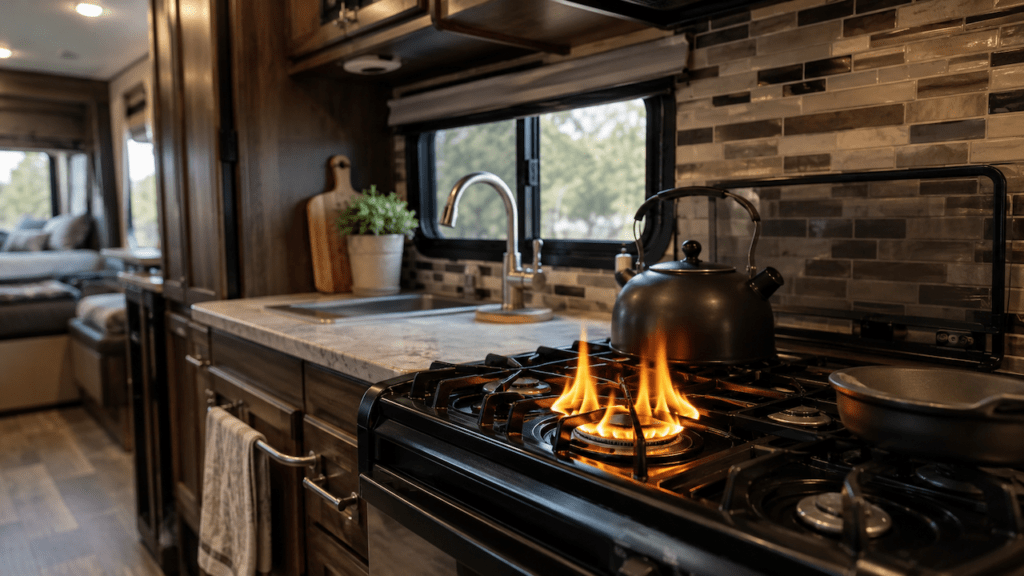
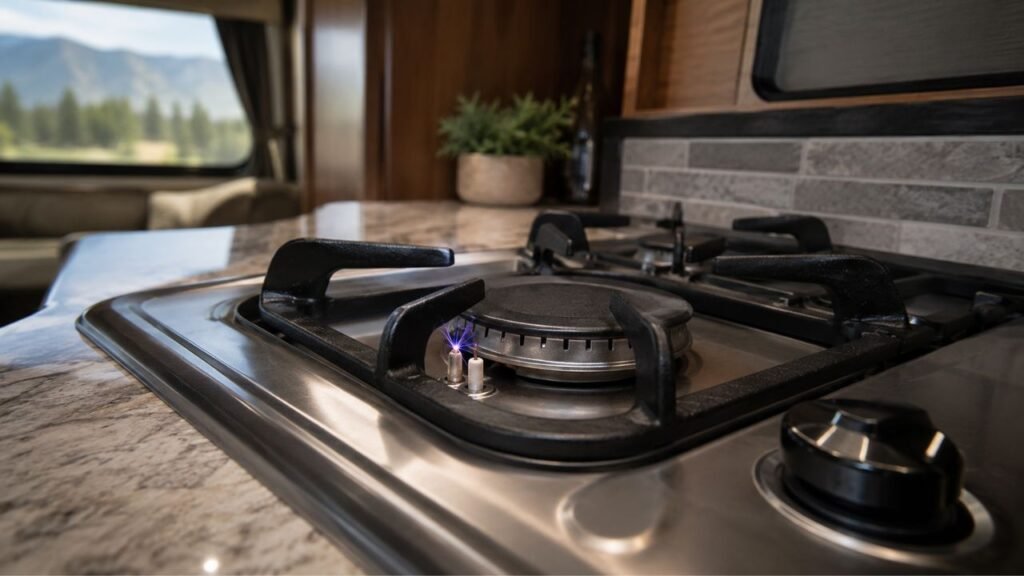
A propane stove burns LP gas through one or more burners.
The flame heats the bottom and sides of your cookware. You control cooking temperature by increasing or reducing the flame.
This system is mechanically simple and familiar to most RV owners.
More importantly for boondocking, the cooking energy comes from your propane supply instead of your battery bank.
Your RV may still use a small amount of 12V electricity for ignition or controls, depending on the appliance. However, that demand is tiny compared with an induction cooktop.
I’m referring here to a properly installed RV propane appliance. An outdoor camping stove should never automatically be treated as safe for indoor RV use.
Which Cooks Better: Induction or Propane?
Cooking performance is one reason many RV owners become interested in induction. But propane still offers excellent control and familiar cooking characteristics.
Cooking Speed and Boiling Water
Induction usually wins when speed matters.
Because the cookware itself becomes the heating element, less energy is lost between the cooktop and pan.
Water can reach boiling temperature noticeably faster than on many RV propane burners.
You may appreciate that when you’re making:
- Morning coffee
- Pasta
- Soup
- Rice
- Boiled eggs
- Hot water for quick meals
Actual cooking speed still depends on burner output, cookware size, starting temperature, and the type of pan you use.
A powerful propane burner can also cook very quickly.
Simmering and Temperature Control
Both systems can provide good temperature control.
Propane gives you a visible flame. You can instantly see whether you’re cooking at low, medium, or high heat.
Induction gives you numerical or stepped power settings.
Good induction cooktops can hold consistent temperatures very well. However, some inexpensive portable models control low heat by cycling power on and off.
That cycling can sometimes make very delicate simmering less smooth.
Searing and High-Heat Cooking
Induction performs extremely well for high-heat cooking.
A compatible cast-iron skillet can become hot very quickly. That makes induction useful for searing meat, browning vegetables, and heating heavy cookware.
Propane remains excellent for the same jobs.
Some cooks simply prefer seeing and controlling a real flame.
For normal RV meals, both systems can produce excellent results.
Cooking With Two Burners at Once
This is something worth checking before buying a dual-burner induction cooktop.
Many 120V RV induction units have a maximum total wattage rather than allowing both burners to run at maximum output simultaneously.
For example, a dual-burner cooktop might have an 1,800-watt total limit.
If one burner is operating near full power, the second burner may automatically receive less power.
That doesn’t make the cooktop unusable. It simply means you should understand how its power-sharing system works before replacing a traditional propane stove.
Power Requirements Are the Biggest Difference
Cooking performance gets most of the attention, but electrical demand should probably be your first consideration. An induction cooktop is essentially a high-powered electrical appliance.
How Many Watts Does an RV Induction Cooktop Use?
Many portable and built-in 120V induction cooktops fall between approximately 1,200 and 1,800 watts.
An 1,800-watt model running at maximum power draws roughly:
1,800 watts ÷ 120 volts = 15 amps
That is a significant load inside an RV.
It can be perfectly manageable on shore power. But you still need to consider everything else running inside the rig.
Always check the actual cooktop label and manufacturer specifications.
Not every induction unit has the same power requirements.
How Much Battery Power Does Induction Cooking Use?
This is where induction becomes more complicated for boondockers.
Suppose you run an 1,800-watt induction burner continuously at maximum power for 30 minutes.
The theoretical AC energy use would be:
1,800 watts × 0.5 hour = 900 watt-hours
Once inverter losses are considered, the battery might need to provide approximately 1,000 watt-hours.
Real meals often use less because the burner cycles and you reduce the heat after boiling or preheating.
Still, the example shows how quickly electric cooking can consume stored battery energy.
There is another important issue.
Your batteries must deliver that energy very quickly.
An 1,800-watt appliance running through a 12V inverter can require roughly 150 to 165 amps from the battery system while operating near maximum power.
That is why induction isn’t simply about having enough total battery capacity.
Your:
- Battery management system
- Inverter
- DC wiring
- Connections
- Fuses
- Breakers
- Battery bank
must all be capable of supporting the load safely.
What Size Inverter Do You Need?
Your inverter must comfortably support the maximum cooktop wattage.
For a single 1,800-watt induction burner, you’ll commonly see RV systems using an inverter in the 2,000-watt or larger range.
However, inverter wattage alone doesn’t answer the question.
You must also consider other appliances running through the inverter.
For example, you might have:
- Refrigerator
- Coffee maker
- Microwave
- Television
- Chargers
- Residential refrigerator
- Electric water heater
A cooktop that technically fits under the inverter rating may still overload the system when several appliances operate together.
A larger inverter also doesn’t fix an undersized battery bank.
Think of the inverter and batteries as one system.
Does Induction Require Lithium Batteries?
No. Induction does not technically require lithium batteries.
However, lithium batteries make high-powered electric cooking considerably easier.
Lithium iron phosphate batteries generally handle deep cycling and high-current loads better than traditional lead-acid batteries when the system is properly designed.
A small lead-acid bank may struggle with repeated high-power cooking.
Voltage drop can also cause the inverter to shut down before you expect.
If you plan to use induction occasionally while plugged into shore power, battery chemistry may barely matter.
If you want induction to become your main boondocking stove, battery design matters a lot.
Can You Run an Induction Cooktop on a 30-Amp RV?
Yes, induction can work perfectly well in a 30-amp RV. You simply need to manage your other electrical loads carefully.
Induction on 30-Amp Shore Power
A standard 30-amp RV service provides approximately:
30 amps × 120 volts = 3,600 watts
Now compare that with an 1,800-watt induction cooktop.
At maximum output, the cooktop could use roughly half your RV’s total available electrical capacity.
That leaves about 1,800 watts for everything else.
This is why combinations such as these can become problematic:
- Induction cooktop and microwave
- Induction cooktop and electric water heater
- Induction cooktop and hair dryer
- Induction cooktop and space heater
- Induction cooktop and air conditioner
Your air conditioner alone can represent a substantial load.
You might need to turn the electric water heater off temporarily or avoid running the microwave while cooking.
Load management becomes part of living with induction in a 30-amp RV.
Induction on a 50-Amp RV
A 50-amp RV electrical system gives you much more breathing room.
A typical 50-amp RV receives two 120V legs, providing up to about 12,000 watts of total theoretical capacity.
That makes simultaneous electric appliances much easier to manage.
However, there is an important detail.
Your induction cooktop still runs from an individual branch circuit.
A 50-amp RV does not mean one outlet can suddenly deliver enormous amounts of power.
The cooktop remains limited by:
- Its circuit rating
- Wiring
- Breaker
- Receptacle
- Manufacturer requirements
A 50-amp service simply gives the RV much greater total electrical capacity.
What About a 15-Amp or 20-Amp Household Outlet?
Some RV owners run a portable induction burner while connected to a household outlet.
Whether that works safely depends on the appliance and circuit.
An 1,800-watt cooktop already approaches 15 amps at 120V.
You therefore need to know:
- Circuit rating
- Other loads on the circuit
- Extension cord requirements
- Adapter limitations
- Cooktop manufacturer instructions
Don’t assume that because the plug fits, the entire setup is appropriate.
Which Is Better for Boondocking?
This is where propane usually takes the lead. Induction can still work off-grid, but the rest of your electrical system must be built around that goal.
Propane With a Small Battery Bank
If your RV has a modest battery bank, propane makes cooking simple.
You aren’t taking hundreds of watt-hours from your batteries every time you prepare dinner.
That leaves your stored electricity available for things such as:
- Lights
- Water pump
- Furnace blower
- Refrigerator controls
- Fans
- Phones
- Laptops
- Television
- Slide systems
- Other 12V equipment
This can make a noticeable difference over several days without hookups.
Induction With Lithium, Solar, and a Large Inverter
Induction becomes much more realistic once your RV has a serious electrical system.
That might include:
- Large lithium battery bank
- 2,000 to 3,000+ watt inverter
- Strong solar array
- Alternator charging
- Generator backup
- High-current wiring
- Battery monitoring
But remember how the energy actually flows.
Your solar panels don’t directly run the induction burner in most RV installations.
The normal energy path is closer to:
Solar panels → charge controller → batteries → inverter → induction cooktop
When the burner demands more power than the panels are producing, the battery bank supplies the difference.
Cloudy Days and Several Days Off-Grid
This is the scenario that catches some all-electric RV owners by surprise.
Induction may feel effortless after a sunny day with full batteries.
Then you get two or three cloudy days.
Now your batteries are also supplying:
- Refrigerator
- Lighting
- Electronics
- Water pump
- Fans
- Furnace blower
- Entertainment
- Other inverter loads
Electric cooking can become a much bigger percentage of the remaining battery capacity.
A good off-grid electrical system should be designed around poor charging conditions, not just the best sunny afternoon.
Generator-Powered Induction Cooking
You can also run induction from a generator with adequate output.
Technically, this works very well.
However, you may eventually ask yourself whether starting a generator just to prepare breakfast is more convenient than lighting a propane burner.
For some RVers, that’s fine.
Others choose propane specifically because they want to avoid generator use.
Is Propane Really Better for Off-Grid Energy Storage?
Induction is more efficient at transferring the electrical energy it receives into your cookware. But that does not automatically mean it offers better off-grid endurance.
Propane stores a large amount of usable cooking energy inside a relatively compact cylinder or onboard tank.
A battery bank capable of storing an equivalent amount of usable cooking energy would be considerably larger, heavier, and more expensive.
This is why two statements can both be true:
Induction is more efficient at the cooktop.
Propane can still provide better off-grid cooking endurance.
Efficiency and energy storage are different issues.
If you’re plugged into campground electricity, induction efficiency is very attractive.
If you’re trying to stretch your onboard energy supply across a week in the desert, propane’s storage advantage becomes more important.
Which Is Safer Inside an RV?
Induction removes several hazards associated with an open flame, but neither system should be treated carelessly. Proper installation and normal cooking safety still matter.
Induction Safety
Induction eliminates an exposed flame.
That means a dish towel or paper plate cannot accidentally drop directly into a burner flame.
Many induction cooktops also offer safety features such as:
- Pan detection
- Automatic shutoff
- Overheat protection
- Timer shutoff
- Control locks
- Residual-heat warnings
The surrounding cooktop also tends to remain cooler than a traditional flame burner.
However, induction is not completely burn-proof.
Cookware can become extremely hot, and the pan can heat the glass underneath it.
Electrical safety matters too.
Avoid allowing water to enter electrical components, and follow manufacturer requirements for installation and clearance.
Propane Stove Safety
Propane has been used safely in RVs for decades.
However, you’re working with an open flame and combustible fuel.
You should keep:
- Towels
- Paper products
- Curtains
- Plastic containers
- Cooking oils
- Other combustible materials
away from the burner area.
The flame should burn normally and evenly.
Unusual flame behavior, gas odor, ignition problems, or damaged components deserve attention.
Propane appliances also produce combustion gases.
That makes proper ventilation especially important inside a small RV.
CO and Propane Detectors Still Matter
A propane-equipped RV should have properly functioning safety detectors as required for the RV and appliance installation.
Test them according to manufacturer instructions and replace them when their service life expires.
A detector is not a substitute for proper ventilation, inspection, or appliance maintenance.
It is another layer of protection.
Does a Propane Stove Add Moisture Inside an RV?
Yes. Burning propane produces water vapor as part of the combustion process.
That moisture enters the RV’s interior air unless it is carried outside through ventilation.
In a small RV, that can contribute to:
- Fogged windows
- Higher indoor humidity
- Condensation
- Damp surfaces
This can become especially noticeable when it’s cold outside and you’re cooking several meals indoors.
Induction avoids this combustion moisture because there is no flame.
However, induction does not eliminate all kitchen humidity.
Boiling pasta, simmering soup, steaming vegetables, and heating water still release moisture into your RV.
You should ventilate the kitchen with either cooking method.
The important difference is that propane adds moisture from both the food and the combustion process.
Which Keeps the RV Cooler While Cooking?
Induction generally keeps the interior cooler.
With propane, the flame heats the cookware, burner assembly, surrounding air, and nearby surfaces.
That extra heat eventually spreads through the RV.
Induction directs a larger share of its energy into the cookware itself.
That can be a noticeable advantage in a small Class B motorhome, camper van, travel trailer, or compact fifth wheel.
It’s especially useful during hot-weather camping in places such as:
- Florida
- Texas
- Arizona
- Southern California
- Gulf Coast campgrounds
Your air conditioner already has enough work to do.
Adding less cooking heat can make the kitchen much more comfortable.
Propane’s extra heat may feel less bothersome in cold weather.
Even then, never use a propane cooking appliance as an RV space heater.
What Cookware Can You Use?
Cookware compatibility is one of propane’s easiest advantages. Induction requires the bottom of the pan to work with its magnetic field.
Cookware for Induction
Induction requires magnetic cookware.
Common compatible materials include:
- Cast iron
- Enameled cast iron
- Many stainless-steel pans
- Cookware with magnetic induction bases
Some stainless steel works. Some doesn’t.
Pure aluminum, copper, and glass generally do not work unless the cookware includes an induction-compatible base.
There is an easy test.
Hold a refrigerator magnet against the bottom of the pan.
If it sticks firmly, the pan will usually work on induction.
Also pay attention to the pan’s bottom diameter.
A tiny pan placed on a large induction zone may not be detected correctly.
Flat cookware generally performs best.
Cookware for Propane
Propane is much less selective.
Most normal stove-safe cookware can be used over a propane burner.
That includes:
- Stainless steel
- Aluminum
- Cast iron
- Carbon steel
- Copper-based cookware
You should still follow the cookware manufacturer’s heat limitations.
The main advantage is that you probably won’t need to replace existing pots and pans when using propane.
Which Is Easier to Clean and Maintain?
Induction usually wins when cleanup matters.
The smooth glass surface can normally be wiped clean after it cools.
Because the area around the pan stays relatively cool, spilled food is also less likely to burn onto the surface as aggressively.
Propane has more physical parts around the cooking area.
Depending on the stove, you may need to clean:
- Grates
- Burner caps
- Burner openings
- Drip areas
- Igniters
- Surrounding metal
That doesn’t make propane difficult to maintain. It simply takes more effort than wiping a flat glass surface.
Induction does have one vulnerability inside an RV.
The glass can scratch or crack.
Make sure heavy objects cannot fall onto the cooktop while traveling.
Don’t leave loose cookware sitting on top of the glass when the RV is moving.
Which One Takes Up Less RV Kitchen Space?
Either system can be compact, but portable induction offers an interesting space advantage.
A built-in propane cooktop permanently occupies countertop space.
A built-in induction cooktop does too.
A portable induction burner can be stored inside a cabinet when you’re finished cooking.
That gives you the countertop back for:
- Meal preparation
- Coffee equipment
- Dish drying
- Food storage
- General workspace
This can be extremely useful in small RV kitchens.
Some RV owners keep their existing propane stove and add one portable induction burner.
When connected to shore power, they cook on induction.
When boondocking, they switch back to propane.
That’s one of the easiest ways to gain induction’s benefits without committing to a complete kitchen conversion.
Induction vs Propane Cost
Don’t compare only the price of the cooktops. The true cost depends on the supporting equipment already installed in your RV.
Upfront Cost
An induction cooktop itself can be reasonably affordable.
The expensive part may be everything required to power it.
You might need:
- Larger inverter
- Lithium battery bank
- Larger battery cables
- Electrical protection
- Additional charging capacity
- Solar panels
- Compatible cookware
If your RV already has those systems, adding induction might be inexpensive.
If you need to rebuild the electrical system around electric cooking, the total cost can become substantial.
Propane can also involve installation expenses.
A propane system may include:
- Cooktop
- Tank or cylinders
- Regulator
- LP lines
- Fittings
- Detectors
- Professional installation
If your RV already has a functioning propane kitchen, keeping it usually costs very little.
Ongoing Cost
There is no universal winner for fuel cost.
At many RV parks, electricity is included with the campsite.
In that situation, induction can feel almost free to operate.
At long-term RV parks, electricity may be metered separately.
When boondocking, electricity isn’t really free either.
You may have paid for:
- Solar equipment
- Batteries
- Generator fuel
- Alternator charging
- Electrical upgrades
Propane prices also vary across the country.
For most RV owners, the difference in cooking fuel cost is relatively small compared with the cost of designing the entire energy system.
Choose the system that fits how you actually camp.
Should You Replace Your RV Propane Stove With Induction?
Replacing propane with induction can make sense, but only when your electrical system can support the change. Think about your entire energy setup before removing a working propane appliance.
When the Conversion Makes Sense
Induction becomes especially attractive if you:
- Spend most nights with full hookups
- Already have a large lithium battery bank
- Already use a high-capacity inverter
- Have strong solar or alternator charging
- Want an all-electric RV
- Prefer easier cleanup
- Want less combustion heat inside
- Want to reduce propane dependence
Full-time RVers staying frequently at RV resorts may find induction particularly convenient.
When You Should Keep Propane
Keeping propane usually makes more sense when you:
- Boondock frequently
- Have a small battery bank
- Have limited solar
- Camp during cloudy weather
- Avoid generator use
- Want simple off-grid cooking
- Already have a reliable propane system
There is little reason to remove a dependable propane cooktop simply because induction is newer technology.
Your camping habits should drive the decision.
What Must Be Checked Before Converting
Before replacing propane with induction, check:
- Cooktop voltage
- Maximum wattage
- Branch-circuit capacity
- Breaker size
- Outlet requirements
- Inverter continuous rating
- Battery discharge capability
- DC cable capacity
- Battery protection
- Countertop opening dimensions
- Cooktop ventilation requirements
- Manufacturer clearances
- Charging capacity
- Unused propane-line termination
Changes to an RV propane system should be handled correctly.
If removing or altering propane plumbing, have the work performed according to applicable appliance and RV requirements by someone qualified to work on RV LP systems.
A poorly capped or modified propane line isn’t worth the risk.
Can You Keep Propane and Add a Portable Induction Cooktop?
Absolutely, and this may be the most practical choice for many RV owners.
You don’t necessarily have to choose one system permanently.
Use induction when:
- You’re connected to shore power.
- Your batteries are fully charged.
- Solar production is strong.
- You want less heat inside.
- You want quick cleanup.
Use propane when:
- You’re boondocking.
- You want to conserve battery.
- Solar production is poor.
- Your electrical loads are already high.
- You’re camping through several cloudy days.
This gives you energy flexibility.
It also gives you a backup cooking method.
If campground electricity fails, propane can still cook dinner.
If you have shore power and want to conserve propane, induction takes over.
For RVers who move between campgrounds and dispersed campsites, I find this approach particularly sensible.
RV Induction Cooktop vs Propane Stove: Which Should You Choose?
Your camping style matters more than which cooking technology looks better on paper. Use the following guidelines to narrow down the choice.
Choose an induction cooktop if:
- You normally stay at campgrounds with hookups.
- Your RV has a large lithium battery system.
- You already own a capable inverter.
- Fast cooking matters to you.
- You want easier cleaning.
- You want less cooking heat indoors.
- You want to reduce propane use.
- You’re building an all-electric RV.
Choose a propane stove if:
- You frequently boondock.
- Your battery bank is small.
- You have limited solar charging.
- You dislike running a generator.
- You travel for several days without hookups.
- You want simple cooking during electrical outages.
- You already have a reliable RV propane system.
Consider keeping both if:
- You alternate between RV parks and boondocking.
- You want maximum energy flexibility.
- You want propane as a backup.
- You want to use campground electricity whenever possible.
- You aren’t ready to redesign the RV electrical system.
Common Mistakes When Choosing an RV Cooktop
A cooktop should fit the RV’s entire energy system, not just the kitchen countertop. Avoid these common mistakes when comparing propane and induction.
- Choosing induction without checking its maximum wattage.
- Looking only at cooktop efficiency.
- Ignoring other appliances on a 30-amp RV service.
- Buying a large inverter without checking battery capability.
- Assuming solar panels directly power the induction burner.
- Ignoring high DC current between batteries and inverter.
- Assuming every stainless-steel pan works on induction.
- Assuming induction glass never becomes hot.
- Forgetting that dual induction burners may share power.
- Cooking with propane without adequate ventilation.
- Using outdoor-only propane appliances inside the RV.
- Treating CO detectors as a replacement for ventilation.
- Removing propane equipment without properly addressing the LP line.
- Designing a boondocking system only around sunny-day solar production.
Final Verdict
For RVers who spend most of their time connected to shore power, induction is probably the better everyday cooking experience. It heats quickly, cleans easily, adds less waste heat inside the RV, and eliminates an open flame at the cooktop.
For frequent boondockers, propane remains the more practical cooking fuel. You can prepare meals without pulling huge amounts of power from your battery bank, and a tank of propane can support many days of normal cooking.
If your RV has a large lithium bank, capable inverter, and strong charging system, induction can also work very well off-grid. You just need to understand how much energy cooking consumes.
For many RV owners, though, I wouldn’t rush to remove a perfectly good propane stove.
Adding a portable induction burner may give you the best overall setup.
Use campground electricity when it’s available. Save propane when you don’t need it. Then switch back to propane when you’re camping away from hookups.
That flexibility can be more valuable than declaring either cooking method the universal winner.
Related FAQs
Is an Induction Cooktop Better Than Propane in an RV?
Induction is generally better when you have shore power or a strong battery and inverter system because it cooks quickly, cleans easily, and produces less indoor heat. Propane is usually better for long off-grid trips because it does not heavily drain the battery bank.
How Many Watts Does an RV Induction Cooktop Use?
Many 120V RV induction cooktops use roughly 1,200 to 1,800 watts at maximum output. Some models allow you to reduce the maximum power level, which can help when using limited campground electrical service.
Can I Run an Induction Cooktop on a 30-Amp RV?
Yes. An induction cooktop can run on 30-amp RV service, but an 1,800-watt model can use about half of your approximately 3,600-watt total capacity. You may need to avoid running other high-powered appliances at the same time.
Can I Run an RV Air Conditioner and Induction Cooktop Together?
It depends on your RV service, air conditioner load, cooktop setting, and other appliances. A 30-amp RV can quickly approach its power limit when an air conditioner and 1,800-watt induction cooktop operate together.
What Size Inverter Do I Need for an RV Induction Cooktop?
The inverter must exceed the cooktop’s maximum continuous wattage while leaving room for other inverter-powered loads. Many RV owners use 2,000-watt or larger pure sine wave inverters, but battery capacity, wiring, and discharge capability must also support the load.
How Much Battery Does Induction Cooking Use?
An 1,800-watt induction burner operating continuously at full power for 30 minutes uses about 900Wh of AC energy. After inverter losses, the battery may supply around 1kWh, although real cooking often uses less because burner power changes throughout the meal.
Can a 100Ah Lithium Battery Run an Induction Cooktop?
A properly designed 100Ah lithium battery system may run a single induction burner, but high-power cooking can consume a large portion of that battery very quickly. The battery’s BMS, inverter, wiring, and current rating must also support the heavy load.
Is Induction Practical for Boondocking?
Yes, but it becomes much more practical with a large lithium battery bank, capable inverter, and strong solar, alternator, or generator charging. With a small battery system, propane is normally easier to manage off-grid.
Does an RV Induction Cooktop Work Without Shore Power?
Yes. An induction cooktop can operate without shore power when connected to a properly sized inverter and battery bank. The challenge is storing and replacing enough battery energy for repeated cooking.
Does a Propane Stove Add Moisture Inside an RV?
Yes. Burning propane produces water vapor, which adds humidity inside the RV along with moisture released by the food itself. Using the kitchen exhaust and ventilation can help reduce condensation.
Does Induction Cooking Heat Up an RV Less Than Propane?
Generally, yes. Induction transfers a larger percentage of its energy directly into the cookware, while propane flames release more heat around the burner and into the surrounding RV interior.
Do I Still Need Ventilation With an Induction Cooktop?
Yes. Induction does not create propane combustion gases, but cooking still produces steam, smoke, grease, odors, and airborne particles. Using your RV range hood or other ventilation remains a good idea.
Can Cast Iron Be Used on an Induction Cooktop?
Yes. Cast iron normally works very well with induction because it is magnetic. Make sure the bottom fits the cooktop’s cooking zone, and place it carefully to avoid scratching or damaging the glass surface.
Can Induction Cookware Be Used on a Propane Stove?
Usually, yes. Most induction-compatible cookware can also be used over propane as long as the cookware manufacturer approves it for gas-stove use.
Can I Replace My RV Propane Stove With Induction?
Yes, provided your RV’s electrical system can support the cooktop. Check the circuit, inverter, batteries, wiring, charging capacity, and countertop requirements before converting, and have unused propane plumbing handled correctly.
Is It Better to Have Both Propane and Induction in an RV?
For many RVers, yes. Induction is convenient when shore power or abundant battery energy is available, while propane provides dependable cooking during boondocking or electrical outages. Having both gives you more flexibility.

Gregory Allen covers outdoor RV camping, essential gear, and travel preparation. His reviews are based on real conditions, not spec sheets alone. He helps RVers choose equipment that works reliably in everyday outdoor use.