An RV inverter is usually better for quietly running everyday appliances from your battery bank, while an RV generator is better for prolonged high-power loads. If you regularly run air conditioning, electric heating appliances, or several large appliances together, a generator is usually more practical. Many off-grid RVers benefit most from using both systems together.
In this guide, I’ll show you how generators and inverters compare for real RV appliances. We’ll also cover battery runtime, air conditioners, generator sizing, costs, boondocking, and safety.
Key Takeaways
- An RV inverter converts stored battery power into usable 120V AC power.
- A generator creates electricity by burning gasoline, propane, or diesel.
- Inverters are ideal for quiet, low-to-medium everyday electrical loads.
- Generators are better for sustained high-wattage appliances and air conditioning.
- Inverter wattage determines what you can run, not how long.
- Battery capacity determines how long an inverter can support your appliances.
- A generator and inverter combination often works best for serious boondocking.
- Always size either system around actual appliance and startup wattage.
RV Generator vs Inverter at a Glance
Both systems can run many of the same appliances when properly sized. The real differences are where the energy comes from, how long it lasts, and how conveniently you can use it.
| Feature | RV Battery Inverter | RV Generator |
| Power source | RV battery bank | Gasoline, propane, or diesel |
| What it does | Converts DC battery power into AC | Produces electricity from fuel |
| Noise | Almost silent except cooling fans | Engine noise while operating |
| Exhaust | None at point of use | Produces exhaust and carbon monoxide |
| Runtime | Limited by battery capacity | Limited mainly by available fuel |
| Small appliances | Excellent | Works, but often unnecessary |
| Microwave | Usually possible with proper sizing | Usually handles it easily |
| Air conditioner | Possible with a large system | Usually more practical |
| Multiple heavy loads | Requires careful load management | Generally easier |
| Sensitive electronics | Pure sine wave models work well | Inverter generators work well |
| Overnight use | Excellent | Often inconvenient or restricted |
| Maintenance | Relatively low | Requires engine and fuel maintenance |
| Best use | Quiet everyday power | Long-duration heavy electrical loads |
Neither option is automatically better for every RV. Your appliances and camping habits should decide.
First, Know What an RV Inverter Actually Does
An RV inverter does not produce electricity by itself. It takes electricity already stored inside your house batteries and changes it into the type most household-style appliances need.
Your RV batteries normally provide direct current, or DC power. Most RV battery systems operate around 12 volts, although larger systems may use higher voltages.
Household outlets and many RV appliances need 120-volt alternating current, or AC power.
The inverter sits between those two systems.
The basic process looks like this:
Battery bank → inverter → 120V AC appliances
Your batteries still need to be recharged afterward. That recharge can come from shore power, solar panels, your alternator, or a generator.
This distinction matters because an inverter gives you access to stored energy. It does not give you unlimited energy.
An RV Inverter Is Not the Same as an Inverter Generator
This terminology causes a lot of confusion, so it is worth clearing up.
An RV battery inverter uses stored battery electricity. There is no fuel-burning engine involved.
An inverter generator is still a fuel-powered generator. It burns gasoline, propane, or another fuel to generate electricity.
The difference is that an inverter generator uses additional electronics to regulate and condition its electrical output.
That generally provides cleaner power, quieter operation, and improved fuel efficiency compared with many traditional portable generators.
Throughout this article, when I say inverter, I mean a battery-powered RV inverter.
When I mean a fuel-powered inverter generator, I will call it an inverter generator.
How Does an RV Inverter Power Appliances?
The inverter pulls DC electricity from your battery bank and converts it into 120V AC electricity.
That sounds simple, but several ratings determine what you can actually run.
Continuous Watt Rating
The continuous rating tells you how much power the inverter can provide steadily.
For example, a 2,000-watt inverter may support loads approaching 2,000 watts when the installation and battery bank are designed appropriately.
You still should not assume every 2,000-watt inverter performs identically.
Manufacturer limits always matter.
Surge Watt Rating
Some appliances briefly demand much more power when starting.
Your inverter must handle that temporary surge without shutting down.
Compressors, motors, pumps, and air conditioners deserve special attention here.
Battery Discharge Capability
Your inverter can only pull as much power as the batteries can safely provide.
A powerful inverter connected to an undersized battery bank may shut down under heavy loads.
The battery management system may also disconnect the battery when current gets too high.
Inverter Efficiency
Converting DC into AC consumes some energy.
That means a 1,000-watt appliance can require more than 1,000 watts from the battery side.
You should always allow room for conversion losses when estimating runtime.
How Does an RV Generator Power Appliances?
An RV generator creates electricity by burning fuel and running an engine.
It can feed AC power into the RV’s electrical system while operating.
Unlike an inverter, it does not depend entirely on stored battery energy.
As long as you have enough fuel and the generator can safely continue running, you can keep producing electricity.
That makes generators especially useful for sustained heavy electrical loads.
Built-in RV generators may use gasoline, propane, or diesel depending on the RV.
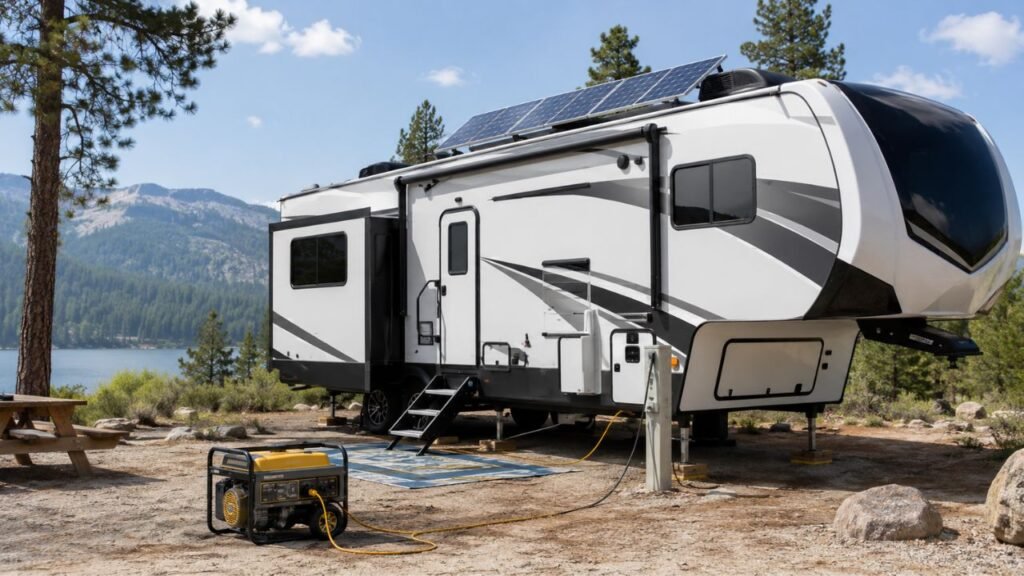
Portable generators are also common among travel trailer and fifth-wheel owners.
A generator can often perform two jobs simultaneously.
It can run your appliances while your RV converter or inverter/charger replenishes the battery bank.
That makes it useful when solar production is poor.
Which Can Run More RV Appliances: Generator or Inverter?
Both can run surprisingly large appliances when properly sized. The bigger difference appears when you consider how long those appliances must operate.
| RV Appliance | Typical Power Demand | RV Inverter | Generator | Better Choice |
| Phone charging | Very low | Excellent | Unnecessary for this alone | Inverter |
| Laptop | Low | Excellent | Works | Inverter |
| Television | Low | Excellent | Works | Inverter |
| Wi-Fi equipment | Low | Excellent | Works | Inverter |
| Residential refrigerator | Low to moderate, cycling | Very good | Very good | Inverter |
| Coffee maker | High, short duration | Good when properly sized | Excellent | Either |
| Toaster | High, short duration | Good when properly sized | Excellent | Either |
| Microwave | High, short duration | Good with larger inverter | Excellent | Either |
| Hair dryer | High | Possible but battery intensive | Excellent | Generator |
| Electric space heater | Very high over time | Poor battery use | Good | Generator |
| Electric water heater | High sustained load | Battery intensive | Good | Generator |
| RV air conditioner | High with startup surge | Requires large system | Excellent | Generator or hybrid |
| Multiple air conditioners | Extremely high | Major battery system needed | Larger generator preferred | Generator |
These are general categories rather than guaranteed wattage figures.
Always check the actual label on your appliance.
Two microwaves of the same size can draw different amounts of electricity.
The same is true for refrigerators, air conditioners, coffee makers, and heaters.
Watts vs Battery Capacity: The Difference That Really Matters
One of the biggest mistakes I see is choosing an inverter based only on watts. You need enough inverter output, but you also need enough stored battery energy.
Inverter Watts Tell You What You Can Run
The inverter’s watt rating mainly describes its power-producing capability at a given moment.
Suppose you have a 2,000-watt inverter.
A 100-watt television is easy for it to handle.
A 1,000-watt coffee maker may also be fine.
Running a 1,000-watt coffee maker and a 1,300-watt microwave simultaneously could exceed the inverter’s continuous rating.
That is a load problem.
Watt-Hours Tell You How Long You Can Run It
Battery energy is usually easier to understand in watt-hours.
A simple estimate is:
Battery watt-hours = battery voltage × amp-hours
For example:
12V × 100Ah = about 1,200Wh
That does not mean every one of those watt-hours will reach your appliance.
Actual usable energy depends on:
- Battery chemistry
- State of charge
- Battery management limits
- Inverter efficiency
- Wiring losses
- Temperature
- Battery age and condition
Still, watt-hours give you a useful starting point.
Starting Watts Can Be Much Higher
Some appliances briefly demand extra power when their motors or compressors start.
An RV air conditioner is the classic example.
Its running power may be within the inverter’s continuous rating.
The compressor startup surge may still trip the inverter.
This is why both continuous and surge ratings matter.
How Long Will an RV Inverter Run Your Appliances?
Runtime depends mostly on usable battery capacity and appliance consumption. A bigger inverter does not automatically give you longer runtime.
Basic Inverter Runtime Formula
You can make a rough estimate with:
Runtime = usable battery watt-hours ÷ appliance watts
You should then reduce the estimate slightly for conversion losses.
For example, imagine you have roughly 1,200Wh of battery energy.
A 60-watt television will use that energy much more slowly than a 1,200-watt microwave.
That difference becomes dramatic with heavy appliances.
Example With a 100Ah Lithium Battery
Suppose you have one 12V 100Ah lithium battery.
Its nominal energy is roughly:
12V × 100Ah = 1,200Wh
If your TV draws around 60 watts, it might operate for many hours.
If a microwave draws around 1,200 watts, the battery could theoretically supply about one hour of cumulative runtime before considering losses and system limits.
Of course, nobody normally runs a microwave continuously for an hour.
That is why high-wattage appliances can still work well on batteries when used briefly.
A coffee maker may run only several minutes.
A microwave may run for three minutes.
Those short bursts can be manageable with a properly designed battery system.
Why a Bigger Inverter Does Not Increase Runtime
This point is easy to miss.
A 3,000-watt inverter does not store more electricity than a 2,000-watt inverter.
It simply allows you to operate larger loads.
If both inverters use the same battery bank, available battery energy remains essentially unchanged.
For longer runtime, you generally need more usable battery capacity.
Can an RV Inverter Run an Air Conditioner?
Yes, an RV inverter can run an air conditioner when the inverter, battery bank, wiring, and startup capability are large enough.
Running it for a long time is the harder part.
Air Conditioner Running Power
RV air conditioners are among the largest loads inside most campers.
A typical rooftop unit may consume well over 1,000 watts while running.
Exact consumption depends on:
- BTU rating
- Outdoor temperature
- Thermostat setting
- Compressor efficiency
- Fan speed
- Unit condition
A 15,000 BTU unit will generally demand more than a small rooftop unit.
Starting Surge Can Cause Problems
The air conditioner compressor often demands a short burst of additional power when starting.
Your inverter might comfortably handle the running load while struggling with startup.
The same issue applies to generator sizing.
You therefore need to check both running and starting requirements.
What Does an RV AC Soft Start Do?
A soft-start device can reduce the compressor’s startup demand.
That may help an appropriately sized inverter or generator start the air conditioner more easily.
However, there is an important limitation.
A soft start reduces startup demand. It does not eliminate the air conditioner’s ongoing energy consumption.
Your batteries still have to provide the normal running power afterward.
Battery Capacity Determines AC Runtime
Imagine your inverter can comfortably start and run the air conditioner.
That proves your system has enough instantaneous power.
It does not prove you have enough energy for overnight cooling.
Air conditioning can consume several kilowatt-hours over a long evening.
That may require a substantial lithium battery bank.
For that reason, generators remain attractive for long-duration air-conditioning use.
Can a 2,000-Watt RV Inverter Run Major Appliances?
A 2,000-watt pure sine wave inverter is a very practical size for many RVs.
It can often handle several common household-style appliances.
Appliances a 2,000W Inverter May Handle
Depending on actual appliance ratings, you may be able to run:
- Microwave
- Coffee maker
- Toaster
- Television
- Laptop chargers
- Residential refrigerator
- Small kitchen appliances
The challenge comes when several high-watt appliances operate simultaneously.
You may need basic load management.
For example, avoid running your coffee maker and microwave together.
That simple habit can prevent overloads.
What Does a 3,000-Watt RV Inverter Add?
A 3,000-watt inverter gives you considerably more flexibility with larger AC loads.
It may allow:
- Larger microwaves
- Hair dryers
- Multiple kitchen appliances
- Some RV air conditioners
- More appliances running simultaneously
However, the battery side becomes much more demanding.
At 12 volts, very large inverter loads can require extremely high current.
That means you need appropriately sized battery cables, fuses, connections, and batteries.
This is not an area where undersized wiring is acceptable.
A 3,000-watt inverter should be treated as part of an electrical system.
It should not be treated as a standalone box.
Why Your Battery Bank Must Match the Inverter
A large inverter connected to one small battery may look impressive on paper.
In actual use, the battery could become the limiting component.
You need to consider:
- Battery continuous discharge rating
- Battery management system limit
- Number of batteries
- Cable size
- Cable length
- Fuse rating
- Connection quality
This becomes especially important with lithium batteries.
Their battery management systems can disconnect power when discharge current exceeds safe limits.
If that happens, the inverter shuts off even though the battery still contains energy.
What Size Generator Do You Need for RV Appliances?
Generator size should be based on the appliances you expect to operate together. Your RV’s shore-power rating gives you a useful upper limit, but it does not automatically determine generator size.
Generator Size for a 30-Amp RV
A standard 30-amp RV electrical connection provides:
30A × 120V = 3,600W
That means the RV can theoretically receive about 3,600 watts through its 30-amp service.
You do not necessarily need a 3,600-watt generator.
Suppose you only want to run:
- One air conditioner
- Refrigerator
- Battery charger
- A few small devices
A properly sized smaller generator may handle those loads.
You simply need to manage what runs simultaneously.
Generator Size for a 50-Amp RV
A 50-amp RV connection is different.
It normally provides two 120V legs.
That gives the RV up to:
50A × 120V × 2 = 12,000W
That is much more potential power than a 30-amp RV.
However, you do not automatically need a 12,000-watt generator.
Many RV owners successfully use smaller generators with 50-amp rigs.
They simply cannot operate every high-power appliance simultaneously.
Add Running and Starting Watts
A simple generator-sizing approach looks like this:
- List everything you expect to run together.
- Find each appliance’s running wattage.
- Add those running loads together.
- Identify appliances with high startup demand.
- Make sure the generator handles that temporary surge.
- Leave some operating headroom.
Air conditioners usually deserve the most attention.
Do not forget battery charging loads either.
Your converter or inverter/charger can draw substantial power when the batteries are heavily discharged.
Which Is Better for Sensitive RV Electronics?
Both systems can work well with modern electronics when they produce quality AC power.
A pure sine wave RV inverter is generally the preferred inverter type for mixed RV loads.
It provides electricity that closely resembles normal household AC power.
That makes it a good choice for:
- Laptops
- Televisions
- Chargers
- Audio equipment
- Residential refrigerators
- Modern electronic control boards
Modern inverter generators can also produce stable, clean electrical output.
So I would not say generators automatically provide poor electricity.
The exact generator design matters.
If you use expensive or sensitive electronics, choose equipment designed for stable power output.
RV Generator vs Inverter for Boondocking
Boondocking is where the difference between these systems becomes especially noticeable. Quiet convenience favors batteries, while prolonged heavy loads still favor fuel.
Inverter Is Better for Everyday Quiet Loads
An inverter is excellent when you want power without starting an engine.
I especially like it for:
- Morning coffee
- Refrigerator operation
- Television
- Laptop work
- Wi-Fi equipment
- Phone charging
- CPAP machines
- Evening outlet use
You can use electricity late at night without disturbing nearby campers.
There are no engine fumes outside your RV either.
Generator Is Better for Sustained Heavy Loads
A generator becomes valuable when your energy consumption suddenly climbs.
Common examples include:
- Air conditioning
- Electric space heating
- Large cooking appliances
- High-rate battery charging
- Several heavy appliances together
Instead of draining a large portion of your battery bank, you can run the generator.
Solar Makes an Inverter Better, Not Unlimited
Solar panels pair extremely well with an inverter system.
During sunny conditions, solar energy can recharge batteries throughout the day.
That reduces generator use significantly.
However, solar production changes constantly.
Clouds, shade, winter sun, panel angle, and short daylight hours all matter.
Your solar array can also produce far less energy than your air conditioner consumes.
Think of solar as a charging source rather than unlimited electricity.
Noise, Fuel, Maintenance, and Convenience
Power capability matters, but daily convenience often determines which system RV owners prefer using.
| Factor | RV Inverter | RV Generator |
| Noise | Nearly silent | Audible engine |
| Fuel storage | Not needed directly | Required |
| Exhaust | None from inverter | Yes |
| Startup | Usually instant | Engine must start |
| Routine maintenance | Low | Oil, filters, plugs, fuel system |
| Nighttime use | Excellent | Often restricted or undesirable |
| Heavy-load runtime | Battery limited | Strong with available fuel |
| Recharge need | Batteries need charging | Requires refueling |
| Cold starts | Not applicable | Can sometimes be harder |
| Storage space | Usually compact | Larger space requirement |
For everyday convenience, I give the inverter a clear advantage.
For sustained energy production, the generator wins.
Which Costs More: an RV Inverter or Generator?
Comparing only the price of an inverter against a generator gives you an incomplete answer. You need to compare the complete systems.
True Cost of an RV Inverter System
Your costs may include:
- Pure sine wave inverter
- Lithium or lead-acid battery bank
- Heavy battery cables
- Fuses and disconnects
- Inverter installation
- Inverter/charger upgrade
- Solar panels
- Solar charge controller
- Battery monitor
- Additional charging upgrades
A large lithium-based system can become expensive quickly.
The upside is quiet operation and low ongoing fuel costs.
True Cost of an RV Generator
Generator expenses may include:
- Generator purchase
- Fuel
- Oil
- Spark plugs
- Air filters
- Fuel stabilizer
- Routine servicing
- Occasional repairs
- Storage or mounting equipment
Fuel expenses continue as long as you operate the generator.
Which Has Lower Operating Costs?
An inverter system usually costs very little each time you use it.
If solar provides much of your charging energy, operating expenses can remain low.
A generator has ongoing fuel and maintenance costs.
However, building a large battery bank may cost significantly more upfront.
Your travel style determines which expense matters more.
Can You Use an RV Generator and Inverter Together?
Yes. In many off-grid RV setups, using both is actually the most practical solution.
How a Hybrid RV Power Setup Works
Think of the inverter as your quiet everyday power source.
Use it for:
- Electronics
- Refrigerator
- Microwave
- Television
- Coffee maker
- Overnight outlet use
Then bring in the generator when power demands become heavier.
The generator can:
- Run an air conditioner
- Support high-watt cooking loads
- Recharge low batteries
- Help during cloudy weather
- Provide backup when solar falls short
Why This Combination Works Well
A hybrid setup lets each power source do what it does best.
You avoid running a noisy generator for tiny loads.
You also avoid draining expensive batteries unnecessarily during sustained heavy loads.
Benefits can include:
- Less generator runtime
- Reduced fuel consumption
- Quiet evenings
- More flexible appliance use
- Better backup power
- Faster battery recovery
For full-time or frequent boondockers, this is often my preferred approach.
Use Proper Power Switching Equipment
Do not improvise connections between shore power, generator power, and inverter power.
Your RV may use:
- Transfer switches
- Inverter/chargers
- Subpanels
- Dedicated inverter circuits
- Automatic power management equipment
These systems prevent power sources from being improperly connected together.
Follow the inverter, generator, battery, and RV manufacturer’s installation requirements.
RV Generator vs Inverter for Different Camping Styles
The right answer changes depending on how you actually camp. Here is how I would choose for several common RV situations.
- Campgrounds with regular hookups: A modest inverter may cover occasional unplugged use.
- Weekend camping: An inverter usually offers the easiest everyday experience.
- Solar-equipped boondocking: A larger inverter becomes especially useful.
- Hot-weather boondocking: A generator or hybrid system is usually more practical.
- Full-time RV living: Consider a substantial battery system with generator backup.
- Minimal battery setup: A generator makes high-watt appliances easier to run.
- Quiet overnight camping: An inverter is clearly better.
- Frequent air-conditioning use: A generator generally gives easier long-duration power.
- Laptop-based remote work: An inverter provides quiet, convenient electricity.
- Long stays without hookups: Using both systems provides the most flexibility.
Try not to choose based only on what another RVer uses.
Two RV owners can have completely different electrical habits.
Your normal appliance use should guide the decision.
RV Generator and Inverter Safety Considerations
Both systems involve serious electrical power, and generators add combustion risks. A few basic precautions can prevent major problems.
- Never operate a portable generator inside your RV.
- Never run one inside a garage or enclosed storage area.
- Keep portable generators well away from doors, windows, and vents.
- A distance of at least 20 feet is a good safety target.
- Point generator exhaust away from occupied areas.
- Keep working carbon monoxide alarms inside the RV.
- Follow generator instructions during wet or rainy conditions.
- Never exceed your generator’s continuous or surge rating.
- Use appropriately sized inverter battery cables.
- Protect inverter wiring with proper overcurrent protection.
- Keep battery terminals tight and protected from accidental shorts.
- Follow the battery’s maximum discharge limits.
- Never bypass battery management or electrical protection devices.
- Have major electrical modifications completed by a qualified professional.
Carbon monoxide deserves particular attention.
You cannot see or smell it.
That makes proper generator placement extremely important.
Final Verdict: RV Generator vs Inverter for Running Appliances
For most everyday RV appliances, I would choose an inverter first. It lets you use televisions, electronics, refrigerators, coffee makers, microwaves, and other moderate loads without starting an engine. It is quiet, convenient, and particularly useful with lithium batteries and solar.
A generator becomes the better choice when you need sustained high power, especially for air conditioning. A properly designed battery system can run an RV air conditioner, but operating it for hours requires much more stored energy. That is where a fuel-powered generator becomes easier and more practical.
If you regularly boondock, I would not necessarily choose only one system. A properly sized inverter and battery bank can handle normal daily electricity, while a generator can provide backup for air conditioning, battery charging, and unusually heavy loads. That combination gives you quiet power when you want it and sustained power when you need it.
Related FAQs
Is an RV Inverter the Same as an Inverter Generator?
No. An RV inverter converts stored battery DC electricity into 120V AC power. An inverter generator burns fuel to create electricity and then uses inverter electronics to regulate its output.
Can a 2,000-Watt Inverter Run an RV Microwave?
Yes, many RV microwaves can operate from a properly installed 2,000-watt inverter. Check the microwave’s actual input wattage, inverter continuous rating, battery discharge capability, and other loads running simultaneously.
Can a 3,000-Watt Inverter Run an RV Air Conditioner?
Yes, many properly designed 3,000-watt inverter systems can run one RV air conditioner. The battery bank must also handle compressor startup and provide enough stored energy for your desired runtime.
How Long Will a 100Ah Battery Run an Inverter?
There is no single runtime because the inverter itself is not the main load. Runtime depends on battery energy, appliance wattage, conversion losses, battery condition, and how much usable capacity remains.
Does an RV Inverter Drain the Battery When Nothing Is Running?
Yes, most inverters consume some standby power while switched on. The amount varies by model, so turning the inverter off when it is not needed can help conserve battery energy.
Do I Need a Pure Sine Wave Inverter in an RV?
A pure sine wave inverter is generally the better choice for modern RVs. It provides cleaner AC power for electronics, refrigerators, chargers, televisions, motors, and appliances with electronic controls.
Can I Run an RV Inverter While the Generator Is Running?
Yes, properly configured RV systems commonly use generators with inverter/chargers. The generator may power loads while charging batteries, but the system needs correct transfer and power-management equipment.
Can an RV Air Conditioner Run From Batteries Overnight?
It is possible with a sufficiently large battery bank and inverter, but air conditioning consumes substantial energy. Long overnight operation can require several batteries and enough charging capacity to replenish them afterward.
Is a Generator Necessary if My RV Has Solar?
Not always. A good solar and battery system may handle your normal electrical needs. A generator remains useful for heavy loads, prolonged bad weather, shaded campsites, and emergency battery charging.
Is an Inverter Better Than a Generator for Boondocking?
An inverter is generally better for quiet everyday electrical loads. A generator is better for sustained high-power use, so frequent boondockers often get the most flexibility from using both.

Gregory Allen covers outdoor RV camping, essential gear, and travel preparation. His reviews are based on real conditions, not spec sheets alone. He helps RVers choose equipment that works reliably in everyday outdoor use.