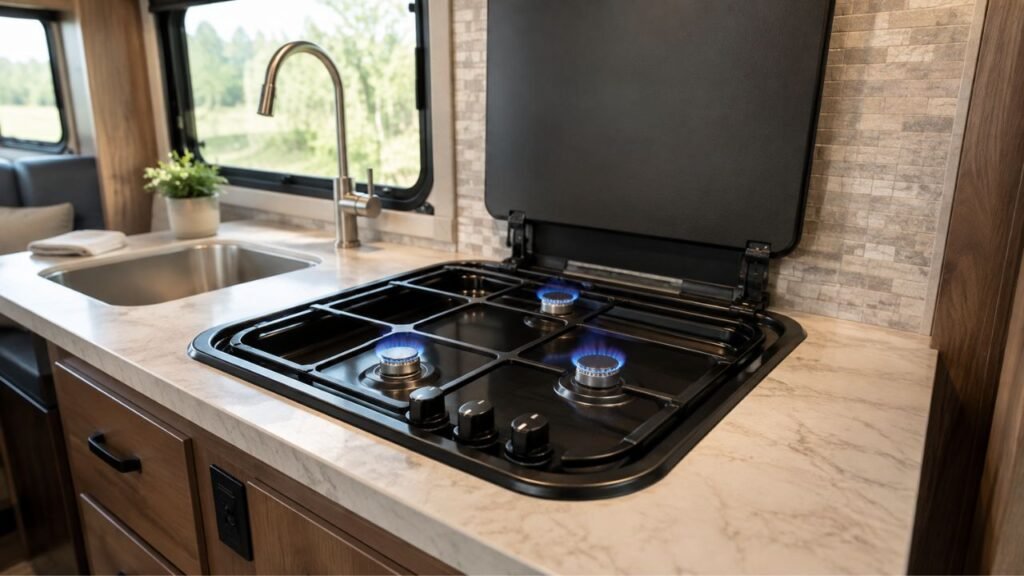
If every burner on your RV stove has a weak flame, the problem usually comes from reduced propane flow or pressure rather than several dirty burners at once. Common causes include a tripped excess-flow safety device, low propane, a restricted pigtail, a failing regulator, or a problem at the stove’s gas inlet.
Below, I’ll help you narrow down the problem without randomly replacing parts. We’ll start with the easiest propane checks, compare your other LP appliances, and then work toward regulator or stove-specific issues.
Key Takeaways
- Weak flames on every burner usually point to a shared propane-supply problem.
- Opening the propane cylinder too quickly can restrict gas flow.
- Low propane and very cold weather can reduce available propane vapor.
- If several LP appliances are weak, suspect the main propane supply.
- If only the stove is weak, the problem may be closer to the stove.
- A regulator can appear functional yet fail when propane demand increases.
- Never adjust RV propane pressure without proper testing equipment.
What Does a Weak Flame on Every RV Stove Burner Usually Mean?
When all your burners become weak at roughly the same time, I would look upstream before cleaning individual burner ports.
Your stove burners share the same propane supply. Gas normally travels from the propane cylinder through the pigtail, regulator, RV propane line, stove inlet, burner valves, and finally the individual burners.
That means one restriction before the burners can reduce flame strength everywhere.
The situation is different when only one burner is weak. A single weak burner is more likely to have grease, debris, a blocked port, or another problem specific to that burner.
Your flame can also remain mostly blue while still being too small. A blue flame tells you combustion may be reasonably clean, but it doesn’t guarantee that enough propane is reaching the burner.
Is the Problem With the Stove or the RV Propane System?
You can often narrow down the problem by looking at what happens elsewhere in your RV. Before replacing anything, compare your stove symptoms with your furnace, water heater, and other propane appliances.
| What You Notice | Most Likely Area to Check |
| One burner is weak while others are normal | Burner ports, burner head, valve, or orifice |
| Every stove burner is weak | Shared propane supply or stove gas system |
| Stove, furnace, and water heater all struggle | Propane tank, pigtail, regulator, or main supply |
| Stove is weak but other propane appliances work normally | Stove regulator, inlet, manifold, or supply connection |
| First burner gets weaker when you light another | Propane pressure or flow restriction |
| Stove weakens when the furnace starts | Main regulator or upstream restriction |
| Problem began after changing a propane tank | Excess-flow restriction or connection problem |
| Problem happens mainly during very cold weather | Low propane vaporization or limited supply |
This simple comparison can save you from taking the stove apart unnecessarily.
What Causes a Weak Flame on Every RV Stove Burner?
Several problems can reduce propane delivery to every burner. I recommend checking the common supply-related causes first because they affect the entire stove rather than one burner.
An Excess-Flow Restriction Has Reduced Propane Flow
This is one of the first things I would check, especially if the problem started immediately after opening or changing your propane cylinder.
RV propane systems include safety features designed to restrict gas flow when an unusually large rush of propane occurs. Opening the cylinder valve very quickly can sometimes make the system react as though there is excessive flow.
You may still get enough propane to light the stove, but the burners can remain unusually small.
This is why a stove can appear to work while producing weak flames on every burner.
The good news is that properly shutting everything down and slowly repressurizing the propane system often clears this condition.
Your Propane Tank Is Low or Empty
It sounds obvious, but don’t skip this check.
A tank that still contains a little propane may provide enough gas for a small flame without supporting normal burner output.
This can become more noticeable when you light several burners together.
If your RV uses two cylinders with an automatic changeover regulator, also check which cylinder is selected. Make sure the reserve cylinder valve is actually open if your system depends on automatic changeover.
A recently filled cylinder doesn’t completely rule out a supply issue either. Check the actual setup instead of assuming propane is available.
Cold Weather Is Limiting Propane Vaporization
Propane appliances don’t burn the liquid sitting inside your cylinder. The liquid propane must first vaporize into gas.
Very cold conditions can reduce how quickly that happens.
You are more likely to notice weak stove flames when several things happen together:
- The propane tank is getting low.
- Outdoor temperatures are very cold.
- Your furnace is running frequently.
- Several propane appliances are operating together.
- You are using smaller propane cylinders.
Cold weather doesn’t automatically cause weak stove flames. However, it can expose a propane supply that was already close to its limit.
The RV Propane Regulator Is Failing
Your RV’s propane regulator reduces high cylinder pressure to the much lower pressure required by RV appliances.
If that regulator starts failing, your stove may still light while producing smaller flames than normal.
A regulator problem becomes more likely when:
- Every stove burner is weak.
- Your furnace also struggles.
- Your water heater has trouble staying lit.
- Flames shrink when another propane appliance starts.
- A full cylinder doesn’t improve the problem.
- Resetting the propane flow doesn’t solve it.
One important point here is that resetting a propane system doesn’t repair a worn regulator.
A reset may correct an excess-flow restriction. A regulator with an aging diaphragm or internal problem may need professional testing and replacement.
A Pigtail or Propane Supply Hose Is Restricting Flow
The short hose connecting your propane cylinder to the regulator is commonly called the pigtail.
A damaged or restricted pigtail can reduce propane delivery before the gas even reaches your regulator.
Look for obvious problems such as:
- Sharp bends
- Crushed sections
- Cracking
- Weather damage
- Loose connections
- Deteriorated hoses
Some hose restrictions happen internally, so a pigtail can look acceptable from the outside and still cause trouble.
If your flames become much weaker under heavier propane demand, the pigtail deserves attention along with the regulator.
The Regulator Vent Is Blocked or Improperly Positioned
Your propane regulator needs to operate in the environment it was designed for.
Mud, insects, road debris, corrosion, water, or other contamination around the regulator can sometimes interfere with normal operation.
You can visually inspect the regulator area without taking it apart.
Look for obvious damage, heavy corrosion, blocked openings, or signs that water has entered the regulator area.
Don’t remove covers or attempt internal regulator repairs yourself.
The Stove’s Own Regulator or Gas Inlet Is Restricting Flow
Here’s an important possibility that is easy to overlook.
Some RV cooktops and ranges contain an appliance-level regulator or other gas-control components near the stove inlet.
If your furnace and water heater perform normally but all stove burners remain weak, the main RV regulator becomes less suspicious.
At that point, the problem may be closer to the stove.
Possible areas include the stove’s:
- Inlet regulator
- Shutoff valve
- Manifold
- Gas supply connection
- Internal gas-control components
This is where stove-specific diagnosis becomes much more useful than replacing your main RV regulator without testing.
The Main Propane Line Has a Partial Restriction
A restriction somewhere in the RV propane distribution system is less common, but it can happen.
Damage, contamination, kinked flexible sections, or a partially closed valve may reduce propane flow.
You may notice that small propane loads work reasonably well while larger loads cause performance to drop.
Gas-line diagnosis isn’t something I recommend handling casually. If the easier checks don’t reveal the problem, have the system tested properly.
Your Propane Setup Is Being Double-Regulated
This usually applies to modified RV propane systems rather than factory-installed stoves.
You might encounter it after adding:
- A portable stove
- An outdoor kitchen appliance
- An RV quick-connect accessory
- A replacement cooktop
- A converted propane appliance
Your RV’s propane has already been regulated before reaching many low-pressure quick-connect outlets.
If you then connect an appliance that still uses its own regulator designed for full tank pressure, the gas may effectively be regulated twice.
The result can be a very small flame.
If your weak-flame problem appeared immediately after changing or adding propane equipment, check whether the appliance is designed for the pressure supplied by that connection.
How Do I Fix Weak Flames on All My RV Stove Burners?
Work through these checks in order instead of replacing parts randomly. The goal is to determine whether your problem begins at the propane cylinder, regulator, RV supply system, or stove itself.
Step 1: Stop If You Smell Propane
Before troubleshooting anything else, pay attention to propane odor.
If you smell strong propane inside or around your RV, don’t keep lighting the stove to test it.
Shut off the propane supply if you can do so safely. Avoid flames, sparks, switches, and anything else that could ignite gas.
Leave the RV and have the propane system inspected before using it again.
A weak flame isn’t worth taking chances with a suspected leak.
Step 2: Check How Much Propane You Actually Have
Confirm that the cylinder supplying your stove contains propane.
If you use a dual-cylinder setup, check both cylinders and your automatic changeover regulator.
Make sure the selected tank contains propane and its valve is open.
If the reserve cylinder is supposed to take over automatically, verify that its valve hasn’t accidentally been left closed.
Step 3: Check the Automatic Changeover Regulator
Many travel trailers and fifth wheels use two propane cylinders with a changeover regulator.
Look at:
- The regulator selector
- Which cylinder is active
- Whether both cylinder valves are open
- The regulator’s status indicator
You may simply be running from an empty cylinder while the reserve side isn’t available.
This is one of those checks that takes seconds but can solve the entire problem.
Step 4: Reset a Possible Excess-Flow Restriction
If your flames became weak after changing cylinders or opening the propane valve, try resetting the propane flow.
Use this basic sequence:
- Turn every propane appliance off.
- Make sure all stove knobs are fully off.
- Close the propane cylinder valve completely.
- Allow the propane system to sit for several minutes.
- Check that the cylinder connection is properly seated.
- Slowly begin opening the cylinder valve.
- Continue opening it gradually until fully open.
- Light one stove burner and check the flame.
Don’t snap the cylinder valve open quickly.
If the flame returns to normal, an excess-flow restriction was likely involved.
Step 5: Compare the Stove With Other Propane Appliances
Now determine whether the problem affects only your stove.
Try operating another propane appliance, such as your furnace or water heater.
If several propane appliances are weak, the problem is probably upstream.
That points you toward the:
- Propane cylinder
- Pigtail
- Main regulator
- Main propane supply
If your other propane appliances perform normally but every stove burner is weak, focus more closely on the stove’s supply components.
Step 6: Turn On Another Burner and Watch the First Flame
This is one of my favorite simple tests because it tells you how the system reacts under additional demand.
Light one burner and observe its flame.
Now light the second burner.
If the first burner suddenly becomes much smaller, your propane system may not be delivering enough gas when demand increases.
Try the third burner as well.
You may also notice the stove weakening when your furnace starts.
That behavior points toward a flow or pressure problem more strongly than a dirty burner does.
Step 7: Visually Inspect the Pigtails and Regulator
You don’t need to disassemble anything for this step.
Look around the propane cylinder and regulator for:
- Cracked hoses
- Sharp hose bends
- Damaged connections
- Heavy corrosion
- Water damage
- A visibly damaged regulator
- Obvious blockage around the regulator vent
If something looks damaged, don’t try patching propane components.
Replace damaged approved components or have an RV propane technician handle the repair.
Step 8: Check the Stove Burners After Supply Problems Are Ruled Out
Burner cleaning still has a place in troubleshooting, but I wouldn’t start here when every burner is equally weak.
Cleaning makes more sense when:
- One burner is weaker than the others.
- Flames are missing around part of a burner.
- Grease is visibly blocking burner openings.
- A burner has an uneven flame pattern.
- One burner has difficulty lighting.
Let the stove cool completely before cleaning removable burner parts.
Avoid using drills, needles, or oversized wires that could enlarge gas openings.
Changing the size of an orifice can affect the fuel-air mixture and create unsafe combustion.
Step 9: Have the Propane Pressure Tested Under Load
If the problem continues, this is where professional testing becomes valuable.
A technician can connect a manometer and check how your propane pressure behaves.
Ideally, the system should be checked both with light demand and with appliances operating.
That helps determine whether pressure looks normal at rest but collapses when propane demand rises.
The technician can then narrow the problem to the main regulator, pigtail, propane line, or stove.
What Should RV Propane Pressure Be?
Most RV propane appliances are designed around low-pressure LP gas supplied at approximately 11 inches of water column.
That is only around 0.4 psi, which is much lower than the pressure stored inside your propane cylinder.
Your regulator’s job is to reduce cylinder pressure to the pressure your RV appliances require.
However, you shouldn’t diagnose a propane regulator by flame size alone.
A proper test uses a manometer and should include propane demand. A regulator might appear acceptable with only one tiny burner operating but fail to maintain pressure once several appliances require propane.
Always follow the specifications for your specific RV and appliance.
I don’t recommend turning regulator adjustment screws yourself. If pressure is incorrect, have a qualified RV propane technician determine why before making adjustments.
Why Does My RV Stove Flame Get Weaker When I Turn On Another Burner?
If one burner looks fairly normal alone but becomes much smaller after you light a second burner, your propane system may be struggling to supply enough gas under increased demand.
That doesn’t automatically mean the stove itself is bad.
The restriction may be in the pigtail, regulator, propane line, stove inlet, or appliance regulator.
Think of it as a delivery problem. One burner doesn’t require much propane, so the problem can remain hidden. When burner two and burner three begin demanding gas, the restriction becomes much easier to see.
The same clue applies if your stove flame becomes noticeably weaker when the furnace starts.
Why Is My RV Stove Weak but My Furnace and Water Heater Work Normally?
If your furnace and water heater work normally on propane, that’s useful information.
It suggests your propane cylinders and main RV regulator are at least supplying enough fuel for those appliances.
Your troubleshooting can then move closer to the stove.
Depending on the stove design, the problem may involve its inlet regulator, manifold, shutoff valve, supply connection, or another stove-specific gas component.
Try operating two or three burners together. Sometimes a stove-side restriction only becomes obvious as burner demand increases.
If all burners remain weak while every other propane appliance performs normally, I would have the stove’s gas supply and inlet pressure inspected before replacing the RV’s main regulator.
Should I Clean the Burners if Every RV Stove Burner Is Weak?
You can inspect and clean the burners, but I wouldn’t make that your first fix when every burner has the same weak flame.
A dirty burner normally creates localized symptoms.
You might see uneven flames, dead spots around the burner ring, delayed ignition, or one burner behaving differently from the others.
A propane supply problem often creates a different pattern.
All burners remain fairly even, but the entire flame is smaller than it should be.
If every burner became weak at roughly the same time, check your propane supply, regulator, and flow first.
How Can I Tell if My RV Propane Regulator Is Going Bad?
A failing propane regulator can cause several symptoms, but no single symptom proves the regulator is bad. Look at the overall pattern before replacing it.
- Every stove burner remains weak after resetting propane flow.
- A full propane cylinder doesn’t improve performance.
- Your furnace or water heater also struggles.
- Stove flames shrink noticeably as propane demand increases.
- Flame strength changes without you moving the burner controls.
- The regulator shows visible corrosion or physical damage.
- The regulator area has signs of an LP leak.
- Proper pressure cannot be maintained during a load test.
If your stove is the only appliance with a problem, don’t immediately blame the main regulator.
You may have a stove-side restriction instead.
When Should I Stop Troubleshooting the RV Propane System?
Basic visual checks and propane-cylinder checks are reasonable for many RV owners. Once troubleshooting involves gas-pressure adjustment or opening propane components, I recommend bringing in a qualified technician.
Stop DIY troubleshooting if:
- You smell propane.
- You find evidence of a gas leak.
- The regulator appears physically damaged.
- Flames remain weak after a proper propane reset.
- Several propane appliances are malfunctioning.
- Propane pressure needs to be measured or adjusted.
- A gas valve, fitting, manifold, or line must be removed.
- Burners repeatedly go out while operating.
- Flames produce soot or behave abnormally.
Propane problems are much easier to diagnose when someone measures pressure rather than guessing from flame appearance.
Final Words
When every burner on your RV stove has a weak flame, don’t start by assuming all your burner ports suddenly became clogged.
Begin with the parts every burner shares.
Check your propane level, confirm the correct cylinder is supplying gas, reset a possible excess-flow restriction, and compare your stove with the RV’s other propane appliances.
If several appliances are weak, focus on the main propane supply, pigtail, and regulator. If everything except the stove works normally, move your attention toward the stove’s own inlet and gas-control components.
And if the flame falls sharply whenever propane demand increases, have the system pressure tested under load. That usually gives you a much clearer answer than replacing parts one by one.
Related FAQs
Can Low Propane Cause a Weak Flame on Every RV Stove Burner?
Yes. A nearly empty propane cylinder may still provide enough gas to create a flame, but it can struggle when multiple burners or other propane appliances operate, especially during very cold weather.
Can Opening an RV Propane Tank Too Fast Cause a Low Flame?
Yes. Opening the cylinder valve too quickly can trigger an excess-flow safety restriction in some propane setups, leaving enough propane for a tiny flame but not enough for normal stove performance.
Why Are My RV Stove Flames Blue but Very Small?
A blue flame doesn’t always mean propane pressure is correct. The gas-air mixture may still burn cleanly while the total amount of propane reaching the burner is too low.
Why Does My RV Stove Flame Drop When I Turn On a Second Burner?
If the first flame shrinks when another burner starts, your propane system may not maintain adequate flow under demand. Check the regulator, pigtail, propane supply, and stove inlet.
Why Are All Three Burners Weak but My Other Propane Appliances Work?
When other LP appliances operate normally, the problem may be closer to the stove. Its inlet regulator, manifold, supply connection, or internal gas controls may be restricting flow.
Can Cold Weather Make an RV Stove Flame Weak?
Yes, particularly when the propane cylinder is low or several appliances are running. Cold temperatures can reduce how quickly liquid propane vaporizes into usable propane gas.
Can a Bad RV Propane Regulator Cause Low Stove Flames?
Yes. A failing regulator may not maintain proper propane pressure, especially when several appliances or burners operate at once. A manometer test can confirm regulator performance.
Can a Kinked Propane Hose Cause a Weak RV Stove Flame?
Yes. A kinked, damaged, or internally restricted propane pigtail can limit gas flow. The problem may become more noticeable when you light additional burners.
Should I Adjust My RV Propane Regulator to Make the Flame Bigger?
No. Don’t adjust propane pressure based only on flame size. A qualified technician should measure system pressure with a manometer and identify the cause before changing regulator settings.
Is 11 Inches Water Column Normal for an RV Propane System?
Approximately 11 inches of water column is common for many RV propane appliances. However, always follow the exact pressure specification provided for your RV and stove.

Gregory Allen covers outdoor RV camping, essential gear, and travel preparation. His reviews are based on real conditions, not spec sheets alone. He helps RVers choose equipment that works reliably in everyday outdoor use.