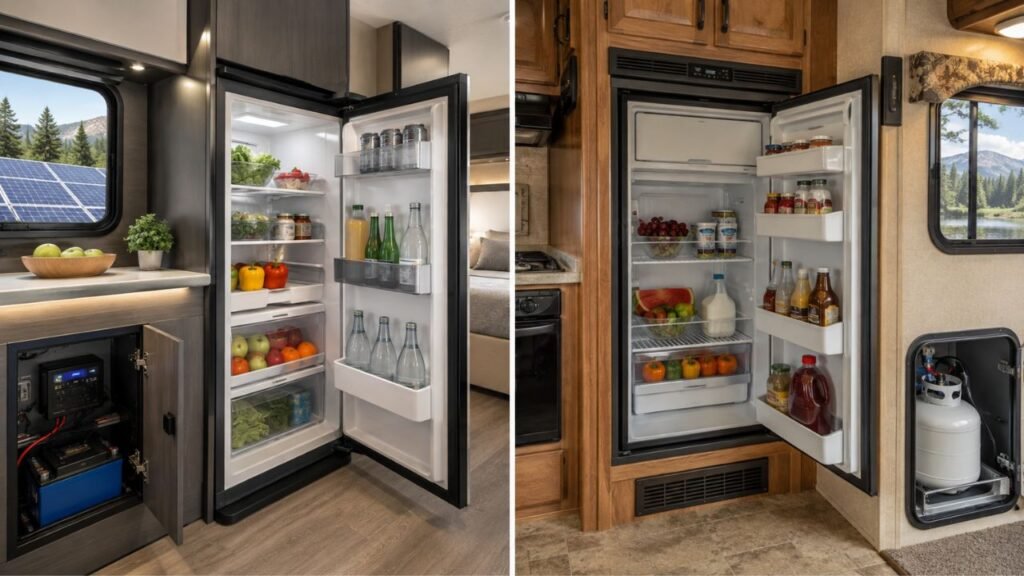
A 12V RV refrigerator is usually better for faster cooling, hot-weather performance, off-level camping, and everyday convenience. A propane refrigerator is often better for long boondocking trips when battery capacity and solar charging are limited. The right choice depends more on how you camp than on the refrigerator itself.
In this guide, I’ll compare cooling performance, battery use, propane consumption, solar needs, leveling, maintenance, safety, installation, and overall cost. By the end, you should have a much clearer idea of which refrigerator fits your RV setup.
Key Takeaways
- 12V compressor refrigerators generally cool faster and maintain steadier temperatures.
- Propane refrigerators use very little house-battery power while operating on LP.
- A 12V refrigerator needs dependable battery capacity and regular charging.
- Compressor refrigerators work normally when your RV is parked slightly off-level.
- Absorption refrigerators must stay within their manufacturer’s leveling limits.
- Hot summer camping generally favors a 12V compressor refrigerator.
- Propane remains practical for extended dry camping with limited solar.
- Your existing battery and charging system can determine the better choice.
12V RV Refrigerator vs Propane Refrigerator: Quick Comparison
Both refrigerator types can work very well inside an RV. However, they solve the cooling problem in completely different ways.
Here is the quick comparison before we look deeper.
| Factor | 12V Compressor Refrigerator | Propane Absorption Refrigerator |
| Cooling method | Compressor and refrigerant | Heat-driven absorption system |
| Initial cool-down | Usually faster | Usually slower |
| Temperature consistency | Generally better | More affected by conditions |
| Hot-weather performance | Usually stronger | Can struggle in extreme heat |
| Leveling sensitivity | Very low | Must remain within allowed limits |
| Main off-grid energy | Battery electricity | Propane |
| Battery demand | Moderate to high | Low while using propane |
| Solar compatibility | Excellent | Not required for cooling |
| Long dry-camping ability | Excellent with charging | Excellent with propane supply |
| Driving operation | Simple | Requires more consideration |
| Noise | Light compressor or fan sound | Almost silent |
| Exterior combustion vent | Not required | Required |
| Interior capacity | Often better for cabinet size | Cooling unit takes rear space |
| High-altitude concerns | Minimal | Propane performance may change |
| Maintenance | Mostly electrical and airflow | Burner, flue, vents, LP system |
| Best for | Modern battery and solar setups | Low-power boondocking |
What Is the Difference Between a 12V RV Refrigerator and a Propane Refrigerator?
The biggest difference is how each refrigerator creates cooling. Knowing that difference makes almost every other comparison easier to understand.
How a 12V Compressor RV Refrigerator Works
A 12V compressor refrigerator operates much like your refrigerator at home. A small compressor circulates refrigerant through the cooling system.
The compressor switches on when the refrigerator needs cooling. Once the selected temperature is reached, it shuts off temporarily.
Because it runs directly from the RV’s 12V system, a true 12V refrigerator normally does not need an inverter.
That makes the system fairly efficient compared with converting battery power into 120V AC first.
How a Propane Absorption RV Refrigerator Works
A propane RV refrigerator does not use a traditional compressor. Instead, it uses heat to move refrigerant through an absorption cooling system.
That heat usually comes from either propane or electricity.
Most common models are called 2-way refrigerators because they can use propane or 120V shore power.
Some older or specialized models are 3-way refrigerators. Those may operate from propane, 120V AC, or 12V DC.
A 12V Compressor Fridge Is Not a 3-Way Fridge on 12V Mode
This point causes plenty of confusion.
A true 12V compressor refrigerator uses electricity to power a compressor.
A 3-way absorption refrigerator running on 12V uses electricity mainly to create heat for the absorption process.
Those systems consume power differently.
So, when someone says an older 3-way refrigerator uses lots of 12V electricity, that does not automatically mean modern 12V compressor refrigerators work the same way.
Which Refrigerator Cools Better?
Cooling performance is one of the biggest reasons RV manufacturers are moving toward compressor refrigerators. However, your environment and installation still matter.
Cool-Down Time
A 12V compressor refrigerator generally reaches operating temperature much faster.
You can often start it several hours before departure instead of preparing it the previous day.
Propane absorption refrigerators tend to cool more gradually. Many RV owners start them the night before traveling.
I would still avoid relying on one exact cool-down time.
A refrigerator’s size, starting temperature, ventilation, outdoor heat, and food load all affect the result.
Loading either refrigerator with warm drinks also increases cool-down time significantly.
Temperature Recovery After Opening the Door
Every time you open the refrigerator, warm air enters.
A compressor refrigerator can usually remove that heat more quickly once the door closes.
This can matter during family camping trips where everyone keeps reaching inside for drinks and snacks.
Absorption refrigerators recover more slowly, particularly during very hot weather.
That does not mean you need to avoid opening them completely. Just avoid leaving the door open while deciding what you want.
Refrigerator and Freezer Temperature Consistency
Compressor refrigerators usually maintain a more predictable temperature throughout changing weather.
The thermostat can cycle the compressor as additional cooling becomes necessary.
Propane refrigerators depend more heavily on proper airflow behind the appliance.
Very high outdoor temperatures can reduce their ability to release heat effectively.
A refrigerator fan and clean exterior vents can sometimes improve absorption refrigerator performance.
The Food-Safety Temperature That Matters
Your refrigerator’s job is not simply making drinks feel cold.
You generally want the refrigerator compartment at 40°F or below for safe food storage.
A freezer should generally remain around 0°F for properly frozen food.
I recommend keeping a small refrigerator thermometer inside your RV refrigerator.
That gives you something objective to check when camping during hot weather.
It is far more useful than guessing temperature by touching a bottle.
Which Works Better in Hot Weather?
A 12V compressor refrigerator generally performs better when summer temperatures climb. It can actively compress refrigerant and respond quickly when additional cooling is required.
Absorption refrigerators have a harder job in extreme heat. They must release heat through the rear cooling system before the cycle can work properly.
If direct afternoon sunlight hits the refrigerator sidewall, performance can suffer further.
Poor ventilation behind the refrigerator can make the problem worse.
This becomes especially noticeable during summer camping in places like Arizona, Nevada, Texas, or southern California.
That does not mean every propane refrigerator stops cooling during hot weather.
A well-installed absorption refrigerator with clean vents may still perform adequately.
However, if I regularly camp where afternoon temperatures approach triple digits, I would strongly favor a compressor refrigerator.
How Much Power Does a 12V RV Refrigerator Really Use?
Battery consumption is the main concern with 12V refrigeration. The important number is not simply the compressor’s running amperage.
Running Amps Are Not the Same as Daily Amp-Hours
Suppose your refrigerator draws several amps while the compressor operates.
That does not mean it draws that amount continuously for 24 hours.
The compressor cycles.
Once the compartment reaches the thermostat setting, it shuts down until more cooling is needed.
How often it runs depends on several factors:
- Outdoor temperature
- Refrigerator size
- Thermostat setting
- Door-opening frequency
- Amount of food stored
- Temperature of newly loaded food
- Ventilation around the refrigerator
- Direct sunlight on the RV
- Refrigerator efficiency
This is why two owners with the same refrigerator can report very different battery consumption.
Calculate Your Refrigerator’s Daily Battery Use
The best approach is using the refrigerator manufacturer’s daily energy figure when available.
You can also estimate consumption from watt-hours.
For example:
Daily watt-hours ÷ battery voltage = approximate daily amp-hours
If a refrigerator consumes 600Wh over 24 hours:
600Wh ÷ 12V = about 50Ah
That means the refrigerator alone could use roughly 50Ah daily.
Your water pump, furnace, lighting, fans, USB chargers, and electronics still need power too.
That is why battery sizing should cover the entire RV, not only the fridge.
Why Wire Size and Voltage Drop Matter
A compressor refrigerator needs sufficient voltage at the refrigerator itself.
Long wire runs and undersized wiring create voltage drop.
The battery may show healthy voltage while the refrigerator receives considerably less.
When voltage drops too far, the refrigerator may shut down or behave unpredictably.
This sometimes gets blamed on the refrigerator when wiring is actually responsible.
If you are replacing an absorption refrigerator with a 12V model, do not assume the existing wiring is automatically adequate.
Check the new refrigerator’s installation specifications first.
How Long Will a 12V RV Refrigerator Run on a Battery?
Battery runtime depends on daily refrigerator consumption and usable battery capacity. It also depends on everything else drawing from the same battery bank.
100Ah Lead-Acid Battery
A 100Ah lead-acid battery does not normally give you 100Ah of comfortably usable energy.
Repeated deep discharges can significantly shorten its life.
Because of that limitation, a single lead-acid battery can feel small when powering a 12V refrigerator overnight.
Add furnace use, lights, and water-pump operation, and capacity disappears quickly.
For regular off-grid 12V refrigeration, I would not build my entire system around one small lead-acid battery.
100Ah Lithium Battery
A lithium battery generally provides much more usable capacity from its rated 100Ah.
That makes it considerably better suited to compressor refrigeration.
Still, one 100Ah lithium battery does not automatically guarantee several days of camping.
If your refrigerator consumes 40 to 60Ah daily, there is not much room left for other loads without regular charging.
200Ah or Larger Lithium Battery Bank
A 200Ah lithium bank provides much more breathing room.
It can handle refrigerator operation overnight while leaving energy for normal RV loads.
You still need a way to replace the electricity used.
That could come from:
- Solar panels
- Shore power
- Generator charging
- Alternator charging
- A DC-to-DC charger
More battery capacity buys time.
Charging creates sustainability.
Why There Is No Universal “Two-Day” Answer
You may see claims that a 12V refrigerator runs one, two, or three days on a specific battery.
Treat those numbers as examples, not promises.
A refrigerator operating during a cool spring weekend might barely work hard.
The same refrigerator inside a hot RV during July may cycle much more often.
Solar changes the calculation too.
Someone replacing most daily consumption through solar could keep operating indefinitely under favorable conditions.
Someone parked under trees with no charging source could run out quickly.
How Much Solar Do You Need for a 12V RV Refrigerator?
Solar sizing should begin with energy consumption, not an arbitrary panel number. Your goal is replacing what the refrigerator and other appliances consume daily.
Start With Daily Refrigerator Consumption
Suppose your refrigerator uses approximately 600Wh each day.
Your solar system must generate at least that amount simply to replace refrigerator consumption.
But solar panels never deliver their rated output continuously.
Clouds, heat, panel angle, shade, wiring losses, and season all reduce real production.
So you need some margin.
Account for Other RV Loads
Your refrigerator is only part of your electrical system.
You may also run:
- LED lights
- Water pump
- Roof vent fans
- Furnace blower
- Television
- Laptop chargers
- Phone chargers
- Inverter
- CPAP equipment
- Water heater controls
Add those loads before choosing battery or solar capacity.
Otherwise, you may build a system that powers the fridge beautifully but leaves nothing for everything else.
Solar Alone Is Not Enough
Solar panels only generate meaningful power during daylight.
Your refrigerator keeps running after sunset.
Therefore, a proper setup needs both energy generation and energy storage.
The battery carries the refrigerator overnight.
Solar replenishes that battery during daylight.
Don’t Treat One Battery and Solar Size as Universal
You will often hear recommendations like 200Ah lithium and 400 watts of solar.
That can be a useful starting point for some RVers.
It is not a universal requirement.
Someone camping mostly in sunny Arizona has different solar conditions than someone staying beneath trees in Oregon.
Your travel season matters too.
Winter solar production can be very different from summer production.
Base your system on your actual daily energy needs whenever possible.
Does a Propane RV Refrigerator Use Battery Power?
Yes, many propane RV refrigerators still need some 12V battery power.
The propane flame provides the heat used for cooling, but electrical components may still require DC power.
Depending on the refrigerator, 12V electricity may operate the control board, ignition, display, gas valve, interior light, or ventilation fans.
That is why a propane refrigerator can sometimes stop operating when the house battery becomes completely discharged.
The advantage is that its electrical consumption on propane is usually much smaller than a compressor refrigerator’s daily demand.
Which Is Better for Boondocking?
For boondocking, the better refrigerator depends on which energy source you can replenish most easily.
A propane refrigerator remains extremely practical when your RV has limited battery capacity and little solar.
You can carry substantial cooling energy inside a propane tank without building a large electrical system.
This works particularly well when you camp in one location for several days.
A 12V refrigerator can be equally practical when your RV has a capable battery bank and regular charging.
If solar replaces your refrigerator’s daily consumption, you may not need propane refrigeration at all.
This is why saying “propane is always better for boondocking” is no longer completely accurate.
For a basic electrical setup, propane usually wins.
For a strong lithium and solar setup, 12V refrigeration can work extremely well.
Can You Run a 12V or Propane Refrigerator While Driving?
Travel operation matters because nobody wants warm groceries after arriving at camp. Both systems can operate during travel, but the considerations differ.
Running a 12V Compressor Refrigerator While Driving
Running a 12V refrigerator while driving is straightforward.
The refrigerator continues pulling electricity from the RV house battery.
However, running the refrigerator and charging the battery are two different things.
Some tow vehicles provide limited current through the trailer connector.
That current might not fully replace what your refrigerator and other loads consume.
A properly designed alternator charging setup or DC-to-DC charger can provide better charging.
Check how much power actually reaches your battery rather than assuming the vehicle handles everything.
Running a Propane Refrigerator While Driving
Many RV owners operate absorption refrigerators on propane during travel.
However, you should follow your RV and refrigerator manufacturer’s instructions.
There may also be locations where propane appliances must be turned off.
So I would avoid treating this as a simple yes-or-no question.
Your exact refrigerator, RV design, route, and local requirements matter.
Fuel Stations, Tunnels, Ferries, and Local Rules
Propane appliances may need to be shut off in specific environments.
Fueling areas are an obvious place to pay attention to open flames.
Some tunnels, ferries, bridges, or transportation systems also have propane restrictions.
Follow posted instructions along your route.
And remember that driving on changing road grades is not the same as leaving an absorption refrigerator operating for hours while parked badly off-level.
Does a Propane RV Refrigerator Really Have to Be Level?
Yes, absorption refrigerators need to remain within their manufacturer’s allowed leveling range while your RV is stationary.
However, that does not mean every refrigerator must be perfectly bubble-level.
Different manufacturers and models may specify different acceptable limits.
The important part is avoiding prolonged operation while parked at a steep angle.
An absorption cooling system depends on gravity-assisted refrigerant movement.
Operating significantly outside the permitted range can reduce cooling and potentially damage the cooling unit.
Whenever possible, level the RV for comfort anyway.
Then confirm your refrigerator’s specific instructions instead of relying on one universal number.
How Do Altitude and Extreme Weather Affect Each Refrigerator?
Outdoor conditions can influence both refrigerator types, but absorption systems are generally more sensitive to environmental changes.
High-Altitude Camping
A 12V compressor refrigerator does not rely on a propane flame.
That makes altitude less important to its cooling process.
A propane refrigerator depends on proper combustion.
At higher elevations, thinner air can affect burner performance on some models.
You may notice weaker cooling or occasional burner problems.
If you frequently camp at high elevations, check the manufacturer’s altitude guidance for your refrigerator.
Extreme Summer Heat
This is where compressor refrigeration usually has a noticeable advantage.
A compressor can actively increase its operating time to remove additional heat.
An absorption refrigerator relies heavily on heat escaping from its rear cooling system.
If outside temperatures rise and ventilation becomes poor, cooling performance can decline.
Keeping exterior vents clear becomes especially important.
Freezing Weather
Cold weather can create a different set of concerns.
Certain absorption refrigerator models have specific cold-weather operating instructions.
Some manufacturers provide special winter kits or cold-weather provisions.
A compressor refrigerator may also have model-specific temperature limitations.
If you camp regularly below freezing, check your appliance manual rather than assuming refrigerator type alone determines performance.
12V vs Propane Refrigerator for Noise, Space, and Everyday Convenience
Cooling and energy consumption receive most attention, but everyday comfort matters too. These smaller differences can become noticeable after several weeks of travel.
- Noise: Propane absorption refrigerators are almost silent. Compressor refrigerators may produce a light hum when running.
- Interior space: Compressor models often provide more usable storage inside similar cabinet dimensions.
- Pre-trip preparation: Propane refrigerators usually benefit from being started well before departure.
- Freezer performance: Compressor refrigerators generally maintain stronger and more consistent freezing.
- Parking flexibility: 12V refrigerators do not have absorption-system leveling concerns.
- Fuel management: A 12V refrigerator eliminates propane consumption for refrigeration.
- Electrical management: Propane reduces your largest refrigerator-related battery load.
- Temperature recovery: Compressor refrigerators usually recover faster after frequent door openings.
Which Requires More Maintenance?
Neither refrigerator should require constant attention, but their maintenance needs are different. Keeping the supporting systems healthy prevents many common cooling problems.
12V Compressor Refrigerator Maintenance
A compressor refrigerator has relatively straightforward maintenance.
Focus on:
- Keeping ventilation openings clear
- Removing dust from accessible areas
- Checking electrical connectors
- Inspecting wiring for heat damage
- Checking door seals
- Defrosting when required
- Monitoring operating voltage
If the refrigerator suddenly shuts down during battery operation, check voltage before assuming the compressor failed.
Low voltage is a common electrical problem in RVs.
Propane Absorption Refrigerator Maintenance
A propane refrigerator needs more attention around the combustion system.
Typical maintenance includes:
- Keeping exterior vents clear
- Cleaning debris near the burner
- Inspecting the burner flame
- Checking the flue area
- Maintaining proper rear ventilation
- Inspecting door seals
- Servicing the LP system when needed
Spider webs, insects, rust, and debris can interfere with burner performance.
That is especially common in RVs stored for long periods.
Which Is More Reliable Long Term?
I would not choose based on claims that one technology always lasts longer.
Both can provide many years of service when properly installed and maintained.
Absorption refrigerators have very few moving cooling components, which sounds attractive.
However, their cooling units can be expensive to repair.
Compressor refrigerators contain moving components, but the technology is widely proven.
Installation quality, vibration, voltage quality, ventilation, maintenance, and usage all affect service life.
Compare warranty coverage and replacement parts availability when choosing a specific refrigerator.
Which Is Safer: 12V or Propane?
A 12V compressor refrigerator eliminates the propane flame and refrigerator gas connection, which simplifies the system.
There is also no combustion exhaust from refrigeration.
That can be appealing if you are trying to reduce propane use inside your RV.
However, 12V refrigerators are not completely risk-free.
Poor electrical connections, undersized wiring, incorrect fusing, or damaged cables can overheat.
Propane RV refrigerators are also designed to operate safely when installed and maintained correctly.
The main difference is that they add combustion, propane plumbing, venting, and burner maintenance to the system.
I would not describe propane refrigeration as automatically dangerous.
Instead, treat proper installation and regular inspection as essential.
Which Refrigerator Gives You More Storage Space?
A 12V compressor refrigerator often provides more usable interior capacity within a similar exterior cabinet opening.
The reason is fairly simple.
An absorption refrigerator needs space behind the refrigerator for its cooling unit, burner components, chimney, and airflow.
Compressor refrigeration can package its mechanical components more compactly.
That can translate into deeper shelves or larger freezer space.
However, cabinet design varies between manufacturers.
Compare actual cubic-foot capacity and interior shelf layout rather than assuming every compressor refrigerator is larger.
Can You Replace a Propane RV Refrigerator With a 12V Refrigerator?
Yes, many RV owners replace older absorption refrigerators with 12V compressor models. However, this is more than simply sliding one refrigerator out and another inside.
Measure the Refrigerator Opening First
Measure:
- Cabinet height
- Cabinet width
- Cabinet depth
- Door-opening clearance
- Trim dimensions
- Mounting locations
Check those measurements against the replacement refrigerator’s installation requirements.
Leave enough clearance for airflow where the manufacturer requires it.
Check the 12V Circuit
Your old refrigerator may already have a 12V connection.
That does not automatically mean the wiring can support a compressor refrigerator.
Check:
- Wire gauge
- Circuit length
- Fuse size
- Connector condition
- Available voltage
- Expected refrigerator current
Voltage drop becomes more important as wire length increases.
Make Sure Your Battery System Can Support It
A physically compatible refrigerator can still overwhelm an undersized electrical system.
Estimate its daily energy consumption first.
Then compare that with your usable battery capacity and expected charging.
If your RV has one aging lead-acid battery and no solar, upgrading the refrigerator alone may create a new problem.
Safely Disconnect the Propane Supply
If the old refrigerator uses LP gas, that supply line must be properly disconnected.
Do not simply fold or abandon an open propane line behind the refrigerator.
The connection needs to be safely capped and checked for leaks.
If you are not comfortable working on an RV propane system, this is a job worth giving to a qualified technician.
What Happens to the Old Exterior Refrigerator Vents?
Do not automatically seal every exterior vent after removing an absorption refrigerator.
Some 12V models still require ventilation around the refrigerator enclosure.
Follow the replacement refrigerator’s installation instructions.
If the old vent is no longer needed, it can sometimes be properly closed or repurposed.
The correct approach depends on your RV and refrigerator design.
Which Costs More: 12V or Propane?
The refrigerator’s price is only part of the real cost. You should compare the complete system needed to keep it operating reliably.
Refrigerator Purchase Price
Prices vary significantly by size, manufacturer, capacity, and features.
Either technology can become expensive in larger RV sizes.
I would compare specific models rather than assuming propane is always cheaper.
Supporting System Cost
A 12V refrigerator may require additional electrical upgrades.
Possible costs include:
- Lithium batteries
- Solar panels
- Solar charge controller
- DC-to-DC charger
- Heavier wiring
- New fuse protection
- Converter upgrades
- Installation labor
If your RV already has a capable electrical system, those costs may not apply.
A propane refrigerator may rely on infrastructure already built into the RV.
However, it also needs proper gas plumbing, exterior venting, and eventual burner maintenance.
Long-Term Operating Cost
There is no universal winner here.
Someone who already owns 600 watts of solar may effectively run refrigeration from energy they already collect.
Someone without solar may need generator time or shore power.
A propane refrigerator uses relatively little propane for cooling, but propane still needs purchasing and refilling.
Choose based on your existing setup rather than comparing appliance prices alone.
12V vs Propane Refrigerator: Which Is Better for Your Camping Style?
This is where the decision becomes easier. Match the refrigerator to how you actually travel, not how someone else camps.
Choose a 12V Refrigerator If You…
- Want faster initial cooling
- Camp frequently in hot climates
- Already have a capable lithium battery bank
- Have reliable solar or alternator charging
- Move campsites frequently
- Park on uneven or primitive sites
- Prefer reducing propane use
- Want easy refrigerator operation while driving
- Value stronger freezer performance
- Want more usable interior storage
Choose a Propane Refrigerator If You…
- Camp off-grid for long periods
- Have limited battery capacity
- Have little or no solar
- Already use propane for other appliances
- Stay parked for several days
- Prefer almost silent refrigerator operation
- Camp mostly in moderate temperatures
- Want to minimize daily electrical consumption
- Do not want major battery-system upgrades
Either Refrigerator Can Work Well With Full Hookups
If you spend most nights in campgrounds with reliable hookups, power availability becomes less important.
Both refrigerator types can work well.
In that situation, I would focus more on cooling performance, refrigerator capacity, replacement cost, noise, and maintenance.
A 12V refrigerator still offers faster cooling and fewer leveling concerns.
A propane refrigerator still gives you a backup energy option when hookups disappear.
Final Verdict: Is a 12V RV Refrigerator Better Than Propane?
For many newer RV setups, I would choose a 12V compressor refrigerator.
It cools faster, handles hot weather better, tolerates uneven parking, and provides simpler operation during travel. If you already have lithium batteries, solar, or strong alternator charging, its biggest disadvantage becomes much easier to manage.
However, I would not call propane refrigeration outdated or useless.
A propane absorption refrigerator can still be the smarter choice for extended boondocking when your RV has a modest battery system and limited charging. A propane tank can keep the refrigerator operating for a long time without consuming large amounts of electricity.
The best way to decide is simple:
Choose the refrigerator powered by the energy source you can reliably replace every day.
If electricity is easy for you to generate, choose 12V.
If propane is easier to carry than electricity is to produce, absorption refrigeration may still make more sense.
Related FAQs
Does a 12V RV Refrigerator Drain the Battery Overnight?
Yes, a 12V refrigerator continues consuming battery energy overnight, but a properly sized battery should handle normal operation. Actual consumption depends on refrigerator size, outdoor temperature, door openings, thermostat setting, and battery condition.
How Long Will a 100Ah Battery Run a 12V RV Refrigerator?
There is no exact runtime for every setup. A 100Ah lithium battery may power the refrigerator considerably longer than a similar lead-acid battery because more capacity is normally usable, but other RV loads also reduce runtime.
Does a 12V RV Refrigerator Need Solar Panels?
No, solar panels are not required. You can recharge the battery from shore power, a generator, alternator charging, or a DC-to-DC charger. Solar simply makes extended off-grid use much easier.
Does a Propane RV Refrigerator Still Need 12V Power?
Most modern propane refrigerators need some 12V electricity for their control board, ignition system, gas valve, display, or fans. Their electrical demand is usually much lower than a compressor refrigerator’s demand.
Is a 12V RV Refrigerator Better in 100-Degree Weather?
Generally, yes. Compressor refrigerators normally handle extreme summer temperatures better than absorption refrigerators. Proper installation and ventilation still matter, especially when direct sunlight heats the refrigerator side of the RV.
How Level Does an RV Need to Be for a Propane Refrigerator?
The RV should remain within the refrigerator manufacturer’s specified leveling limits while parked. It does not necessarily need to be perfectly level, but prolonged operation on a steep slope can reduce cooling and damage some absorption systems.
Can You Run a 12V RV Refrigerator While Driving?
Yes, a 12V refrigerator can normally operate while you drive. Make sure your house battery stays adequately charged because a basic trailer charging circuit may not replace all the refrigerator’s electrical consumption.
Can You Run a Propane Refrigerator While Driving?
Some RV refrigerators are designed to operate on propane during travel, but you should follow the appliance manufacturer’s instructions and any local restrictions. Propane appliances may need to be turned off around fueling areas, ferries, or certain tunnels.
Can I Replace My Propane RV Refrigerator With a 12V Model?
Yes, but check cabinet dimensions, ventilation, wiring size, fuse protection, battery capacity, and charging ability first. The old propane supply must also be safely disconnected and properly capped.
Does a 12V Refrigerator Need an Inverter?
A true 12V DC compressor refrigerator normally does not need an inverter because it connects directly to the RV’s 12V electrical system. Residential 120V refrigerators are different and generally require an inverter when operating from batteries.
Which Refrigerator Is Better for Boondocking?
Propane is often better with a small battery bank and limited solar. A 12V refrigerator can be excellent for boondocking when your RV has enough battery storage and reliable solar, alternator, or generator charging.
Are 12V RV Refrigerators Noisy?
They are usually quiet, but not completely silent. You may hear the compressor or cooling fan cycle periodically. Propane absorption refrigerators are generally quieter because their cooling system has no compressor.

Gregory Allen covers outdoor RV camping, essential gear, and travel preparation. His reviews are based on real conditions, not spec sheets alone. He helps RVers choose equipment that works reliably in everyday outdoor use.