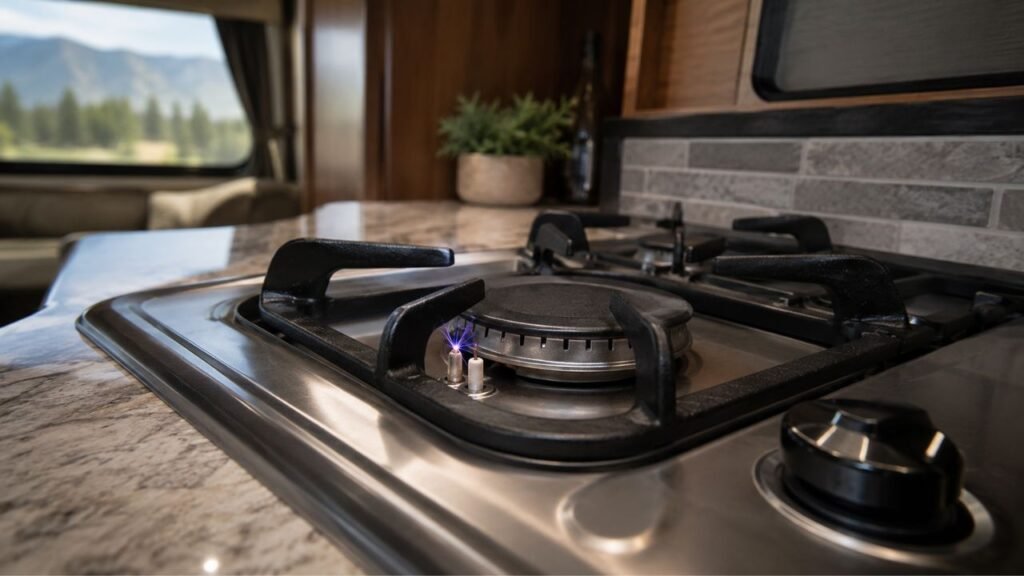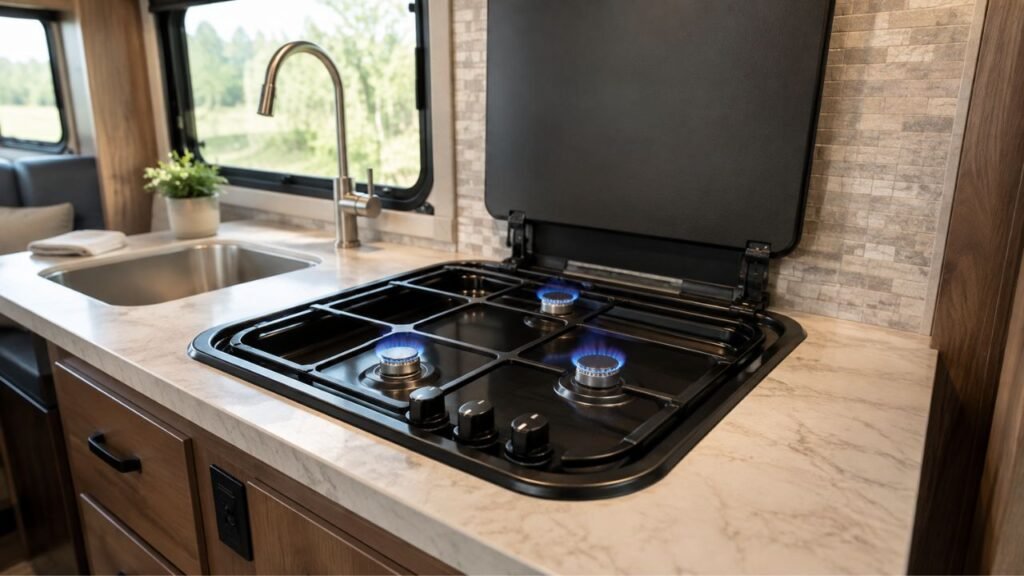
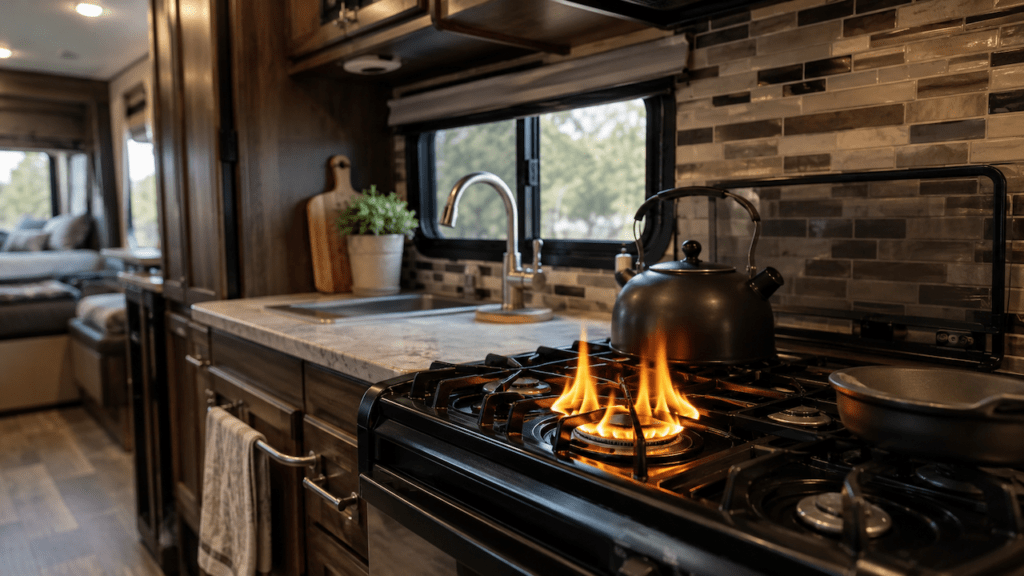
An RV stove flame usually turns yellow or orange because the propane is not mixing with enough air for clean combustion. Dirty burner ports, blocked burner tubes, restricted airflow, or propane-pressure problems are common causes. However, temporary orange coloration can also come from humidity, airborne minerals, dust, or salt in the air.
The good news is that you can often narrow down the cause quickly. I’ll show you what the flame color means, what to inspect first, which fixes are safe to try, and when the propane system needs professional attention.
Key Takeaways
- A healthy RV propane stove flame should burn mostly blue.
- Small yellow tips do not always indicate a serious problem.
- Large, lazy yellow flames usually mean poor combustion.
- Black soot on cookware deserves immediate investigation.
- One yellow burner usually points toward that specific burner.
- Yellow flames on every burner may indicate a shared propane issue.
- Humidifiers, moisture, minerals, and high altitude can change flame color.
- Avoid adjusting propane regulators unless you have proper training.
What Does a Yellow or Orange RV Stove Flame Mean?
The flame color gives you useful clues about how your propane is burning.
A normal RV stove burner should produce a mostly blue flame. Blue generally means propane and oxygen are combining efficiently before burning.
A few tiny yellow tips may occasionally appear on a propane flame. That alone does not always mean your stove has failed.
A large, soft, lazy yellow flame is different. That usually means the propane is receiving too little combustion air.
You may also notice orange streaks moving through an otherwise blue flame. Those can sometimes come from dust, moisture, or airborne minerals.
The warning sign I pay the most attention to is soot. If your pans suddenly develop black deposits, something is interfering with combustion.
That is when I would stop treating the flame color as cosmetic.
Is One Burner Yellow, or Are All the RV Stove Burners Yellow?
Before removing anything, look at every burner. This simple comparison can save you a lot of unnecessary troubleshooting.
| What You Notice | More Likely Cause | What to Check First |
| One burner is yellow | Dirty ports or blocked burner tube | Inspect that burner |
| One burner makes soot | Restricted airflow or contamination | Check ports and air inlet |
| All burners are yellow | Propane delivery or airflow issue | Look for system-wide symptoms |
| All burners suddenly turn orange | Environmental contamination | Check humidity and airborne particles |
| Flame changed after cleaning | Moisture or poor reassembly | Dry and reseat burner components |
| Flame changed after propane work | Air or debris in the system | Monitor other propane appliances |
| Flame worsens at high altitude | Reduced available oxygen | Check manufacturer altitude guidance |
| Yellow flame leaves black soot | Incomplete combustion | Stop normal use and investigate |
If only one burner looks wrong, start locally.
If every burner changes at the same time, think bigger. The issue may involve propane delivery, ventilation, elevation, or surrounding air.
What Causes an RV Stove Flame to Turn Yellow or Orange?
Several different problems can create similar-looking flames. The surrounding symptoms usually tell you which one is most likely.
Dirty or Clogged Burner Ports
Burner ports are the small openings around the burner head.
Grease, food spills, carbon deposits, and dried cooking residue can partially block them. When that happens, propane may leave the burner unevenly.
You might notice several blue flames followed by one yellow section. Some areas may also appear taller than others.
That pattern often points toward localized contamination rather than a regulator problem.
Cleaning the ports is usually one of the first things worth trying.
Dust, Rust, or Spider Webs Inside the Burner Tube
RV burners can collect more than cooking residue.
Campers often sit unused for weeks or months. During storage, insects and spiders can reach small openings around the stove.
A small spider web inside the burner tube can disrupt airflow considerably. Dust, rust flakes, and debris can cause similar problems.
The propane still reaches the burner, but it no longer mixes properly with air.
The result may be a yellow, weak, or uneven flame.
Restricted Combustion Air
Your stove needs oxygen to burn propane cleanly.
If the burner cannot pull enough air into the fuel mixture, the flame becomes richer. That often produces yellow coloration and soot.
Restricted airflow can come from debris around the burner tube. It can also happen when ventilation openings become blocked.
RV interiors are small, so airflow changes can sometimes affect appliances noticeably.
Make sure you have not accidentally covered or blocked stove ventilation areas.
Burner Cap or Burner Head Is Out of Position
Did the flame change immediately after you cleaned the stove?
Check the burner assembly before assuming something expensive has failed.
Burner components must sit in their proper positions. If something is tilted, offset, or incorrectly seated, propane may not distribute evenly.
Remove and reposition only the components your stove manual allows you to remove.
Make sure everything sits flat before lighting the burner again.
Incorrect Air-to-Propane Mixture
Most persistent yellow-flame problems eventually come back to combustion balance.
Propane needs the correct amount of oxygen before it burns.
Too much propane relative to available air creates incomplete combustion. The flame may become larger, softer, and yellower.
This does not automatically tell you which part failed.
The incorrect mixture may result from a blocked burner, restricted air inlet, pressure problem, or another propane-system issue.
That is why checking the simple causes first makes sense.
Air Shutter or Primary Air Intake Problems
Some RV stove burners use an adjustable air shutter near the burner tube.
The shutter helps control how much primary air mixes with propane.
If it is too restricted, the flame may become yellow. Too much air can create other flame problems.
However, do not assume your stove has an owner-adjustable shutter.
Different RV ranges use different burner designs.
Check the manual for your specific stove before adjusting anything. If the manufacturer does not provide an adjustment procedure, leave it alone.
RV Propane Regulator or Gas Pressure Problems
The regulator controls the propane pressure supplied to your RV appliances.
If the pressure becomes incorrect, stove flames may change.
A regulator becomes more suspicious when every burner behaves similarly. You may also notice unusual operation from another propane appliance.
Possible symptoms include unstable flames, weak flames, popping, or flames that seem to lift away from the burner.
Cleaning one burner will not fix a system-wide pressure problem.
Propane pressure should be tested with the proper equipment. I would leave regulator diagnosis and adjustment to an RV propane technician.
Debris or Air in the Propane Line
Sometimes the problem begins after propane-system work or service.
Small amounts of air or contamination may enter the line. This can temporarily affect how the burner behaves.
You might see intermittent orange coloring or unstable flames.
If the condition continues, however, do not assume it will eventually clear.
Persistent symptoms should be checked properly.
Humidity or an Ultrasonic Humidifier
This one surprises many RV owners.
An ultrasonic humidifier can release tiny mineral particles into the air. Those particles can pass through a gas flame and change its apparent color.
Your stove may suddenly burn orange even though nothing mechanical has changed.
Turn the humidifier off and allow the air to clear. Then check the stove again.
If the flame returns to blue, airborne minerals were probably influencing the color.
This is especially common when mineral-rich tap water is used.
Salt Air and Other Airborne Minerals
Camping near the ocean can occasionally change burner flame appearance.
Salt and other microscopic airborne particles can create orange coloration as they pass through the flame.
Dust and other contaminants can do something similar.
This usually looks different from a heavy, lazy, sooty yellow flame.
If the stove operates normally and produces no soot, consider your surroundings before taking the appliance apart.
High-Altitude Camping
Elevation matters because the air becomes less dense as you climb.
That means less oxygen is available for combustion.
An RV stove that burns perfectly at lower elevation may develop yellower flames in the mountains.
You may also notice weaker combustion or soot at sufficiently high elevations.
Do not start modifying propane orifices yourself.
Check your appliance manufacturer’s altitude guidance. Some equipment may require specific adjustments or service procedures.
Is a Yellow or Orange Flame on an RV Stove Dangerous?
Not every orange flicker means your stove is producing dangerous combustion. A temporary color change from minerals or dust can happen without a mechanical failure.
A persistent yellow, lazy, or sooty flame is different. Incomplete combustion can increase carbon monoxide production, so those symptoms deserve attention.
Stop using the burner and investigate when you notice:
- Black soot forming under pots or pans
- Large, soft yellow flames
- Flames extending beyond their normal area
- Persistent popping or unstable combustion
- Flames suddenly behaving very differently
- A propane smell around the stove
- An RV propane alarm activating
- A carbon monoxide alarm activating
Never ignore a carbon monoxide alarm.
Also make sure your RV has functioning carbon monoxide and propane detectors.
How Do You Fix a Yellow or Orange RV Stove Flame?
Start with simple, low-risk checks before moving toward propane-system repairs. Most burner-related problems can be narrowed down without touching the regulator.
Turn Off the Burner and Let Everything Cool
Do not clean or inspect a hot stove.
Turn the burner controls off and allow the entire cooktop to cool completely.
If you plan to remove approved burner components, shut off the propane supply according to your RV’s procedures.
Check Whether the Burner Is Positioned Correctly
Look at the affected burner first.
Make sure removable burner parts are seated correctly. Compare the problem burner with another burner if their designs match.
A slightly crooked burner head can change flame distribution significantly.
This check takes seconds and can solve problems after cleaning.
Clean the Burner Ports
Food and grease buildup are very common around RV stove burners.
Remove loose debris with a soft brush or another method approved by the manufacturer.
If you clean individual burner holes, be extremely gentle.
Do not enlarge the openings.
Changing the size of a burner port can alter propane flow and create a worse combustion problem.
After cleaning, make sure no cleaning material remains inside the burner.
Inspect the Burner Tube and Air Inlet
If the visible burner looks clean, check the accessible burner tube.
Look for dust, insect material, rust, grease, or other debris.
A flashlight can help you inspect difficult areas.
Avoid dismantling gas valves or fittings simply to reach deeper areas.
If access requires opening the gas-control system, that becomes technician territory.
Let Wet Burner Parts Dry Completely
Moisture can temporarily affect combustion.
If you recently washed burner components, make sure they are fully dry before reassembly.
Water hiding inside small passages may cause strange flames until it evaporates.
Allowing everything to dry can sometimes solve the issue without further work.
Turn Off a Nearby Ultrasonic Humidifier
If your flame is orange but otherwise looks healthy, try this test.
Turn off any ultrasonic humidifier running inside your RV.
Allow the airborne mist to settle, then relight the burner.
If the flame returns to blue, the stove itself may be fine.
Using distilled water can also reduce mineral particles from ultrasonic humidifiers.
Consider Your Elevation
Think about where the problem started.
Did your stove work normally at home but turn yellow after reaching a mountain campground?
Elevation may be part of the answer.
Check your stove manufacturer’s instructions regarding high-altitude operation.
Avoid drilling, changing, or modifying propane orifices yourself.
Check the Appliance Manual Before Adjusting Primary Air
You may find advice online telling you to adjust the air shutter.
That can be appropriate on certain burners.
It is not universal advice.
Your RV stove may use a different burner design or require specific servicing procedures.
Use the manufacturer’s instructions for your exact model.
Have the Propane Pressure Tested if the Problem Remains
If cleaning changes nothing, especially on multiple burners, propane pressure should be considered.
An RV technician can test the system using proper measuring equipment.
That can reveal regulator problems or gas-delivery issues that are invisible from the cooktop.
I would not recommend guessing at regulator adjustments.
Incorrect propane pressure can affect every gas appliance in your RV.
How Can I Tell if My RV Propane Regulator Is Causing the Yellow Flame?
A regulator becomes more likely when the problem affects the entire stove rather than one burner. Look for symptoms elsewhere in the propane system before blaming the regulator.
Possible clues include:
- Every stove burner becomes yellow or weak.
- Burner strength changes at the same time.
- Another propane appliance also behaves strangely.
- Flames pop or lift away from the burner.
- Cleaning the stove does not improve anything.
- The problem continues at different campgrounds.
- Environmental changes do not explain the flame color.
None of these symptoms proves the regulator is bad.
They simply tell you that burner cleaning may not be enough.
A technician can compare actual propane pressure with your appliance requirements and inspect the regulator properly.
Should You Adjust an RV Stove Air Shutter Yourself?
Some RV stove models provide a method for adjusting primary combustion air. Others are not intended to be adjusted by the owner.
That difference matters.
If your stove manual clearly describes an air-shutter adjustment, follow those instructions exactly. Make small changes and observe the resulting flame.
Do not improvise based on another stove model.
If the adjustment requires removing gas fittings, altering the valve, changing the regulator, or modifying an orifice, stop there.
Those components should be serviced correctly rather than adjusted by trial and error.
Why Does My RV Stove Flame Turn Orange Only Sometimes?
An intermittent orange flame often points toward changing conditions rather than a permanently clogged burner.
A nearby ultrasonic humidifier can cause orange coloring. Moisture after cleaning can also temporarily change the flame.
Dust in the air may create brief orange streaks.
Coastal salt, campground dust, and other airborne minerals can do the same thing.
Altitude changes can also explain why your stove behaves differently during one trip.
Pay attention to whether soot appears.
An orange tint without soot is less concerning than a large yellow flame that blackens your cookware.
Why Does Only One RV Stove Burner Have a Yellow Flame?
When one burner turns yellow while the others stay blue, start with that burner rather than the main propane regulator.
Check its ports for grease or food.
Inspect the burner head for poor positioning.
Look at the accessible air inlet and burner tube for debris or insect material.
Compare its flame distribution with another burner.
A single abnormal burner strongly suggests a localized airflow or contamination problem.
That makes burner cleaning a much better first move than replacing a regulator.
Why Are All My RV Stove Burners Burning Yellow?
When every burner changes together, look for something they all share.
Possible causes include:
- Incorrect propane pressure
- A regulator problem
- Reduced oxygen at high elevation
- Unusual ventilation conditions
- Airborne minerals or humidity
- Contamination farther upstream in the propane system
Start by considering what changed recently.
Did you move to a mountain campground?
Did you start using a humidifier?
Was the propane system recently serviced?
Are other propane appliances acting differently?
Those clues often point you in the right direction faster than dismantling the stove.
How Do You Prevent Yellow RV Stove Flames?
Routine cleaning and proper propane maintenance can prevent many flame problems before they interrupt your trip.
- Wipe up food spills before they harden.
- Keep burner ports free from grease buildup.
- Let washed burner components dry completely.
- Reinstall burner parts in their proper positions.
- Inspect accessible burner areas after long storage.
- Keep stove ventilation openings unobstructed.
- Watch for insects around stored RV appliances.
- Investigate recurring soot instead of ignoring it.
- Follow your stove manufacturer’s maintenance schedule.
- Have propane-pressure problems professionally tested.
A few minutes of inspection can prevent much bigger troubleshooting later.
When Should You Call an RV Technician?
Some problems are reasonable for an owner to inspect. Others involve the propane system itself and deserve proper service.
Call an RV technician when:
- Burner cleaning does not restore a normal flame.
- Several burners continue burning yellow.
- Black soot quickly returns after cleaning.
- Flames behave unusually around the air inlet.
- You suspect propane pressure is incorrect.
- The stove produces persistent popping.
- You smell propane near the appliance.
- The regulator or gas valve needs adjustment.
- A gas fitting needs to be disconnected.
- Your stove manual does not describe the required repair.
Propane systems are reliable when properly maintained.
They are not a good place for experimental adjustments.
Final Words
A yellow or orange RV stove flame does not always mean the same thing. Start by looking at the flame shape, soot, and how many burners are affected.
One yellow burner usually points toward dirt, airflow, or burner alignment. Multiple yellow burners can point toward propane delivery, elevation, or environmental conditions. Work through the simple checks first, and bring in an RV technician when the problem moves beyond basic burner maintenance.
Related FAQs
What Color Should an RV Propane Stove Flame Be?
An RV propane stove flame should normally appear mostly blue. Small yellow tips can sometimes occur, but a large, lazy yellow flame or one producing soot should be inspected.
Is a Little Yellow on an RV Stove Flame Normal?
A small amount of yellow at the flame tips can sometimes be normal with propane. Persistent yellow flames covering most of the burner are more likely to indicate poor combustion.
Why Is My RV Stove Flame Orange but Not Producing Soot?
Orange coloration without soot may come from dust, moisture, salt, or airborne minerals. Ultrasonic humidifiers are another common cause of temporary orange flames inside RVs.
Why Does Only One RV Stove Burner Turn Yellow?
One yellow burner usually indicates a localized problem. Dirty ports, a blocked burner tube, restricted air intake, or incorrect burner positioning are common causes.
Why Did All My RV Stove Burners Suddenly Turn Orange?
When all burners change simultaneously, look for shared causes. Humidity, a humidifier, high altitude, propane-pressure changes, or airborne contaminants may affect every burner together.
Can an Ultrasonic Humidifier Make an RV Stove Flame Orange?
Yes. Ultrasonic humidifiers can release tiny mineral particles into the air. Those particles may pass through the propane flame and make it appear orange.
Can High Altitude Cause a Yellow Propane Flame?
Yes. Higher elevations have less available oxygen, which can change propane combustion. Some RV appliances may develop weaker or yellower flames at mountain campgrounds.
Can Low Propane Make an RV Stove Flame Yellow?
A nearly empty propane cylinder does not automatically create a yellow flame. However, propane-delivery or pressure problems associated with the system can affect burner performance.
Can a Bad Propane Regulator Cause Orange Stove Flames?
Yes. Incorrect propane pressure can create abnormal flame behavior across multiple burners. If every burner is affected, having the regulator and system pressure tested makes sense.
Why Is My RV Stove Leaving Black Soot on My Pans?
Black soot usually indicates incomplete combustion. Dirty burners, restricted airflow, incorrect fuel-to-air mixture, or propane-pressure problems should be investigated before continuing normal stove use.
Should I Adjust the Air Shutter on My RV Stove?
Only adjust an air shutter if your specific stove provides one and the manufacturer explains the procedure. Do not assume instructions for another RV stove apply to yours.
Can I Keep Cooking if My RV Stove Flame Is Yellow?
A tiny yellow tip may not require immediate shutdown, but a large yellow flame, heavy soot, unstable combustion, propane odor, or alarm activation means you should stop using the stove and investigate.

Gregory Allen covers outdoor RV camping, essential gear, and travel preparation. His reviews are based on real conditions, not spec sheets alone. He helps RVers choose equipment that works reliably in everyday outdoor use.