A soft spot in an RV kitchen floor is usually caused by hidden water damage. Leaking plumbing, sink drains, refrigerator lines, slide seals, or exterior gaps can slowly weaken the subfloor. However, delamination, compressed foam, weak framing, and repeated foot traffic can also make an RV floor feel soft.
The important part is finding why the floor became soft before repairing it. Below, I’ll help you narrow down the likely cause, locate hidden moisture, and decide how serious the damage may be.
Key Takeaways
- Hidden water damage is the most common cause of soft RV floors.
- Kitchen sink plumbing and drain connections should be checked first.
- Refrigerator drains and water lines can also leak unnoticed.
- Exterior seams, windows, doors, and slide seals may allow rainwater inside.
- A dry soft spot may indicate delamination or compressed floor foam.
- Weak support around vents and floor openings can create localized flex.
- The visible soft spot may be smaller than the actual damaged area.
- Always repair the underlying cause before rebuilding the floor.
What Causes a Soft Spot in an RV Kitchen Floor?
Several problems can make an RV kitchen floor feel soft or spongy. Water damage is the first concern, but the floor structure itself can also fail.
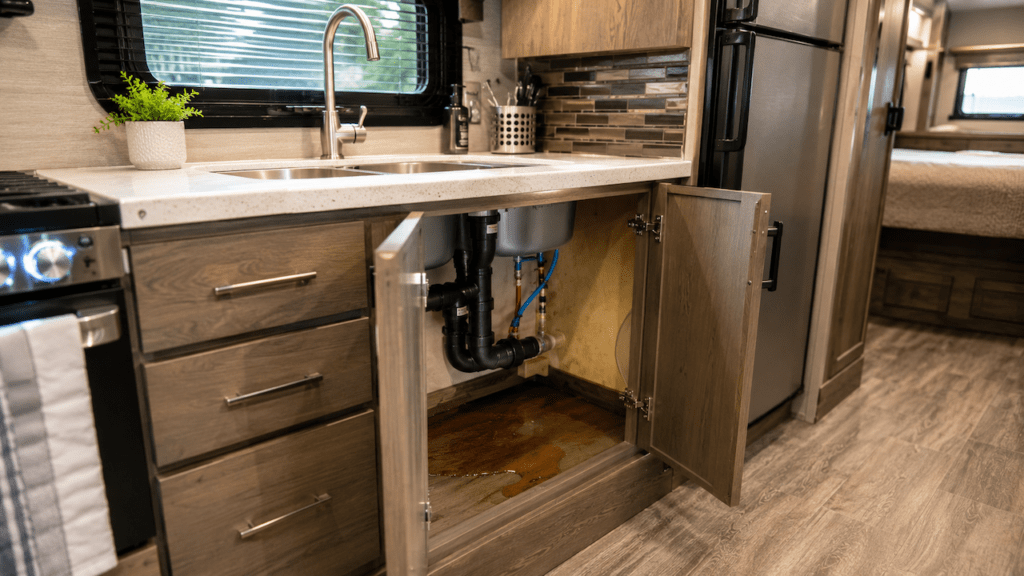
A Slow Leak Under the Kitchen Sink
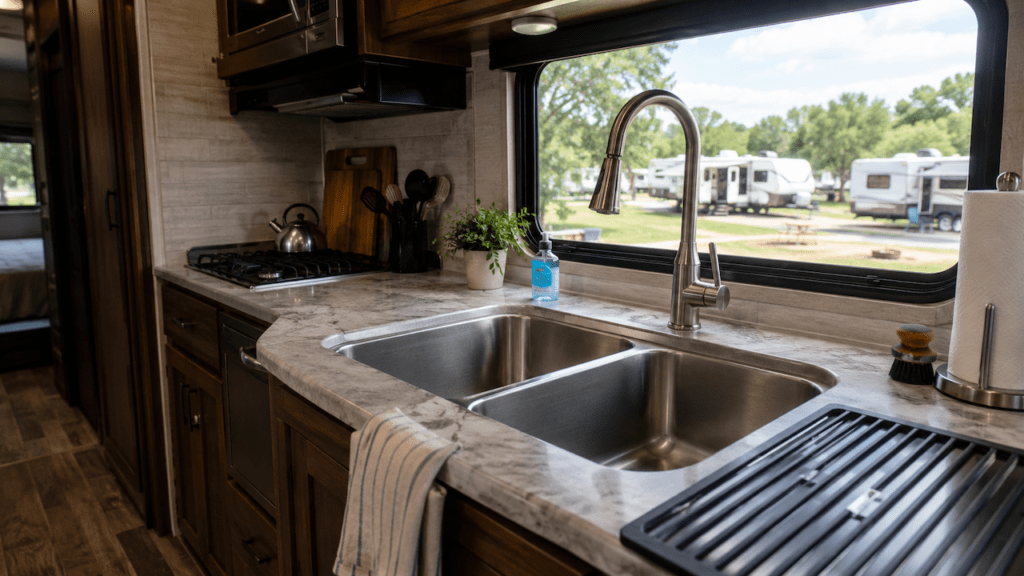
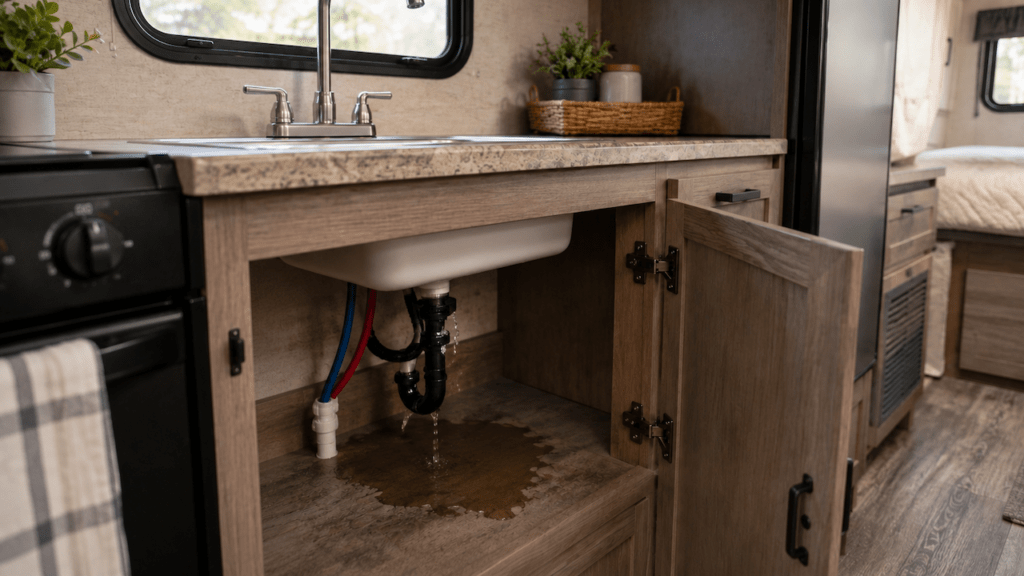
The area beneath your kitchen sink should be your first inspection point.
RV plumbing fittings can loosen from vibration while you travel. Even a tiny drip can continue for weeks without becoming obvious.
Check the hot and cold water lines carefully. Look around PEX fittings, faucet connections, shutoff valves, and supply hoses.
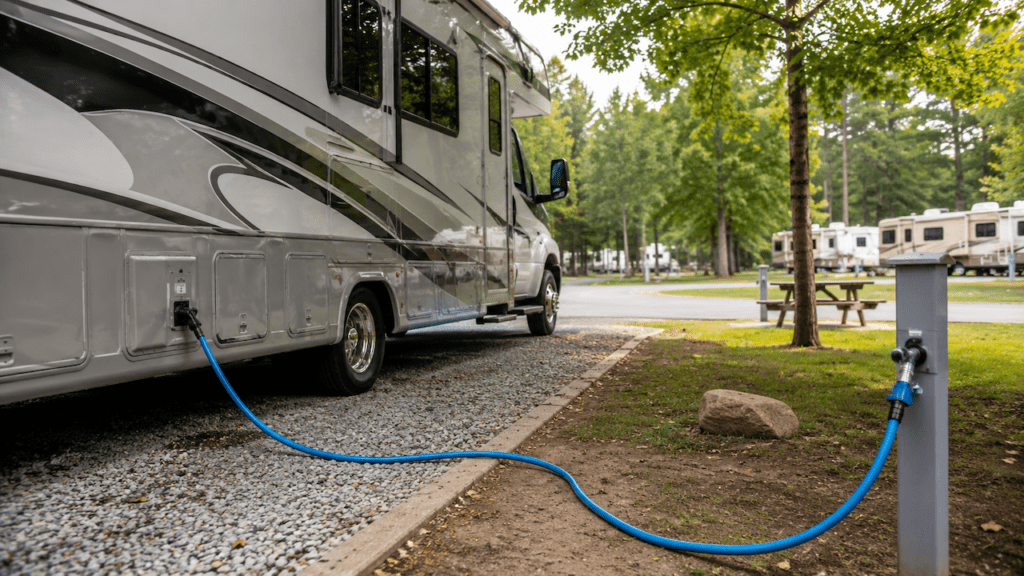
A pressurized water leak may occur whenever your pump operates. It can also happen while connected to campground city water.
The frustrating part is that the leak may remain hidden. Water often runs behind cabinets before reaching the visible floor.
By the time you feel softness underfoot, damage may already exist underneath.
A Leaking Sink Drain or P-Trap
Not every kitchen leak comes from the pressurized water system.
Your sink drain, basket connection, or P-trap can also leak. These leaks usually appear only while water flows through the drain.
That makes them particularly easy to miss during a quick inspection.
Fill the sink with some water, then let it drain. Watch every drain connection while the water flows through the pipes.
Run a dry paper towel around each fitting afterward. Even a small amount of moisture deserves attention.
Refrigerator or Ice-Maker Water Leakage
Your refrigerator area can also create hidden kitchen floor damage.
Some RV refrigerators use condensation drain tubes that route moisture outside. A cracked, blocked, or disconnected tube may release water inside instead.
Certain refrigerators also have ice-maker or drinking-water supply lines. These small lines can leak around connectors and valves.
You may never see a puddle on the finished floor.
Water can instead collect beneath the refrigerator cabinet. From there, it may slowly soak nearby flooring materials.
Check the refrigerator compartment if your soft spot sits nearby.
Rainwater Entering Around a Kitchen Window or Exterior Seam
The water damaging your kitchen floor may not come from plumbing.
Rainwater can enter around a poorly sealed window or exterior seam. Cracked sealant can allow surprisingly large amounts of moisture inside.
Water may then travel downward behind the interior wall panel.
Eventually, it reaches the floor and spreads beneath the finished surface.
This means a soft floor beside your kitchen wall may actually begin with a leak several feet higher.
Inspect nearby windows, exterior trim, roof edges, and wall penetrations carefully.
Water Getting In Around a Slide-Out
Pay special attention if your kitchen sits inside a slide-out.
Slide seals work hard every time the room moves inward or outward. They also face sunlight, rain, dust, and temperature changes.
Worn wiper seals can allow water past the slide opening. Damaged bulb seals can create similar problems.
Lower slide corners are especially worth inspecting.
Water entering there may travel underneath the flooring before becoming visible.
You may notice softness near the slide edge first.
Water Entering Through the Entry Door or Wheel-Well Area
Some RV kitchens sit close to the entry door or wheel well.
A leaking door seal can allow rainwater around the threshold. Poor exterior sealing may also let moisture enter around lower trim.
Wheel-well areas can create another potential path.
Road spray gets thrown against these areas whenever you drive through rain. Damaged sealant or underbelly material may allow moisture upward.
Check underneath your RV when the soft spot sits near an axle.
Look for torn material, damp insulation, stains, or damaged sealing.
Water-Damaged Plywood, OSB, or Luan
Water itself creates the leak, but the subfloor creates the softness.
Many RV floors contain plywood, OSB, luan, or similar wood products. These materials lose strength when moisture remains trapped inside them.
The wood fibers may swell first.
As exposure continues, bonded layers may separate. Eventually, sections can become soft, crumbly, or structurally weak.
This is why fixing only the plumbing leak may not solve everything.
The damaged flooring must still be inspected afterward.
Laminated Floor Delamination
Some RVs use lightweight laminated floor assemblies rather than thick plywood alone.
These floors are usually built from several bonded layers. Depending on the RV, they may include thin wood skins, foam, composite materials, and adhesives.
When those layers separate, the floor can feel springy.
You may notice movement even when everything appears completely dry.
Moisture can contribute to delamination, but it is not required.
Heat, age, repeated flexing, adhesive failure, and manufacturing issues can also weaken the bond.
Compressed or Damaged Foam Core
Some laminated RV floors use rigid foam inside the floor structure.
That foam helps provide insulation while keeping the RV lightweight.
However, repeated pressure can sometimes compress weakened sections. Once that happens, the upper floor layer may flex under your weight.
Kitchen walkways experience concentrated foot traffic every day.
The area directly in front of the sink is especially vulnerable. You may stand in nearly the same position repeatedly.
If the floor remains completely dry, compressed core material becomes more plausible.
Inadequate Support Between Floor Joists
Sometimes the flooring itself is still reasonably solid.
Instead, the problem may be insufficient support underneath.
Floor joists or aluminum framing members carry much of the load. The flooring can flex when the unsupported span becomes too wide.
This flex may be more noticeable in lightweight RV construction.
A floor that feels soft between two solid areas could indicate support problems.
However, you should still rule out moisture before assuming this cause.
Weakness Around a Furnace Vent or Floor Opening
Floor openings can create surprisingly weak areas.
Your RV floor may contain openings for furnace registers, plumbing, wiring, or ductwork. Cutting these openings removes some surrounding structural material.
If the opening sits between support members, nearby flooring may flex.
A soft spot immediately beside a heat register does not automatically mean rot.
Removing the register can sometimes provide a useful inspection opening.
You may see the floor layers without cutting new holes.
Repeated Foot Traffic in the Same Kitchen Area
RV kitchens often have narrow walkways and limited standing space.
That means your feet repeatedly load the same small floor area.
Common high-traffic spots include:
- Directly in front of the kitchen sink
- Between an island and surrounding cabinets
- Beside the refrigerator
- In front of the stove
- Near the entry doorway
Normal walking should not quickly destroy a healthy floor.
However, repeated loading can expose existing weakness, compressed foam, or poor bonding.
Is a Soft RV Kitchen Floor Always Caused by Water Damage?
No. Water damage should always be investigated first, but it is not the only possible cause.
A dry soft spot may result from delamination, compressed foam, insufficient support, or weakness around a floor opening.
The way the floor feels can provide useful clues.
A wet or mushy floor increases suspicion of moisture damage. A springy floor may point toward a laminated-floor problem.
A floor that flexes mainly between structural supports may have framing issues.
None of these clues provides a guaranteed diagnosis. You still need to inspect the surrounding structure before repairing anything.
Where Is the Soft Spot? Location Can Point to the Cause
The location of the soft area often tells you where to investigate. Use this table as a starting point rather than a final diagnosis.
| Soft Spot Location | Possible Cause | Where to Check First |
| In front of kitchen sink | Supply or drain leak | Sink cabinet and plumbing |
| Under refrigerator | Drain tube or water-line leak | Refrigerator compartment |
| Along exterior wall | Window or seam leak | Window frame and exterior sealant |
| Beside slide-out | Slide seal leakage | Slide corners and lower seals |
| Near furnace register | Weak opening or delamination | Remove register and inspect |
| Near entry door | Door seal leakage | Threshold and lower door frame |
| Above wheel well | Road spray or failed sealing | Wheel well and underbelly |
| Busy kitchen walkway | Foam compression or delamination | Floor structure underneath |
| Away from plumbing | Migrating hidden moisture | Trace outward from damaged area |
How Can You Tell Water Damage From Floor Delamination?
Water damage and delamination can feel similar underfoot. Look at several signs together before deciding what you are dealing with.
Signs the Floor May Be Water Damaged
Look for several moisture-related warning signs:
- Musty or damp odor
- Dark staining around flooring edges
- Swollen vinyl or wood
- Soft or crumbly exposed material
- Damp insulation underneath
- Rust around fasteners
- Visible mold or mildew
- Soft area gradually becoming larger
- Moisture inside nearby cabinets
One warning sign alone does not confirm rot.
Several signs appearing together make hidden moisture far more likely.
Signs It May Be Delamination or Foam-Core Failure
A dry laminated-floor problem often feels different.
Possible clues include:
- Springy movement beneath your foot
- No visible moisture or staining
- Floor rebounds after pressure is removed
- Hollow feeling beneath the surface
- Softness follows a high-traffic walkway
- Weakness appears beside a floor opening
- Moisture checks continue showing dry material
You still need to verify there is no hidden leak.
Signs the Floor May Lack Structural Support
Structural flex often occurs in a more defined pattern.
You may notice:
- Movement mainly between support points
- Softness following a floor seam
- Flex around a furnace register
- Dry, solid-looking flooring
- Similar movement present since the RV was newer
If the problem suddenly appears or gets worse, investigate further.
How to Find the Source of a Soft Kitchen Floor Before Cutting It Open
You can learn a surprising amount before removing finished flooring. Start with simple checks and move toward more invasive inspection only when needed.
1. Map the Entire Soft Area
Walk gently around the affected section.
Pay attention to where firm flooring changes into flexing flooring.
You can mark those boundaries with removable painter’s tape.
Do not jump or repeatedly stomp on the weak section.
Your goal is finding its approximate size without causing additional damage.
2. Empty the Sink Cabinet and Inspect Every Connection
Remove everything beneath your kitchen sink.
Use a flashlight and inspect:
- Hot water connection
- Cold water connection
- PEX fittings
- Faucet supply hoses
- Drain fitting
- P-trap
- Cabinet floor
Feel around each connection with dry paper towels.
Paper makes small leaks easier to notice.
3. Test the Pressurized Plumbing Separately
Next, check the water supply system.
Dry the cabinet first.
Turn on your RV water pump or use regulated city water. Watch the supply connections without draining water through the sink.
If moisture appears, the pressurized side becomes the likely source.
Remember that campground pressure can expose weak fittings.
4. Test the Sink Drain Separately
Now test only the drain system.
Fill the sink partway, then release the water.
Watch the basket fitting, drain pipe, P-trap, and downstream connections.
A drain leak might only appear during heavy water flow.
That explains why some kitchen leaks remain hidden for months.
5. Inspect the Refrigerator Area
Check beneath and behind the refrigerator where safely accessible.
Look for moisture, stains, disconnected drain tubing, or leaking water lines.
Also inspect the exterior refrigerator access compartment where applicable.
Rainwater can sometimes enter through poorly sealed exterior openings.
6. Inspect Nearby Windows, Slides, Doors, and Exterior Seams
Move outside and inspect the kitchen-side wall.
Look closely around:
- Windows
- Exterior trim
- Slide seals
- Lower slide corners
- Entry door
- Roof-to-wall seams
- Utility penetrations
Old sealant may crack, shrink, separate, or pull away.
Even a narrow gap can allow recurring moisture inside.
7. Look Through an Existing Floor Vent When Possible
A furnace register can sometimes become a convenient inspection opening.
Remove the register if it comes out easily.
You may be able to see:
- Floor thickness
- Foam core
- Wood layers
- Damp material
- Delamination
- Crumbling subfloor
This can prevent unnecessary cutting during early diagnosis.
8. Inspect the Underbelly and Wheel-Well Area
Look beneath the RV near the damaged location.
Check for:
- Sagging underbelly material
- Water trapped underneath
- Wet insulation
- Tears or punctures
- Failed wheel-well sealing
- Water stains
A leaking pipe can sometimes fill the enclosed underbelly before you notice anything inside.
9. Determine What Type of Floor Your RV Has
Before planning a repair, identify the floor construction.
Your RV may use plywood, OSB, composite panels, foam-core laminates, or another system.
Check your manufacturer’s construction information when possible.
You can also inspect an exposed edge around a vent.
Knowing the floor design helps you choose the correct repair method.
Can Water Travel Away From the Leak Before Making the Floor Soft?
Yes. Water inside an RV rarely stays exactly where it entered.
Moisture can travel along the subfloor, framing, insulation, or laminated layers. It may also move beneath continuous vinyl flooring.
That means the soft spot may not sit beneath the original leak.
For example, water entering around a window can run downward behind the wall. It may then spread several feet across the floor.
This is why checking only the area directly above the soft spot can miss the real problem.
Does a Soft Spot Mean the Entire RV Floor Is Rotten?
No. A soft spot can be very localized.
A small plumbing leak, weak vent opening, delamination, or compressed foam may affect only one section.
However, water damage can spread farther than you can feel.
The flooring may remain firm while moisture continues moving underneath.
That is why defining the damaged area requires more than walking over it.
You should inspect the surrounding floor before choosing repair boundaries.
How Serious Is a Soft Spot in an RV Kitchen Floor?
Some soft spots need immediate attention, while others develop slowly. The following signs can help you judge how urgent your situation may be.
Small, Dry, Stable Soft Spot
A small dry area may involve localized delamination or support issues.
You should still investigate it.
Monitor whether the area grows or changes over time.
A stable dry section is less alarming than a wet floor. However, that does not automatically make it structurally sound.
Soft Spot That Is Getting Larger
Expansion is an important warning sign.
A growing soft area may indicate:
- Continuing water intrusion
- Progressive wood rot
- Spreading delamination
- Ongoing structural fatigue
Do not keep postponing inspection when the damaged area expands.
Wet, Mushy, or Cracking Floor
This type of floor needs faster attention.
Wet or mushy material often indicates advanced moisture damage.
Reduce unnecessary traffic across the weak section.
Then locate and stop the water source as quickly as possible.
Floor Sagging Under Cabinets or Appliances
Sagging beneath heavy kitchen components deserves professional evaluation.
Kitchen islands, refrigerators, cabinets, and walls add significant concentrated weight.
A weakened floor may no longer provide adequate support.
Repair can also become more complicated when fixed cabinetry covers the damage.
What Happens If You Ignore a Soft RV Floor?
A soft spot rarely improves without addressing the underlying problem.
Ignoring it can lead to:
- Continued hidden water intrusion
- Larger areas of damaged subfloor
- Spreading delamination
- Mold or mildew growth
- Weakened appliance support
- Damaged cabinets or nearby walls
- Wet insulation inside the underbelly
- More expensive floor reconstruction later
Early diagnosis usually gives you more repair options.
What Type of Repair Does a Soft Kitchen Floor Need?
The correct repair depends completely on what caused the softness.
Water-damaged wood usually requires stopping the leak first. The area should then dry before damaged structural material is replaced.
Delaminated flooring may need bonding or sectional replacement. The best method depends on how the floor was manufactured.
Compressed foam may require rebuilding or reinforcing that floor section.
Insufficient structural support may require added framing or reinforcement where appropriate.
Avoid injecting foam, epoxy, wood hardener, or fillers immediately.
Those products may hide symptoms without solving the underlying cause.
You need to know what failed before choosing the repair.
When Should an RV Technician Inspect the Floor?
Some soft-floor problems quickly move beyond a simple DIY inspection.
Consider professional help when:
- The soft area is spreading quickly.
- Exposed wood is badly rotten.
- Widespread mold is present.
- The floor supports an island or refrigerator.
- Damage extends beneath fixed cabinetry.
- A slide-out structure is involved.
- Plumbing or wiring runs through the damaged area.
- You cannot identify the floor construction.
- Extensive underbelly removal is required.
- Your RV may still have structural warranty coverage.
A professional inspection can also prevent unnecessary floor demolition.
How Can You Prevent Another Soft Spot in the Kitchen?
Once the floor is repaired, prevention becomes much easier. Regular inspection can catch tiny leaks before they damage structural materials.
- Look beneath the kitchen sink regularly.
- Feel plumbing connections for moisture.
- Check drain fittings while water runs.
- Inspect refrigerator drains where applicable.
- Inspect refrigerator water lines where equipped.
- Maintain exterior windows and wall sealant.
- Check slide seals and lower corners.
- Dry spills immediately around cabinets.
- Control excessive interior humidity.
- Inspect wheel-well sealing periodically.
- Check underbelly material for damage.
- Investigate new floor flex as soon as you notice it.
Five minutes of inspection can prevent a much larger repair later.
Final Words
A soft spot in your RV kitchen floor deserves attention, but it does not automatically mean the entire floor is rotten.
Start by checking the kitchen sink, plumbing, refrigerator, exterior seals, and slide area. Then determine whether the floor is actually wet.
If everything stays dry, investigate delamination, compressed foam, weak support, and nearby floor openings.
The most important rule is simple: find the cause before repairing the floor.
Fixing only the soft surface can leave the real problem underneath. Once you understand why the floor failed, you can choose a repair that actually lasts.
Related FAQs
Can an RV Floor Have a Soft Spot Without a Water Leak?
Yes. A completely dry soft spot can result from laminated-floor delamination, compressed foam, weak structural support, adhesive failure, or repeated loading in a high-traffic area.
Why Is My RV Floor Soft Only in Front of the Kitchen Sink?
The area in front of the sink experiences heavy foot traffic and sits close to several plumbing connections. Check supply lines, drain fittings, the P-trap, and the subfloor beneath the cabinet before assuming normal wear caused it.
Can a P-Trap Leak Cause a Soft RV Floor?
Yes. A loose or cracked P-trap can leak whenever water drains from the sink. Because the leak may only happen during sink use, it can remain unnoticed while slowly damaging the floor below.
Can an RV Refrigerator Cause a Soft Floor?
Yes. Refrigerator condensation drains, exterior compartments, and water lines on equipped models can release moisture near the floor. Hidden water can then spread beneath cabinetry and finished flooring.
How Do I Know If My RV Subfloor Is Rotten?
Rotten subflooring may feel mushy, crumble when probed, smell musty, or show dark staining and swelling. However, you usually need access to the floor layers to confirm the actual condition.
What Does RV Floor Delamination Feel Like?
Delamination often feels springy, bouncy, or slightly hollow underfoot. The surface may move downward and rebound even though the surrounding materials appear dry.
Can Foam Inside an RV Floor Become Compressed?
Yes. Foam-core flooring can lose support if the foam becomes damaged or compressed. Repeated loading in narrow walkways can make existing weaknesses increasingly noticeable.
Why Is My RV Floor Soft Around a Furnace Vent?
The opening for a furnace register removes part of the surrounding floor material. Poor support, delamination, or moisture near that opening can create localized flex around the vent.
Can Water Travel Under RV Vinyl Flooring?
Yes. Water can move beneath continuous vinyl flooring and spread across the subfloor. The visible soft area may therefore be several feet away from the original leak.
Will a Soft Spot Keep Getting Bigger?
It can. Active leaks, continuing rot, delamination, and structural fatigue may cause the damaged area to expand. A growing soft spot should be investigated promptly.
Can You Repair One Section of an RV Floor?
Yes, localized floor sections can often be repaired when the surrounding structure remains solid. The repair method depends on your RV’s floor construction and the extent of hidden damage.
Should I Walk on a Soft RV Floor?
Limit unnecessary loading until you understand the cause. A mildly flexible area may remain usable, but wet, sagging, cracking, or severely soft flooring should not be repeatedly stressed.

Gregory Allen covers outdoor RV camping, essential gear, and travel preparation. His reviews are based on real conditions, not spec sheets alone. He helps RVers choose equipment that works reliably in everyday outdoor use.