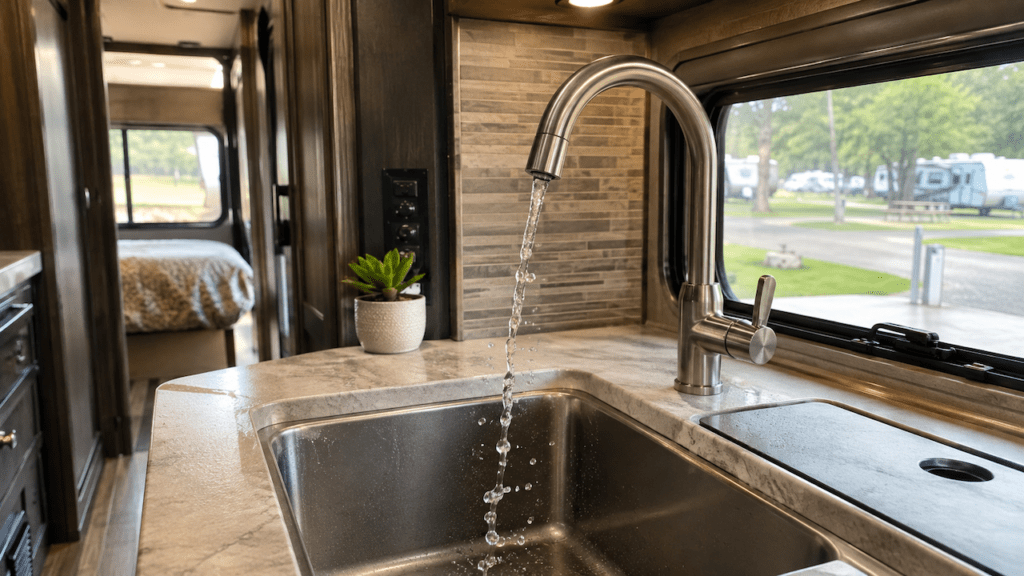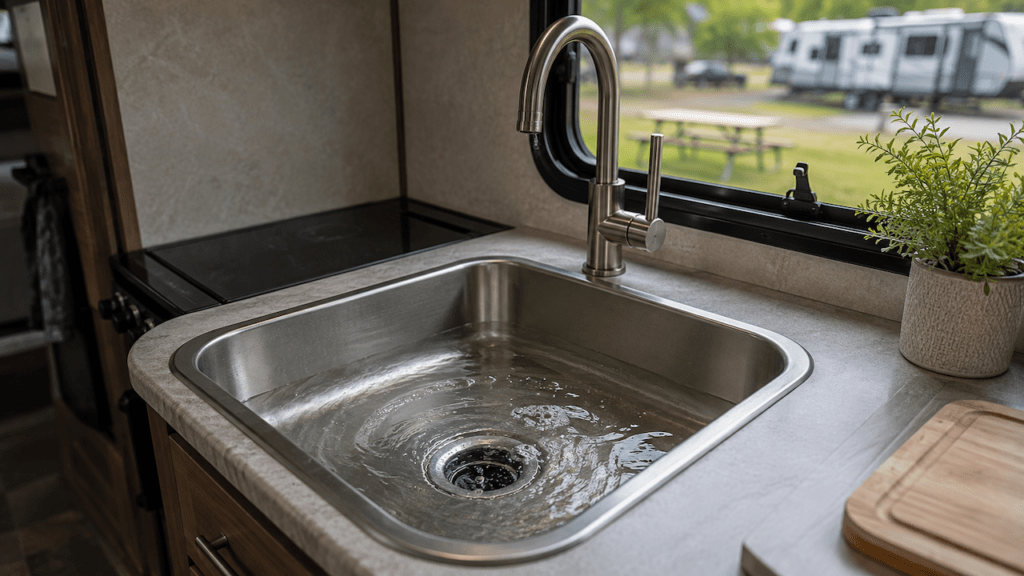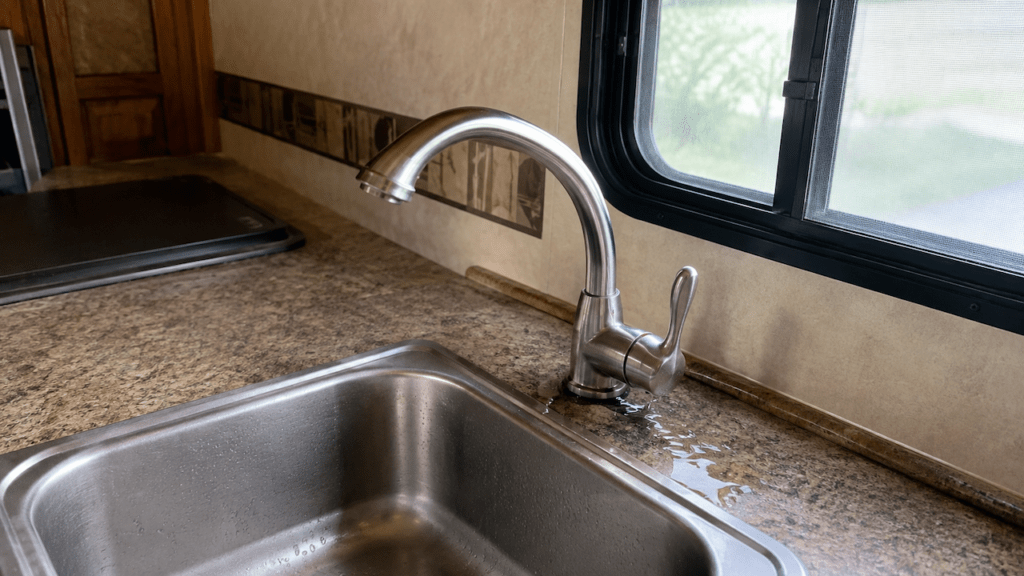
Your RV faucet usually drips after the water pump stops because the faucet cartridge or internal seal is letting pressurized water pass through the closed valve. A few drops can also come from water trapped inside a high-arc spout. If the dripping continues, though, I would treat it as a small plumbing leak rather than normal drainage.
The good news is that you can usually narrow this down without replacing parts at random. I’ll show you how to tell harmless leftover water from a bad cartridge, debris, pressure trouble, or water-heater expansion.
Key Takeaways
- A few drops that stop quickly may simply be leftover spout water.
- Steady dripping usually points to a worn cartridge, seal, washer, or valve seat.
- Your RV plumbing stays pressurized even after the pump shuts off.
- A leaking faucet can eventually make the water pump cycle back on.
- Debris inside the valve can keep a perfectly usable cartridge from sealing.
- Dripping that appears mainly after heating water may involve thermal expansion.
- Do not adjust pump pressure before confirming the faucet itself is healthy.
Why Does an RV Faucet Keep Dripping After the Pump Shuts Off?
The part that often causes confusion is the pump itself. When your RV water pump stops running, the plumbing does not suddenly lose its water pressure.
A demand pump runs until the plumbing reaches its shutoff pressure. Depending on the pump, that can be somewhere around the normal RV pressure range. The pump then switches off, but the water between the pump and your fixtures stays under pressure.
When you close a healthy faucet, its internal valve blocks that pressurized water.
If the cartridge, washer, seal, or valve seat does not close completely, that pressure slowly pushes water through the faucet. You see it as a drip from the spout even though the pump is no longer running.
That is why the timing can be misleading.
The pump stopping did not cause the leak. It simply built enough pressure for an existing weak seal to become noticeable.
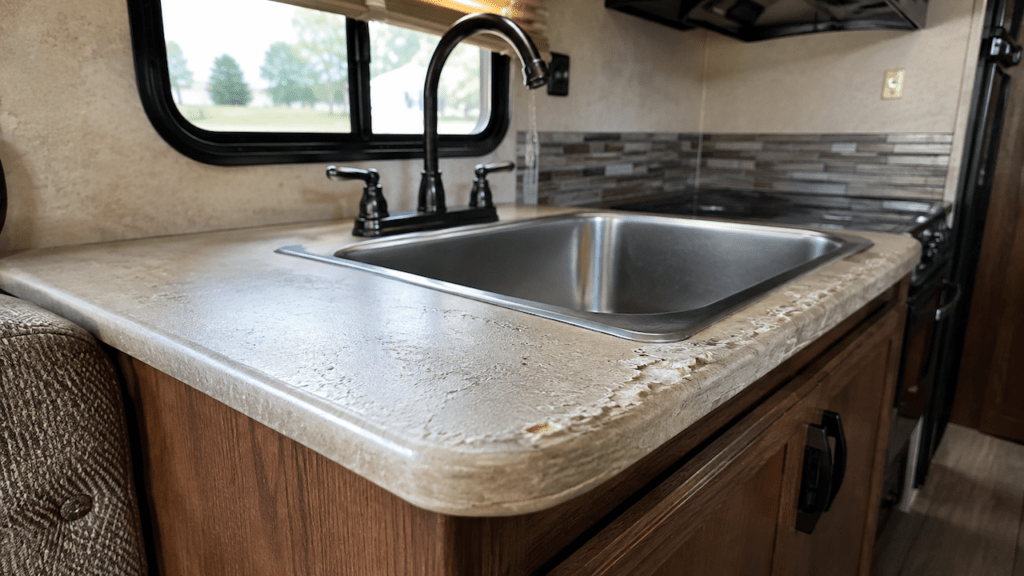
There is one exception worth knowing. Tall gooseneck and high-arc faucets can hold a small amount of water inside the spout. That leftover water may drain after the faucet closes, even when the internal valve is working correctly.
Is a Few Drips After Turning Off an RV Faucet Normal?
A few drops can be normal, especially with a tall kitchen faucet. The important question is how long the dripping continues and whether new pressurized water is entering the spout.
If you get three, five, or perhaps several drops immediately after shutting off the faucet, then everything becomes completely dry, you may simply be seeing water drain from the neck of the faucet.
I become more suspicious when the faucet:
- keeps dripping for several minutes;
- never completely stops;
- drips again after sitting quietly;
- causes the pump to restart later;
- drips faster when the water heater is hot;
- suddenly starts dripping after previously working normally.
Those patterns suggest more than leftover water.
If the faucet continues receiving tiny amounts of water after its valve should be closed, you need to find out why.
What Is Causing My RV Faucet to Drip After the Pump Stops?
The drip pattern can tell you a lot. Short-lived dripping often comes from water already inside the spout. Continuous dripping usually means pressurized water is getting past something that should be sealing it off.
Worn or Damaged Faucet Cartridge
A worn cartridge is one of the first things I would suspect on a single-handle RV faucet.
The cartridge controls how water enters and exits the faucet. When you move the handle to the off position, sealing surfaces inside the cartridge should completely block both hot and cold water.
Those surfaces can eventually wear, crack, distort, or become scratched.
Once that happens, even a tiny gap is enough for system pressure to push water toward the spout.
You may notice the drip is worse after the pump has just pressurized the system. It may then slow as pressure falls.
If your faucet has been in service for years and the dripping has gradually become worse, the cartridge deserves close attention.
Worn O-Rings, Washers, Seats, or Springs
Not every RV faucet uses the same internal design.
Some faucets rely heavily on a cartridge. Others use washers, valve seats, springs, O-rings, or combinations of these parts.
Rubber parts can become:
- hard;
- flattened;
- cracked;
- torn;
- swollen;
- permanently compressed.
A damaged washer may look fine at first glance but still fail to seal under pressure.
If you have a two-handle faucet, worn washers or valve seats may be more likely than on a modern single-handle design.
The key is to identify the faucet design before ordering replacement parts.
Water Trapped Inside a High-Arc Spout
This is the harmless possibility, and it is easy to mistake for a leak.
A tall faucet neck can hold a small column of water above the valve. Gravity continues pulling that water downward after you close the handle.
You may get a few delayed drops as the water works its way out.
Here is the important distinction:
Trapped spout water has a limited volume. Eventually it should stop.
A leaking valve can keep supplying new water to the spout.
So if you wipe everything dry and the faucet continues producing drops for many minutes, I would stop blaming the shape of the spout.
Dirt or Mineral Debris Preventing the Valve From Closing
Sometimes the faucet itself is not worn out.
A tiny particle can get caught between sealing surfaces and create a small path for water.
Possible debris includes:
- mineral scale;
- campground-water sediment;
- tiny PEX or plastic particles;
- residue loosened during sanitizing;
- debris disturbed during plumbing repairs;
- particles released during winterizing or dewinterizing.
This can explain why a faucet that worked perfectly yesterday suddenly starts dripping today.
If the problem began immediately after plumbing work, flushing the system, sanitizing the fresh tank, or reconnecting water after storage, debris moves much higher on my suspect list.
Higher-Than-Normal System Pressure
High pressure can make a weak faucet leak more noticeably.
However, I would not assume your pump pressure is the problem just because the faucet drips.
A healthy faucet should normally remain closed at the pressure its RV plumbing system was designed to handle.
Pressure becomes more interesting when:
- you recently changed the water pump;
- someone adjusted the pump;
- multiple fixtures started leaking together;
- water flow suddenly feels unusually aggressive;
- fittings begin weeping;
- the problem appeared after changing plumbing components.
In those cases, checking actual pressure with a gauge makes more sense than guessing.
Water Heater Thermal Expansion
This is an overlooked cause.
When water inside a tank-style RV water heater heats up, it expands. In a closed plumbing system, that expansion can raise pressure.
Normally, the system has ways to accommodate this.
If the pressure rises enough, though, the weakest seal in the plumbing may start showing symptoms. Sometimes that weak point is the faucet cartridge.
You may notice:
- the faucet is dry when the water heater is cold;
- dripping starts after the heater finishes a heating cycle;
- the first burst of water feels stronger than normal;
- another pressure-related leak appears;
- a water-heater relief valve also shows unusual weeping.
If the dripping clearly follows water-heating cycles, I would investigate thermal expansion before replacing cartridges repeatedly.
RV Faucet Dripping Symptoms and What They Usually Mean
You do not have to dismantle the faucet immediately. Start by matching what you are seeing with the likely cause below.
| What You Notice | Most Likely Cause | Quick Test | First Thing to Check |
| A few drops, then completely dry | Water trapped in the faucet spout | Leave faucet untouched and watch it | Usually nothing |
| Dripping continues for minutes | Internal faucet leak | Release plumbing pressure | Cartridge or seals |
| Dripping stops after pressure release | Pressure-driven valve leak | Open another faucet with pump off | Cartridge, washer, seat |
| Pump starts again after several minutes | System is losing pressure | Close all fixtures and listen | Faucet and other leaks |
| Problem began after winterizing | Debris inside valve | Flush faucet and inspect cartridge | Cartridge sealing surface |
| Drips mainly after water heats | Thermal expansion | Compare cold and hot conditions | Water-heater pressure behavior |
| Began after installing a new pump | Pressure may differ from old pump | Test static pressure | Pump specifications |
| Only one faucet has the problem | Local fixture issue | Compare other faucets | That faucet |
| Several fixtures begin leaking | System pressure issue more likely | Measure water pressure | Pump/system pressure |
Do This 60-Second Test Before Taking the Faucet Apart
This is the first test I would do. It helps separate water left inside the faucet from water being pushed through a leaking valve.
Step 1: Turn the Water Pump Off
Switch off the RV water pump.
Make sure you are not connected to city water during this test. Otherwise, city water can keep the plumbing pressurized and confuse the result.
Step 2: Watch the Dripping Faucet
Do not touch anything for a short period.
See whether the faucet:
- stops after a few drops;
- continues dripping steadily;
- slows but never completely stops.
Make a mental note of the pattern.
Step 3: Release the Plumbing Pressure
With the pump still off, briefly open another faucet.
Let the trapped pressure escape.
You do not need to drain the entire fresh-water system. You just want to remove pressure from the plumbing.
Then close that second faucet.
Step 4: Watch the Problem Faucet Again
Now check the original faucet.
If the dripping stopped immediately after you released pressure, the faucet valve was probably allowing pressurized water through.
That makes the cartridge, washer, seat, or internal seal your leading suspect.
If a few more drops still come out despite the system being depressurized, they may simply be water sitting inside the spout.
This simple test can save you from replacing a pump that was never the problem.
How to Fix an RV Faucet That Keeps Dripping
Start with the simplest checks and work inward. There is little reason to replace an entire faucet before inspecting the parts responsible for shutting the water off.
Step 1: Shut Off the Pump and Relieve Water Pressure
Turn off your RV water pump.
If city water is connected, disconnect it or shut it off.
Open a faucet until pressure is released.
If you will be working around the hot-water side, turn the water heater off and make sure you are working under safe conditions.
Never disassemble a pressurized hot-water system.
Step 2: Remove the Aerator and Flush Loose Debris
Unscrew the aerator from the end of the faucet if it is removable.
Inspect the screen for:
- sand;
- scale;
- plastic debris;
- sediment.
Rinse it thoroughly.
A dirty aerator usually does not explain why a closed valve allows water through. The aerator sits downstream from the shutoff valve.
However, finding debris in the aerator tells you there may also be debris around the cartridge.
With the aerator removed, briefly flushing the faucet can help push loose particles out.
Step 3: Remove and Inspect the Cartridge
The exact procedure depends on your faucet.
Usually, you remove a handle cap or screw, lift the handle, and access the retaining hardware holding the cartridge.
Take a photo before disassembling anything. That little step makes reassembly much easier.
Inspect the cartridge closely.
Look for:
- damaged rubber seals;
- cracks;
- scratches;
- mineral deposits;
- distorted sealing surfaces;
- debris lodged around ports;
- hardened O-rings.
If you have a two-handle faucet, inspect the appropriate stem, washer, and seat instead.
Do not assume every RV faucet uses the same cartridge.
Step 4: Clean or Replace the Cartridge and Seals
If the cartridge looks physically healthy but has visible dirt or mineral buildup, cleaning may solve the problem.
Rinse away loose debris carefully.
Avoid aggressively scratching sealing surfaces.
If rubber seals are cracked, hardened, cut, or permanently flattened, replacement is usually the better choice.
A cracked cartridge body should also be replaced.
When buying parts, match the cartridge by:
- faucet manufacturer;
- model number;
- cartridge dimensions;
- stem shape;
- port layout.
Taking the old part with you can make matching much easier.
Step 5: Reassemble and Pressure-Test the Faucet
Reinstall the cartridge and handle.
Close the faucet.
Turn the pump back on and let it run until it shuts off naturally.
Now leave everything untouched.
Watch the faucet for several minutes.
A successful repair should give you:
- no continuous dripping;
- no unexplained pump cycling;
- no leaks around the handle;
- no leaks underneath the sink.
A couple of initial spout drops may still be normal depending on the faucet design.
What If the Faucet Still Drips After Replacing the Cartridge?
If a new cartridge does not solve the problem, do not immediately install another one. At this point, I would widen the diagnosis to pressure, valve-body condition, and the rest of the RV plumbing system.
Measure the Pump’s Actual Water Pressure
Use an appropriate water-pressure gauge and compare your reading with the specifications for your particular pump and RV.
Do not rely on one universal pressure number.
Many RV systems operate somewhere around the 40 to 55 PSI range, but the exact pump shutoff pressure varies by model.
If measured pressure is substantially higher than specified, investigate why.
Do not blindly turn adjustment screws on the pump.
Some pump adjustments interact with internal bypass settings, and incorrect adjustments can create new cycling or shutdown problems.
Check Whether the Water Heater Is Creating a Pressure Spike
Let the water heater cool and test the faucet.
Then operate the water heater normally and check again after the water becomes fully hot.
If the faucet only begins dripping when the water is hot, thermal expansion becomes a stronger possibility.
That does not automatically mean the water heater is defective.
It means the plumbing pressure behavior changes as the stored water heats.
Follow the water-heater manufacturer’s procedure for checking or restoring the proper air cushion if applicable to your system.
Check the Faucet Valve Body
A perfect new cartridge cannot always fix a damaged faucet body.
The cartridge seals against surfaces inside the fixture.
If the valve housing itself is cracked, deformed, badly scaled, or damaged, replacing the faucet may make more sense than continuing to rebuild it.
Check for Other Pressure-Side Leaks
If your pump also cycles periodically, make sure the faucet is actually the only leak.
Check:
- toilet valve;
- bathroom faucet;
- shower controls;
- outside shower;
- water-heater fittings;
- PEX connections;
- low-point drains;
- pump fittings;
- fresh-water plumbing connections.
One tiny leak can slowly lower system pressure.
Can an RV Water Pump Cause the Faucet to Drip?
Usually, the pump is not the direct cause.
The pump creates pressure. The faucet is supposed to hold that pressure when it is closed.
If only one faucet drips while every other fixture remains dry, I would inspect that faucet before blaming the pump.
The pump becomes more suspicious if:
- the pressure is actually above specification;
- a different pump was recently installed;
- someone adjusted its pressure setting;
- several fixtures develop leaks together;
- the pump behaves abnormally.
Also remember that a failing pump check valve causes a different type of problem.
A bad check valve may allow pressure to fall or water to move backward. It does not normally force water through a faucet whose internal shutoff valve is sealing correctly.
Why Does the Water Pump Turn Back On After the Faucet Starts Dripping?
This behavior actually helps confirm that you have a pressure leak.
Here is what happens:
The pump runs and builds pressure.
Then it reaches its shutoff point and stops.
The faucet continues leaking a tiny amount of water.
As water escapes, system pressure slowly drops.
Eventually, pressure falls low enough for the pump to switch on again.
The pump runs briefly, restores pressure, and shuts off.
Then the cycle repeats.
So when a pump runs every few minutes, the pump itself may be responding correctly.
The real issue may be a dripping faucet somewhere in the system.
If repairing the faucet stops the cycling, you have likely found the pressure loss.
Could the RV Water Heater Be Making the Faucet Drip?
Yes, but usually indirectly.
Water expands as it heats.
Inside an RV’s closed plumbing system, that expansion can raise pressure after the water heater runs.
If the faucet cartridge already has a weak seal, the increased pressure may make the drip appear or become worse.
This is especially worth investigating when:
- the faucet stays dry with cold water;
- dripping begins after the water heater heats;
- the drip is worse in the morning after a heating cycle;
- the first faucet opening releases a strong burst;
- pressure symptoms affect more than one fixture.
If you have a tank-style water heater, check the manufacturer’s instructions regarding the designed air pocket.
Do not open a hot pressurized water heater or pressure-relief component while the system is unsafe to service.
Should I Adjust My RV Water Pump Pressure to Stop the Drip?
I would not start there.
If one faucet leaks and the other fixtures are fine, changing pump pressure treats the symptom rather than the most likely cause.
Fix the faucet first.
Then measure pressure if the problem remains.
Only adjust the pump if:
- measured pressure is outside specification;
- your pump manufacturer allows field adjustment;
- you understand exactly which adjustment you are making.
Reducing pressure to hide a worn cartridge is not a proper repair.
Likewise, increasing or changing the wrong pump setting can lead to poor shutdown behavior, rapid cycling, or excessive plumbing stress.
Should I Repair or Replace the RV Faucet?
Both options make sense in the right situation. I usually base the decision on the condition of the faucet body and whether the correct replacement parts are easy to obtain.
Repair the Faucet When:
- the correct cartridge is available;
- the fixture body is still solid;
- the leak has one obvious internal cause;
- the faucet is otherwise in good condition;
- the repair parts are inexpensive.
A cartridge replacement can often restore a good faucet without much work.
Replace the Faucet When:
- the plastic faucet body is cracked;
- the cartridge is unavailable;
- replacement cartridges keep failing;
- the valve body is damaged;
- several internal parts are worn;
- the original fixture is inexpensive and badly aged.
Many RV owners eventually replace lightweight factory faucets with better residential-style fixtures.
That can work well, but do not assume every household faucet fits every RV.
Check:
- mounting-hole spacing;
- countertop clearance;
- cabinet clearance;
- supply-line connections;
- faucet height;
- spout reach;
- hose routing.
A five-minute measurement can prevent a frustrating installation.
When Should I Worry About a Dripping RV Faucet?
A very occasional residual drop is usually not urgent. Continuous dripping, pressure loss, or leaks around the fixture deserve attention because RV water systems can hide damage in cabinets and wall cavities.
Pay closer attention when:
- dripping never completely stops;
- the pump runs while no fixture is open;
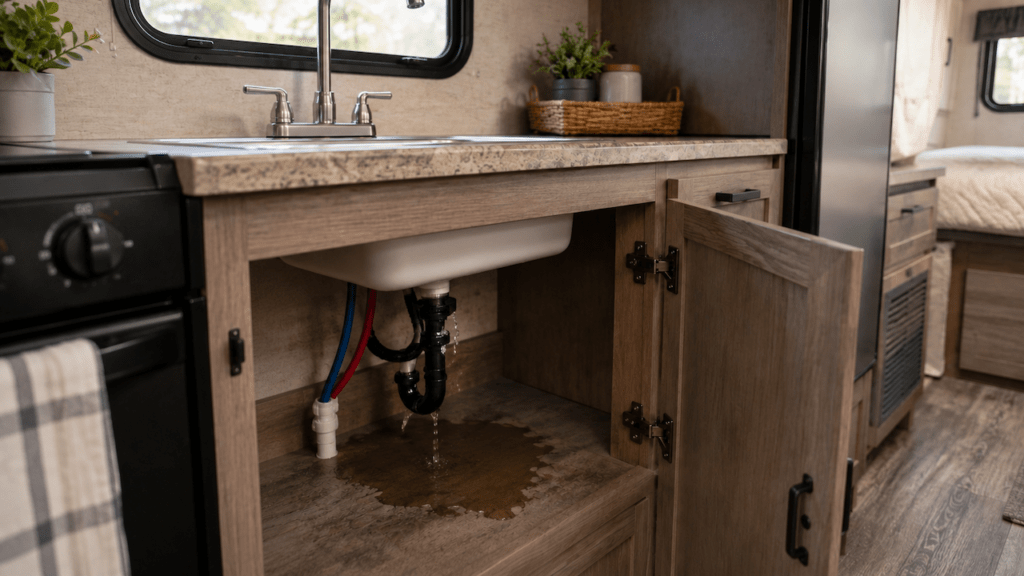
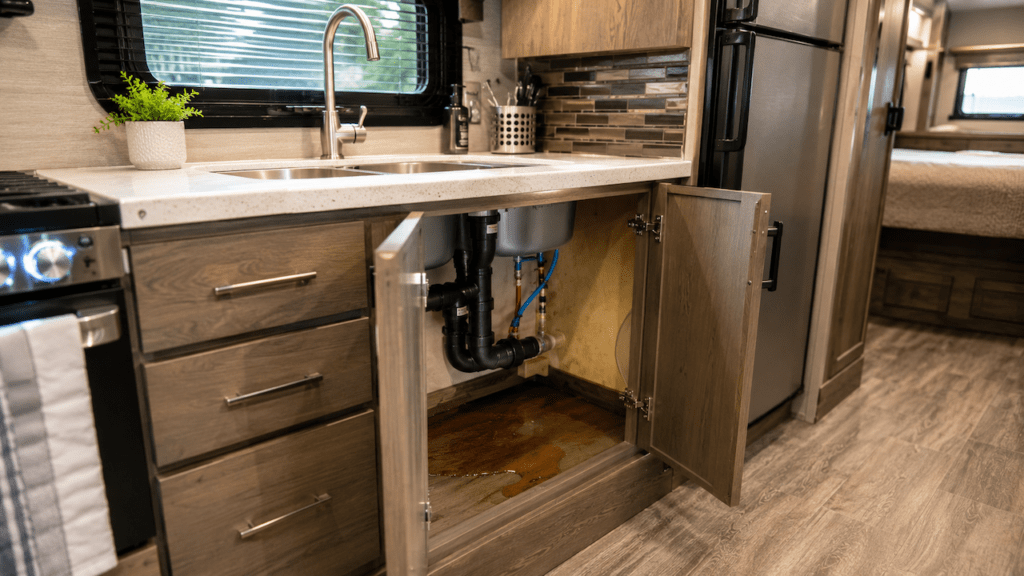
- water appears under the sink;
- cabinet flooring becomes damp;
- several plumbing fittings start leaking;
- pressure suddenly feels unusually high;
- dripping becomes worse after heating water;
- the faucet body itself is cracked;
- you will leave the RV unattended.
If you leave the RV for an extended period, switching off the water pump is a sensible precaution.
That prevents the pump from continuously feeding water into a leak if a fitting or hose fails while you are away.
Final Words
If your RV faucet gives you only a few delayed drops and then becomes completely dry, you may simply be seeing water drain from a high-arc spout.
But if the faucet continues dripping after the pump stops, start by turning the pump off and releasing system pressure. If that immediately stops the dripping, inspect the faucet cartridge, washer, or internal seal before touching pump adjustments.
When the problem appears mainly after the water heater runs, add thermal expansion to your troubleshooting list. When the pump cycles as well, remember that the pump may simply be reacting to pressure lost through the leaking faucet.
Work through those clues in that order, and you can usually find the actual problem without replacing half of your RV plumbing system.
Related FAQs
Is It Normal for an RV Faucet to Drip After Turning It Off?
A few drops can be normal when water remains inside a high-arc or gooseneck spout. Continuous dripping for several minutes is different and usually means water is getting past the faucet’s internal valve.
Why Does My RV Water Pump Run Every Few Minutes With No Faucet Open?
The plumbing is probably losing pressure somewhere. A dripping faucet, toilet valve, loose fitting, low-point drain, water-heater connection, or another small leak can lower pressure enough to make the pump restart.
Can a Bad Faucet Cartridge Make My RV Water Pump Cycle?
Yes. A leaking cartridge allows water to escape after the pump shuts off. As system pressure falls, the pump eventually reaches its restart pressure and turns on again.
Why Does My RV Faucet Drip More When the Hot Water Is On?
Heat can make worn faucet seals behave differently, and heated water also expands inside the plumbing system. If dripping mainly appears after the water heater runs, check both the faucet cartridge and system pressure behavior.
Will an Accumulator Tank Stop My RV Faucet From Dripping?
An accumulator tank can smooth pressure changes and reduce frequent pump cycling, but it should not be used to hide a leaking faucet cartridge. If water is passing through a closed valve, the valve still needs repair.
Can High Water Pressure Damage an RV Faucet?
Yes. Excessive pressure can stress cartridges, seals, plastic faucet bodies, PEX fittings, and other plumbing parts. Measure the actual pressure and compare it with your RV and pump specifications before assuming pressure is the cause.
Why Does My Faucet Still Drip With the RV Water Pump Turned Off?
Turning off the pump does not instantly remove pressure already stored in the plumbing. That trapped pressure can continue pushing water through a weak faucet valve until you release the pressure or it slowly falls.
Do I Need to Replace the Whole RV Faucet if It Drips?
Not necessarily. If the faucet body is sound and the correct cartridge, washer, or seal is available, repairing it is usually enough. Replacement makes more sense when the body is cracked, badly worn, or parts cannot be found.

Gregory Allen covers outdoor RV camping, essential gear, and travel preparation. His reviews are based on real conditions, not spec sheets alone. He helps RVers choose equipment that works reliably in everyday outdoor use.