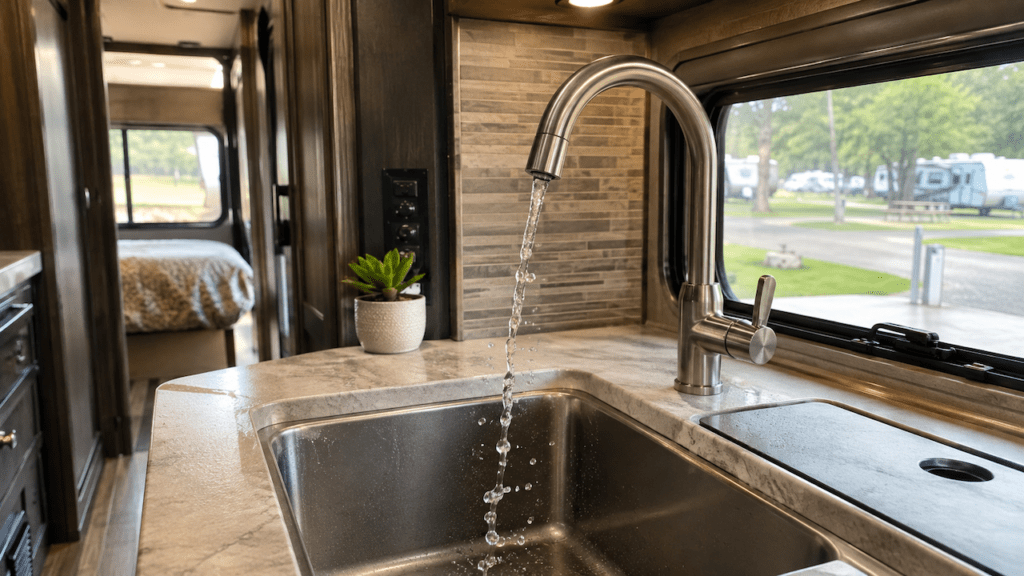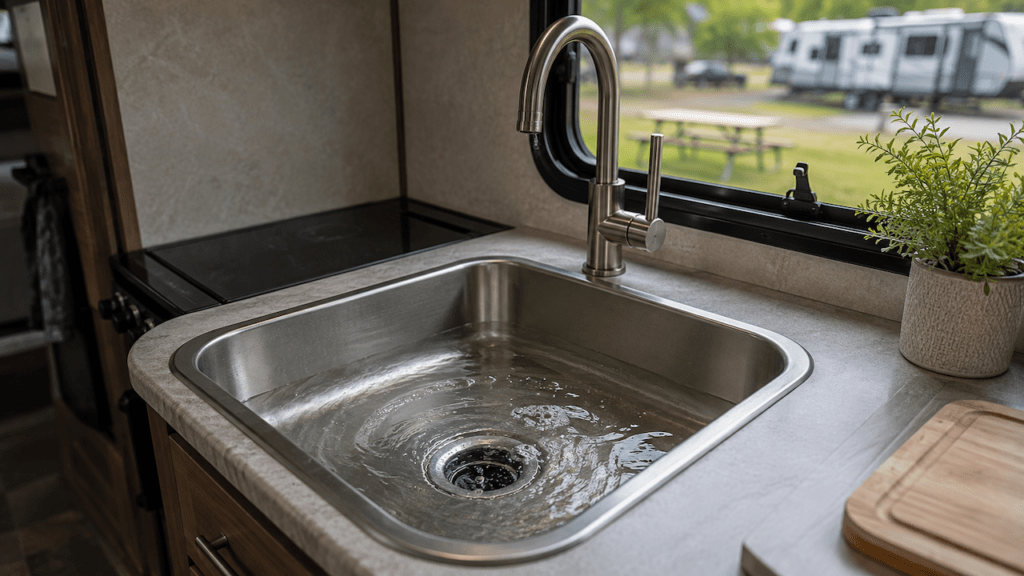
Water usually returns to your RV sink after draining because wastewater cannot keep moving freely toward the holding tank. A partial drain clog, full gray or galley tank, blocked tank vent, sagging flexible drain hose, or poor pipe slope can let water drain briefly before it rises toward the sink again.
The good news is that you can usually narrow this problem down without dismantling the whole plumbing system. I’ll walk you through what each symptom means, what to check first, and how to fix the most common causes.
Key Takeaways
- Check the gray or galley tank before taking plumbing apart.
- A partial clog can drain briefly before water rises again.
- Multiple affected fixtures can point toward tank or vent trouble.
- A separate kitchen galley tank may be full unexpectedly.
- Slide-out kitchens can develop sagging or kinked drain hoses.
- Gurgling often appears with restrictions or poor tank venting.
- Water inside a P-trap is normal. Water returning into the basin is not.
- Do not automatically replace the under-sink air admittance valve.
- Start with simple checks before opening walls or underbelly panels.
What Does It Mean When Water Drains and Then Comes Back Up?
When water disappears from your RV sink and then rises again, something farther downstream is usually slowing or stopping its movement. The first rush of water may have enough force to pass through part of the drain. Once that water reaches the restriction, tank, or trapped section of pipe, it can begin backing toward the sink.
This symptom is different from a sink that never drains.
A completely blocked drain may leave standing water immediately. A partial blockage often lets the sink empty at first. Water then returns as the drainpipe fills behind the restriction.
Airflow can also influence how well an RV drain works. Wastewater entering a gray tank displaces air inside that tank. If the tank cannot vent properly, drainage can become slow, uneven, or noisy.
One thing I do not want you to mistake for a problem is the water inside a normal P-trap. A traditional P-trap intentionally holds a small amount of water. That water blocks odors from traveling back into your RV.
If water actually rises into the sink basin again, that is different. You have a drainage problem worth investigating.
What Your RV Sink Symptoms Usually Point To
You can often save yourself plenty of unnecessary work by watching exactly how the sink behaves. The pattern usually tells you which part of the plumbing deserves attention first.
| What You Notice | Most Likely Cause | First Thing to Check |
| Sink drains, then slowly rises again | Partial drain restriction | P-trap and downstream drainpipe |
| Sink stops draining after several gallons | Full gray or galley tank | Correct holding tank and dump valve |
| Shower also begins backing up | Full shared gray tank | Gray tank capacity |
| Drain gurgles while emptying | Restriction or venting problem | Drain line, then tank vent |
| Sink works better with gray valve open | Tank-side flow or venting issue | Gray tank vent and tank plumbing |
| Only the kitchen sink has trouble | Local clog, hose problem, or galley tank | Kitchen drainage system |
| Monitor says empty but sink backs up | Sensor error or wrong tank dumped | Verify actual tank and valve |
| Problem started after moving the slide | Flexible drain hose kink or sag | Slide-out plumbing |
| P-trap is clean but water still returns | Downstream blockage or trap issue | Drain line beyond the trap |
Most Common Reasons Water Returns to an RV Sink
Several problems can create almost identical symptoms. I recommend checking them in a sensible order instead of replacing parts randomly.
The Gray Water Tank Is Full
A full gray tank is one of the simplest explanations.
Your sink cannot continue draining if the tank has nowhere to accept more wastewater. Once the tank fills near its inlet, water can begin moving backward through the connected plumbing.
You may notice other clues as the tank fills.
The shower might drain slowly. The bathroom sink may gurgle. Water can appear in the shower pan because it is often one of the lowest fixtures connected to the tank.
Do not depend entirely on your monitor panel.
RV tank sensors commonly become coated with soap residue and debris. The display can show an inaccurate level.
If you are unsure, dump the correct gray tank and test the sink again.
If the sink immediately drains normally, you likely found the cause.
Your Kitchen May Have a Separate Galley Tank
This one catches many RV owners by surprise.
Some travel trailers and fifth wheels have more than one gray tank. The bathroom may drain into one tank while the kitchen drains into a separate galley tank.
That means you can empty one gray tank completely and still have kitchen wastewater backing up.
Look underneath your RV for another termination valve. You can also check your owner’s manual or plumbing diagram.
If your sink keeps backing up even though you just dumped the gray tank, make sure you did not overlook a separate kitchen tank.
This is one of the first things I would check on larger trailers and fifth wheels.
There Is a Partial Clog in the P-Trap or Drain Line
A partial clog fits this symptom extremely well.
Food particles, grease, soap residue, coffee grounds, and other debris can slowly narrow the drain passage.
Water may still move through the pipe at first. Once the restricted section fills, drainage slows enough for water to rise toward the sink again.
You might also notice:
- Slow drainage before the water returns
- Gurgling from the drain
- Greasy residue around the sink opening
- Better drainage when only small amounts of water are used
- Water backing up faster during heavy dishwashing
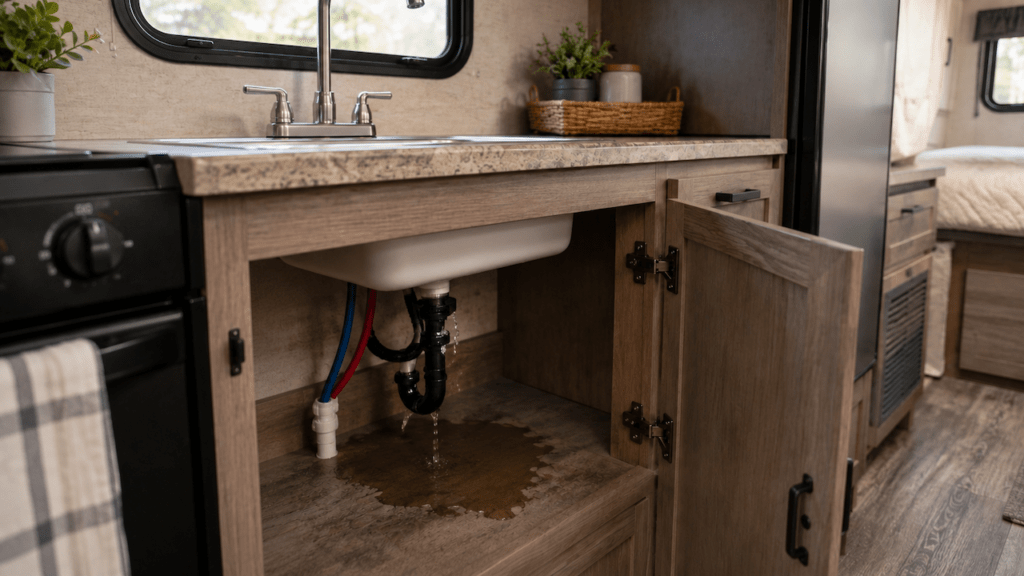
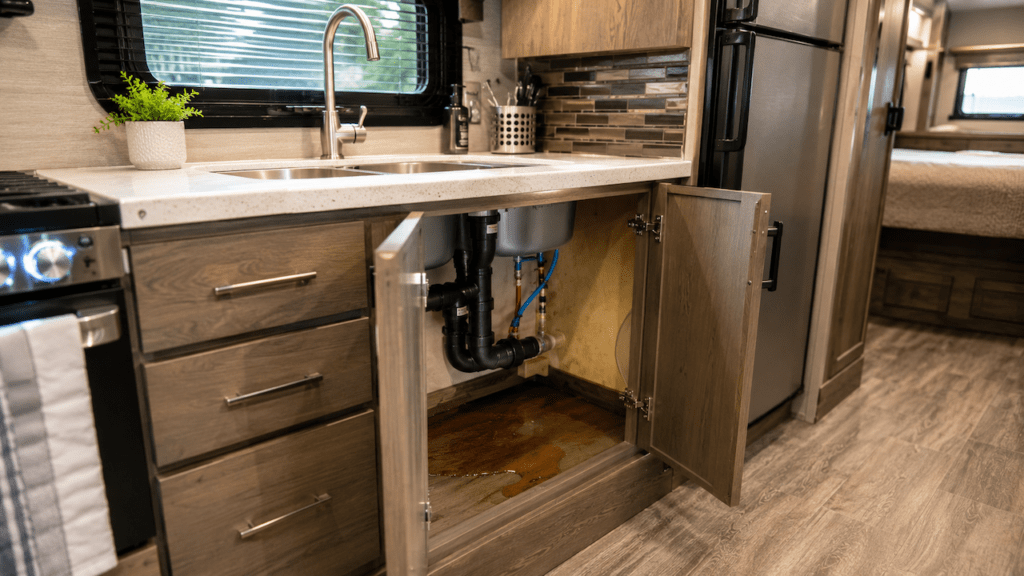
Start with the accessible plumbing directly under the sink.
If you have a removable P-trap, place a bucket underneath before opening it. Clear any debris and inspect the trap carefully.
If the trap is clean, the obstruction may be farther downstream.
The Gray Tank Roof Vent Is Blocked
Your gray tank needs airflow while wastewater enters it.
As water flows into the tank, air inside must escape somewhere. The roof vent provides that path.
Leaves, dirt, insect nests, damaged vent caps, ice, or other debris can restrict airflow.
A venting problem may cause:
- Gurgling
- Bubbling
- Intermittent slow drainage
- Several fixtures acting strangely
- Drainage improving when the dump valve is open
The important point is that vent trouble usually affects more than just one inch of drainpipe beneath the sink.
If several fixtures are reacting together, I would start thinking beyond a simple local clog.
Do not climb onto the RV roof unless it is designed for safe roof access. Use appropriate fall protection and follow your RV manufacturer’s instructions.
A Flexible Drain Hose Is Sagging, Kinked, or Holding Water
RV plumbing is not always built with rigid household-style piping.
Kitchens installed in slide-outs may use flexible drain hoses. Those hoses need enough movement to extend and retract with the slide.
Unfortunately, that flexibility can create problems.
A hose may sag between support points. It can develop a low loop where wastewater collects. It may also kink when the slide moves.
That low section can behave like an unwanted second trap.
Water leaves the sink, reaches the sag, and begins pooling. Continued drainage becomes slower until some water pushes backward.
Look beneath the sink and around any visible slide-out plumbing.
The hose should have a reasonable downhill path without sharp bends or deep low spots.
Do not stretch flexible plumbing completely tight. It still needs enough movement for slide operation.
A Waterless Trap Is Sticking or Restricted
Not every RV uses a traditional curved P-trap.
Some RV manufacturers install compact waterless traps or dry-sealing drain valves. These save space and can work well in tight cabinets.
However, debris can interfere with their internal seals.
A sticky or dirty waterless trap can restrict flow enough to resemble a normal drain clog.
If your sink does not have a familiar curved P-trap underneath, inspect the plumbing design before pushing anything through it.
Avoid blindly forcing a snake through a waterless trap. You can damage the internal sealing membrane.
Remove or service the trap according to its design instead.
The Drain Pipe Does Not Have Enough Downward Slope
RV plumbing moves and flexes over time.
Road vibration, repairs, loose brackets, slide movement, or previous modifications can change the way a drainpipe sits.
Wastewater needs gravity to keep moving toward the tank.
A nearly level pipe can hold water. A section that slopes backward can make things even worse.
Watch the exposed plumbing beneath the sink.
If the pipe runs uphill before heading toward the tank, or visibly sags between supports, drainage may struggle.
Correcting the slope can sometimes solve the problem without replacing anything.
There Is a Blockage Near the Gray Tank Inlet
Sometimes the P-trap looks perfectly clean, but the problem continues.
In that case, the restriction may be farther downstream.
Debris can collect where drain lines join. It can also accumulate near the point where the plumbing enters the gray tank.
This possibility becomes more likely when:
- The sink remains slow after cleaning the trap
- Other nearby fixtures also drain poorly
- The tank is definitely empty
- No visible hose kinks exist
- The roof vent appears clear
A deeper blockage can require access below the RV or behind enclosed plumbing.
That is where professional RV service may become worthwhile.
Is the Under-Sink Air Admittance Valve Causing the Backup?
The air admittance valve under your sink and the gray tank roof vent do different jobs.
An air admittance valve, often called an AAV, allows air into the drain system when negative pressure develops. It then closes to keep odors and gases from entering the living space.
The gray tank roof vent serves the holding tank itself. It lets displaced air escape as wastewater enters.
That difference matters when troubleshooting.
A failed AAV often creates odor or drainage-related symptoms. However, I would not automatically replace it simply because your sink drains slowly or backs up.
A partial blockage is usually more important to rule out first.
If only one sink has trouble, inspect the local drain system carefully.
If multiple fixtures gurgle or react together, the holding-tank vent deserves more attention.
How to Find the Cause Before Taking the Plumbing Apart
A simple testing sequence can tell you a lot. Work through these checks in order before opening difficult plumbing areas.
- Stop running water into the affected sink.
- Check whether the shower or another sink drains normally.
- Confirm which holding tank receives the kitchen wastewater.
- Dump the correct gray or galley tank completely.
- Test the kitchen sink again.
- Notice whether drainage changes with the dump valve open.
- Listen for gurgling, bubbling, or air movement.
- Inspect all visible plumbing beneath the sink.
- Look for kinks, low loops, or sagging flexible hoses.
- Remove and inspect an accessible traditional P-trap.
- Identify whether your RV uses a waterless trap.
- Investigate the holding-tank vent if several symptoms remain.
Do not skip the first few steps.
I would rather see you dump the correct tank first than spend an hour pulling apart a perfectly clean sink drain.
What If the Gray Tank Is Empty but Water Still Returns?
If you know the gray tank is empty, focus on what sits between the sink and that tank.
The most likely possibilities include:
- You emptied a different gray tank
- The kitchen uses a separate galley tank
- The P-trap contains a partial clog
- The drainpipe is restricted farther downstream
- A waterless trap is sticking
- Flexible drain plumbing has sagged
- A hose became kinked during slide movement
- The gray tank roof vent is blocked
- The drainpipe has poor slope
- The tank monitor gave an inaccurate reading
One useful clue is how much water the sink accepts.
If a tiny amount drains normally but larger amounts return, I would suspect a partial restriction or trapped section of plumbing.
If almost nothing drains despite an empty tank, the blockage may be more severe.
Why Does My RV Sink Drain Normally When the Gray Valve Is Open?
If the sink works noticeably better with the gray valve open, pay attention to the tank side of the system.
Opening the valve changes how wastewater and air move through the holding-tank plumbing.
When drainage becomes poor again after closing the valve, the problem may involve tank ventilation, tank capacity, or plumbing near the tank.
Gurgling makes vent trouble even more suspicious.
That does not prove the roof vent is blocked, but it is a strong diagnostic clue.
Do not leave the gray valve permanently open at every campsite just to hide the problem. You still want to understand why the closed system drains poorly.
How to Fix Water Backing Up Into an RV Sink
Once you know where the problem probably sits, the repair becomes much easier. Start with the least invasive fix and retest after every step.
Empty the Correct Gray or Galley Tank
Begin here because it costs you almost nothing.
Connect your sewer hose properly and dump the correct wastewater tank.
If your RV has multiple gray valves, identify which one serves the kitchen.
After dumping, close the valve and run several gallons through the sink.
If the water no longer returns, the tank was simply full.
If the problem remains, move to the local drain plumbing.
Clean the P-Trap
If your RV uses a removable P-trap, cleaning it is straightforward.
Place a bucket and towel underneath the trap.
Loosen the slip nuts carefully. Remove the trap and allow any trapped water to drain into the bucket.
Clean out food debris, grease, and residue.
Check the sealing washers before reinstalling everything.
Tighten the fittings snugly without overtightening plastic plumbing.
Run water afterward and check carefully for leaks.
Clear a Partial Drain-Line Clog
If the trap is clean, the blockage may sit farther down the line.
Start gently.
Warm water and appropriate RV-safe drain cleaning methods are better choices than immediately reaching for aggressive household chemicals.
Avoid using boiling water on unknown RV plumbing. Extremely hot water can damage some plastics, seals, and fittings.
If you use a mechanical drain tool, first identify the trap design.
Never force a snake through a waterless trap without confirming that the device can handle it.
Correct Sagging Flexible Drain Plumbing
Inspect any flexible drain hose beneath the sink.
You want a smooth route toward the tank without deep dips.
Support sagging sections carefully so wastewater can continue flowing downhill.
Do not create a new high point while fixing the sag.
For slide-out kitchens, cycle the slide afterward and watch the hose movement.
Make sure it does not kink when fully extended or retracted.
Check the Holding-Tank Roof Vent
If several fixtures gurgle or drainage improves with the tank valve open, inspect the vent system.
Look for obvious problems such as:
- Leaves
- Insect nests
- Dirt buildup
- Damaged caps
- Ice or snow
- Loose vent components
Never push debris deeper into the vent blindly.
If the vent requires roof access, confirm your RV roof can safely support you first.
When roof access is unsafe, an RV technician is the better choice.
Inspect or Replace a Faulty Waterless Trap
If your RV uses a compact waterless trap, remove it according to its design.
Check for food debris, grease, or a distorted internal membrane.
Some waterless traps can be cleaned. Others may need replacement.
Avoid treating one like a normal open piece of drainpipe.
Its internal valve is what keeps tank odors from reaching your living space.
What You Should Not Do to an RV Sink Drain
Some common plumbing shortcuts can create bigger problems in an RV.
- Do not keep adding water to a backing-up sink.
- Do not trust the tank monitor without verifying the tank.
- Do not push a drain snake blindly through unknown plumbing.
- Do not force tools through a waterless trap.
- Do not use harsh drain chemicals without checking compatibility.
- Do not pour boiling water into unknown plastic plumbing.
- Do not blast high-pressure air through the drain system.
- Do not permanently block the holding-tank vent.
- Do not climb onto an RV roof unless access is safe.
- Do not ignore wastewater leaking underneath the RV.
RV plumbing uses lightweight fittings, plastics, flexible connections, and seals. Fixing one clog is not worth creating three new leaks.
When Water Returning to the Sink Needs Professional Repair
Some drainage problems go beyond normal owner maintenance.
Consider an RV technician when:
- The drain disappears into an enclosed underbelly
- You cannot locate the restriction safely
- Wastewater leaks beneath the RV
- Several fixtures back up after dumping the tank
- The vent pipe appears damaged or disconnected
- The gray tank looks loose or deformed
- Plumbing must be rerouted inside a slide
- The problem started after road impact
- A repair requires removing cabinetry or underbelly panels
- The problem repeatedly returns after cleaning
A persistent backup usually means something is still restricting water or airflow.
Repeatedly treating the sink without finding that cause will only waste your time.
How to Keep Water From Backing Up Again
Once the drain works properly again, a few simple habits can reduce the chance of another backup.
- Use a sink strainer for food particles.
- Scrape plates before washing them.
- Keep grease and cooking oil out of the drain.
- Flush the gray tank periodically.
- Inspect flexible slide-out plumbing for sagging.
- Watch for new kinks after slide movement.
- Check plumbing vents during regular roof maintenance.
- Learn which fixtures feed each holding tank.
- Do not wait solely for the tank monitor.
- Address slow drainage before it becomes a complete blockage.
A sink that becomes slightly slower each week is giving you an early warning.
Fixing that warning is much easier than dealing with a basin full of wastewater later.
Final Words
When water drains from your RV sink and then returns, focus on where that water stopped moving. The problem is usually a full tank, partial clog, poorly routed drain line, or ventilation issue.
I would start with the correct gray or galley tank, then check the trap and visible plumbing. If those look good, move farther downstream toward the vent and tank connections.
That order keeps troubleshooting simple and prevents unnecessary repairs.
Related FAQs
Why Does My RV Sink Drain and Then Fill Back Up?
Your RV sink usually drains and fills back up because wastewater meets a partial restriction farther down the system. Common causes include a full gray tank, clogged drain, sagging hose, or poor tank venting.
Can a Full Gray Tank Cause Water to Come Back Into the Sink?
Yes. Once the gray tank reaches capacity, wastewater may back up through connected drain lines. The lowest connected fixture may show the problem before other sinks do.
Why Is My RV Sink Backing Up When the Gray Tank Says Empty?
The monitor may be inaccurate, you may have emptied the wrong tank, or your kitchen may use a separate galley tank. A local drain clog can also cause the same symptom.
Why Does My RV Sink Gurgle When Water Drains?
Gurgling usually means air is struggling to move through the drainage system. A partial clog, poor venting, or restricted tank airflow can create that sound.
Can a Clogged RV Roof Vent Make a Sink Back Up?
Yes. A blocked gray tank vent can interfere with airflow as wastewater enters the tank. You may notice slow drainage, gurgling, bubbling, or several fixtures acting strangely.
Can an RV Air Admittance Valve Cause Slow Drainage?
It can contribute to drainage problems if it fails, but do not assume it is the main cause. A partial drain blockage is often more likely and should be checked first.
Why Does My RV Sink Drain Better With the Gray Valve Open?
Opening the gray valve changes how wastewater and air move through the holding-tank system. If drainage improves dramatically, inspect tank venting, tank capacity, and tank-side plumbing.
Can a Slide-Out Cause an RV Kitchen Sink to Drain Poorly?
Yes. Slide-out kitchens often use flexible drain plumbing. The hose can sag, kink, or develop a low loop that traps wastewater and slows drainage.
Is Standing Water in My RV Sink P-Trap Normal?
Yes. A conventional P-trap intentionally holds some water to block odors. Water rising back into the actual sink basin after draining is not normal.
Should I Use Drain Cleaner in My RV Kitchen Sink?
Use caution. Some strong household drain cleaners can damage RV plastics, seals, or specialized waterless traps. Start with mechanical cleaning and RV-compatible products whenever possible.

Gregory Allen covers outdoor RV camping, essential gear, and travel preparation. His reviews are based on real conditions, not spec sheets alone. He helps RVers choose equipment that works reliably in everyday outdoor use.