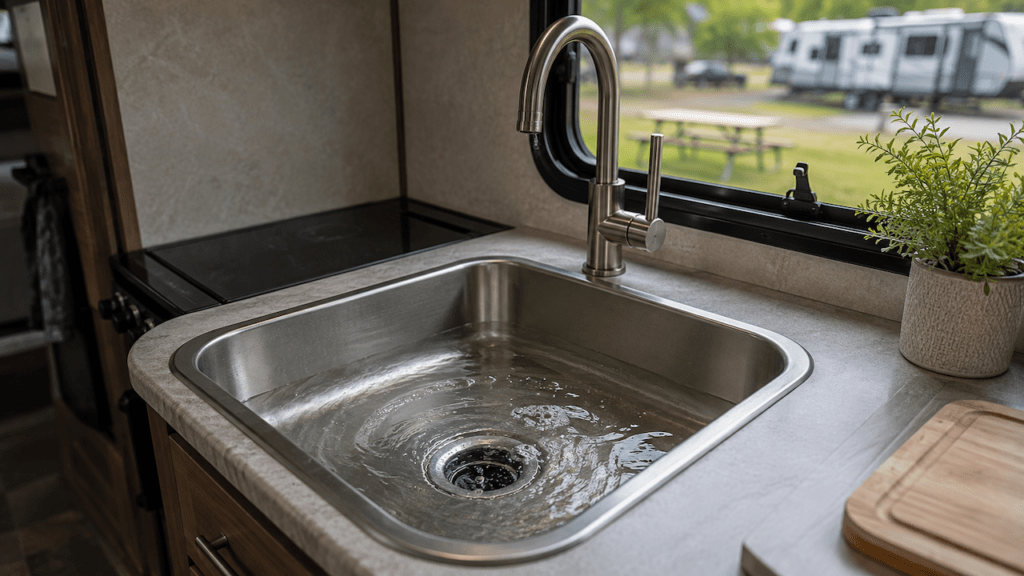
Your RV kitchen sink usually gurgles because water and air cannot move freely through the drain system. If the sink also drains slowly, suspect a partial clog first. If it drains normally but still gurgles, check the air admittance valve or venting. And, if the noise worsens as the gray tank fills, check the correct tank and roof vent.
This guide helps you match the sound with the most likely cause. I’ll show you what to check first, what each symptom means, and when the problem needs more than basic DIY work.
Key Takeaways
- Gurgling usually points to restricted drainage or poor airflow.
- Slow draining plus gurgling usually suggests a partial clog.
- Normal draining plus gurgling often points toward venting.
- Gurgling that worsens with tank level suggests tank-side problems.
- Some RV kitchens drain into a separate galley gray tank.
- An under-sink AAV and a roof vent do different jobs.
- Multiple gurgling fixtures usually suggest a wider plumbing issue.
- Start with the tank and local drain before checking the roof.
What Does the Gurgling Sound Usually Mean?
A gurgling RV sink is usually telling you that water and air are fighting for space inside the drain system.
When water leaves the sink, air must move through the plumbing too. If that airflow becomes restricted, pressure changes form inside the drain.
That trapped air then moves backward through the water.
You hear that movement as bubbling, gulping, or gurgling.
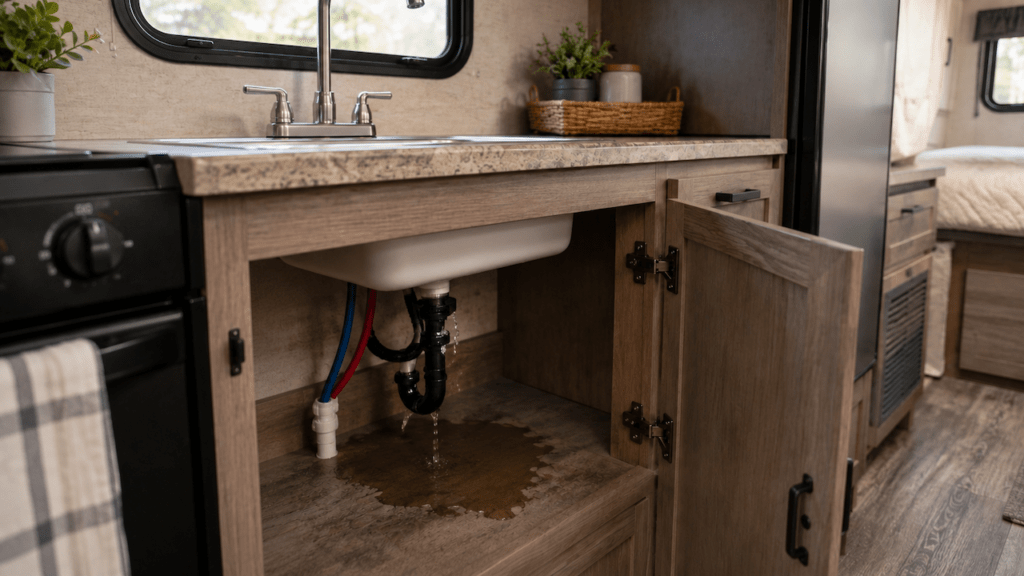
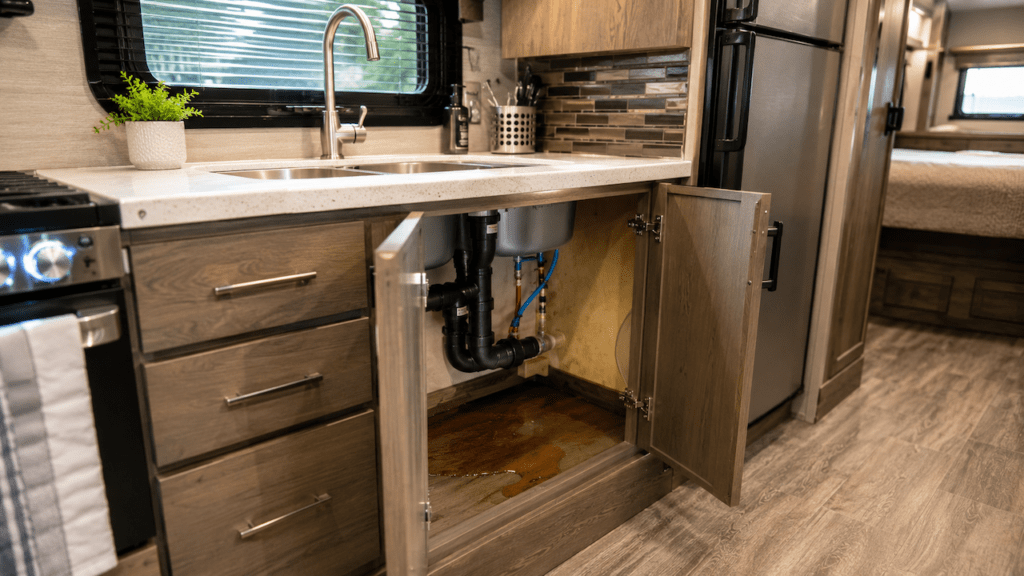
The basic kitchen drain path usually looks like this:
Kitchen sink → trap → drain line → gray or galley tank
Your plumbing system may also use two different venting components.
The first is the roof vent connected to the holding tank.
The second may be an air admittance valve under the sink.
These parts are not interchangeable.
The roof vent helps manage pressure inside the holding tank. The AAV mainly allows air into the drain branch when needed.
That difference becomes very useful when diagnosing the sound.
Find Your Most Likely Cause First
You can usually narrow this problem down quickly. Match your symptom before taking anything apart.
| What Your Sink Is Doing | Check This First | Most Likely Problem |
| Gurgles and drains slowly | Kitchen drain or trap | Partial clog |
| Gurgles but drains normally | AAV or venting | Airflow restriction |
| Gurgles more as tank fills | Correct gray tank | Tank nearing full |
| Stops gurgling after dumping | Tank level or tank vent | Tank-related airflow issue |
| Gurgles when shower drains | Shared tank or vent | Wider venting problem |
| Backs water into sink | Tank or major blockage | Severe restriction |
| Gurgles with bad odor | AAV, trap, or vent | Venting or trap problem |
| Changes when RV is tilted | Drain slope | Sagging or poorly routed pipe |
Use this table as your starting point.
If your symptoms clearly fit one row, start there first.
That saves time and keeps you from replacing parts randomly.
If the Sink Gurgles and Drains Slowly, Check for a Partial Clog
Slow drainage changes the diagnosis considerably.
When your RV kitchen sink gurgles and empties slowly, I would inspect the local drain before worrying about roof venting.
A partial clog often forms from everyday kitchen waste.
Common buildup includes:
- Cooking grease
- Food crumbs
- Soap residue
- Oil
- Coffee grounds
- Small pieces of rice or pasta
The drain does not need to become completely blocked.
Water may still squeeze through a narrowed section.
However, there is less room for both water and air.
Air bubbles then work backward through the flowing water.
That creates the gurgling sound.
Signs the Kitchen Drain Is Partially Clogged
A partial clog becomes more likely when:
- Water briefly pools around the drain.
- Drainage has gradually become slower.
- Only the kitchen sink has symptoms.
- Gurgling happens after washing greasy dishes.
- Cleaning the trap improves drainage temporarily.
If these signs match your situation, start beneath the sink.
Do not begin with the roof vent.
Check the Sink Strainer and Trap First
Remove anything visible around the drain opening.
Then inspect the accessible trap beneath the sink.
Place a pan or towel underneath before loosening fittings.
Some water will usually remain inside the trap.
Look for:
- Grease coating
- Food pieces
- Thick sludge
- Foreign objects
- Damaged seals
Clean the trap thoroughly before reinstalling it.
Hand-tighten plastic fittings carefully.
RV plumbing parts can crack if overtightened.
What if the Trap Is Clean?
A clean trap does not completely rule out a clog.
The restriction may sit farther downstream.
A flexible manual drain tool may help with reachable buildup.
Avoid forcing large snakes through lightweight RV plumbing.
Sharp bends and thin plastic fittings can be damaged easily.
If drainage improves after cleaning, you likely found the cause.
And, if drainage remains normal but gurgling continues, check venting next.
If the Sink Gurgles but Drains Normally, Check the AAV
This symptom often gets misdiagnosed.
If your RV sink empties normally but still makes repeated gurgling sounds, airflow becomes more suspicious than a serious blockage.
Many RV kitchen sinks use an under-sink air admittance valve.
You may also hear it called:
- AAV
- Mini vent
- Mechanical vent
- Cheater vent
It usually sits vertically above the nearby drain line.
What Does the Air Admittance Valve Actually Do?
The AAV opens when draining water creates negative pressure.
It briefly allows air into the plumbing branch.
That incoming air helps water move without pulling against a vacuum.
The valve then closes again.
That prevents gray-tank odors from freely entering the RV.
If the valve sticks closed, your drain may still work.
However, airflow becomes restricted.
The result can be repeated gurgling after the sink drains.
Signs the AAV May Be the Problem
Look toward the AAV when:
- The sink drains at normal speed.
- Only the kitchen sink gurgles.
- The noise happens near the end of draining.
- You sometimes notice odor beneath the sink.
- The problem comes and goes.
- Cleaning the trap changes nothing.
Inspect the valve visually.
Check whether it is:
- Upright
- Loose
- Cracked
- Damaged
- Dirty
- Installed where air can reach it
A mechanical valve can eventually wear out.
If it sticks or no longer seals properly, replacement may help.
Use the correct replacement size for your plumbing.
If Gurgling Gets Worse as the Tank Fills, Check the Correct Gray Tank
This is one of the most important RV-specific checks.
Your kitchen sink does not always drain into the same gray tank as your shower.
Some RVs use multiple gray tanks.
One may serve bathroom fixtures.
Another may serve only the kitchen.
That kitchen tank is often called a galley tank.
Why a Nearly Full Tank Can Cause Gurgling
Wastewater entering the holding tank displaces air.
That air needs somewhere to go.
As the tank gets very full, drainage can become less forgiving.
If venting is also marginal, bubbling may become more noticeable.
Eventually, water may begin backing toward the sink.
Make Sure You Dumped the Correct Tank
This mistake is surprisingly easy.
You pull one gray valve and see water discharge.
Then you assume every gray-water fixture is empty.
Meanwhile, the galley tank may still be full.
Check:
- Owner’s manual
- Waste-valve labels
- Plumbing diagrams
- Tank monitor layout
- Manufacturer documentation
Then dump the tank serving the kitchen.
Run the sink afterward.
If the gurgling disappears immediately, tank level was involved.
And, if it returns quickly, inspect tank venting next.
If the Sink Gurgles More as the Tank Fills, Check the Roof Vent
A holding tank needs a reliable air path.
As wastewater enters, displaced air should escape through the vent system.
Most RV gray tanks connect to a vent extending toward the roof.
If that vent becomes restricted, pressure may push backward.
The kitchen drain can become the easiest path for that air.
That is when you hear gurgling.
Signs the Roof Vent Deserves Attention
A roof vent problem becomes more likely when:
- Several fixtures gurgle.
- The kitchen gurgles when the shower drains.
- Symptoms worsen as the tank fills.
- Dumping improves the problem temporarily.
- Local kitchen plumbing appears clean.
- The AAV seems to work normally.
Possible vent restrictions include:
- Leaves
- Dirt
- Insect nests
- Damaged vent caps
- Internal debris
- Misaligned vent piping
Inspect only if roof access is safe and permitted.
Never assume every RV roof is designed for walking.
Do Not Blindly Push Tools Down the Vent
Avoid forcing rods or long tools into the vent pipe.
You could damage a fitting.
You could also push debris deeper into the plumbing.
If the blockage is not visible near the opening, stop there.
A deeper vent problem may need professional inspection.
If the Shower Makes the Kitchen Sink Gurgle, Look Beyond the Sink
This symptom tells you something important.
A tiny food clog near the kitchen strainer usually does not react strongly when someone uses the shower.
If shower drainage makes the kitchen sink bubble, the problem may sit farther downstream.
Possible causes include:
- Shared gray tank
- Shared drain branch
- Shared vent path
- Restricted tank vent
- Nearly full holding tank
First, confirm whether both fixtures use the same tank.
Do not assume they do.
RV plumbing layouts vary considerably between floorplans.
If both fixtures share a tank, empty that tank first.
Then test the shower again.
If the kitchen still gurgles, venting deserves closer inspection.
If Gurgling Stops After Dumping, the Tank or Venting Is Involved
This is one of the strongest troubleshooting clues.
Suppose your kitchen sink gurgles before dumping.
You empty the correct gray or galley tank.
The sound disappears.
That tells you the kitchen drain itself may be fine.
The problem likely relates to:
- Tank level
- Tank venting
- Tank sensor accuracy
- Restricted airflow as the tank fills
Watch what happens over the next several days.
If the sound returns only when the tank approaches full, monitor capacity.
If it returns when the tank is only partly full, inspect the roof vent.
A partly restricted vent can become noticeable before the tank fills completely.
If the Gray Tank Is Empty but the Sink Still Gurgles, Check These Three Things
An empty tank eliminates one cause.
It does not eliminate the entire problem.
If the correct tank is definitely empty, check these next:
1. Partial Drain Restriction
Look for slow drainage or water pooling.
Clean the strainer, trap, and accessible drain line.
2. Air Admittance Valve
If drainage speed looks normal, inspect the AAV.
A sticking valve can create gurgling without slowing the sink much.
3. Roof Vent or Drain Routing
If multiple fixtures react together, check shared venting.
If the problem changes with RV position, inspect pipe slope.
This order keeps troubleshooting focused.
Can a Sagging Drain Pipe Cause Gurgling?
Yes, especially when cleaning does not solve the problem permanently.
RV drain lines need enough slope for wastewater to keep moving.
If a pipe sags between supports, water can sit inside it.
That low spot creates several problems.
Standing water can:
- Reduce the available pipe opening.
- Trap air.
- Collect grease.
- Catch food residue.
- Cause recurring slow drainage.
The sink may gurgle every time water crosses that low section.
Signs the Drain Line May Have Poor Slope
Look for:
- Repeated clogging after cleaning
- Visible pipe sagging
- Loose supports
- Drainage changing with RV angle
- Previous plumbing repairs
- Water sitting inside horizontal pipe sections
This issue needs more than drain cleaner.
The pipe itself may require better support or rerouting.
Can Being Unlevel Make an RV Kitchen Sink Gurgle?
A slightly unlevel RV usually does not create gurgling by itself.
However, it can expose an existing drainage problem.
Suppose a drain line already has marginal slope.
Tilting the RV may make that section hold more water.
That can reduce airflow and make gurgling more noticeable.
If the noise changes significantly with RV position, inspect drain routing.
Do not assume leveling alone is the permanent fix.
How to Diagnose the Problem in the Right Order
I recommend following this sequence instead of jumping between causes. Each step helps rule out the next one.
Step 1: Identify the Correct Holding Tank
Determine whether your kitchen uses:
- Main gray tank
- Second gray tank
- Separate galley tank
Empty that tank completely.
Then test the sink.
Step 2: Check Drain Speed
Run a moderate amount of water.
Watch how quickly it leaves.
Slow drain: inspect the local drain and trap.
Normal drain: inspect the AAV and venting.
Step 3: Compare Other Fixtures
Run the bathroom sink and shower.
Kitchen only: local kitchen plumbing is more likely.
Several fixtures: shared tank or venting is more likely.
Step 4: Clean the Accessible Kitchen Drain
Check the strainer and trap.
Remove food, grease, and debris.
Retest the sink.
Step 5: Inspect the AAV
Check whether it is upright and undamaged.
Pay attention to odors around the valve.
Replace a clearly faulty valve with the proper type.
Step 6: Check the Roof Vent
Inspect visible openings safely.
Remove only accessible debris.
Do not force tools deep into the vent.
Step 7: Inspect Drain Routing
Check accessible horizontal piping.
Look for sagging, poor supports, or strange repairs.
If the pipe disappears into the underbelly, professional diagnosis may be easier.
How Do You Fix an RV Kitchen Sink That Keeps Gurgling?
The correct fix depends on what your diagnosis showed. Avoid treating every gurgle like a clog.
Fix a Partial Kitchen Drain Clog
Clean the sink strainer first.
Remove and clean the accessible trap.
Flush light residue using warm water.
Avoid boiling water unless your RV manufacturer specifically allows it.
Use a suitable flexible drain tool only when necessary.
Avoid aggressive household drain chemicals.
RV tanks, valves, seals, and lightweight pipes deserve extra care.
Empty and Maintain the Correct Gray Tank
Dump the tank serving your kitchen.
Do not rely entirely on monitor-panel readings.
Tank sensors can become inaccurate because of residue.
Learn which waste valve serves each holding tank.
That information prevents many future troubleshooting mistakes.
Replace a Failed Air Admittance Valve
A worn AAV is often inexpensive compared with deeper plumbing repairs.
Replace it when it:
- Sticks
- Cracks
- Leaks odor
- Fails to admit air properly
Keep the replacement accessible.
Install it upright as intended.
Clear a Restricted Roof Vent
Remove visible debris around the vent opening.
Replace a broken vent cap when necessary.
If the vent remains blocked deeper inside, seek professional help.
Repair a Sagging Drain Line
Support or reroute the affected pipe.
A structural low spot will keep collecting wastewater.
Cleaning it repeatedly will only provide temporary relief.
What Should You Avoid Pouring Down an RV Kitchen Sink?
Preventing buildup is easier than clearing it later.
Keep these materials out of your RV kitchen drain:
- Cooking grease
- Bacon fat
- Vegetable oil
- Coffee grounds
- Large food scraps
- Rice
- Pasta
- Thick sauces
- Paint residue
- Solvents
- Harsh drain chemicals
Use a sink strainer whenever possible.
Also wipe greasy cookware before washing it.
Those two habits can greatly reduce buildup.
Is a Little Gurgling Normal in an RV?
A brief water sound is not automatically a problem.
RV plumbing is compact.
You may hear water movement more clearly than at home.
However, repeated bubbling or loud gurgling deserves attention.
I would investigate when the sound is:
- New
- Getting louder
- Happening every time
- Combined with slow drainage
- Combined with odor
- Causing another fixture to bubble
The pattern matters more than one isolated noise.
When Should You Call an RV Technician?
Many causes are simple enough to inspect yourself. Some problems deserve professional help.
Call an RV technician when:
- Water begins backing into the sink.
- Several drains gurgle together.
- Strong gray-water odors enter the RV.
- Gurgling continues after basic cleaning.
- The correct tank is empty but symptoms remain.
- The roof vent appears clear.
- Drain pipes are hidden inside the underbelly.
- Plumbing appears cracked or badly sagged.
- The problem keeps returning.
- Water leaks beneath cabinets or flooring.
You should also stop if roof access feels unsafe.
There is no reason to risk injury for a vent inspection.
How to Prevent RV Kitchen Sink Gurgling
Most recurring gurgling problems begin with buildup or poor tank habits. A few simple habits can reduce both.
- Scrape plates before washing them.
- Wipe grease from cookware first.
- Use a sink strainer.
- Never pour cooking oil down the drain.
- Keep coffee grounds out of the sink.
- Learn which tank serves your kitchen.
- Dump tanks before they become completely full.
- Investigate slow drainage early.
- Inspect accessible vent components periodically.
- Keep visible drain piping properly supported.
You do not need complicated maintenance.
You mainly need clean drains and proper airflow.
Final Words
If your RV kitchen sink gurgles, do not start replacing parts randomly.
Match the symptom first.
If it gurgles and drains slowly, check for a clog.
If it gurgles but drains normally, inspect the AAV.
And, if it gets worse as the tank fills, check the correct gray tank.
And, if the shower makes it gurgle, investigate shared tank venting.
The easiest troubleshooting order to remember is:
Correct tank → drain speed → trap → AAV → roof vent → drain routing
That approach usually gets you to the real cause faster.
Related FAQs
Can a Full Gray Tank Make an RV Kitchen Sink Gurgle?
Yes. A full or nearly full gray tank can interfere with normal drainage and airflow. Empty the tank serving your kitchen first, especially if your RV uses a separate galley tank.
Why Does My RV Kitchen Sink Gurgle but Drain Normally?
Normal drainage with repeated gurgling often points toward an airflow problem. Check the under-sink air admittance valve first, then inspect the tank venting if other fixtures also react.
Can a Bad Air Admittance Valve Make an RV Sink Gurgle?
Yes. A sticking AAV may fail to admit enough air as water drains. That pressure imbalance can make the kitchen sink bubble or gurgle even when drainage speed looks normal.
How Do I Know if My RV Gray Tank Vent Is Clogged?
A clogged vent becomes more likely when multiple fixtures gurgle, symptoms worsen as the tank fills, or the kitchen sink bubbles when the shower drains. Inspect the roof vent safely.
Why Does My RV Kitchen Sink Gurgle After I Dump the Gray Tank?
If gurgling continues after dumping, check whether you emptied the correct tank. If you did, inspect the kitchen drain, AAV, roof vent, and drain-line slope next.
Why Does My RV Sink Gurgle When Someone Takes a Shower?
The shower and kitchen may share a gray tank or vent path. Shower water changes pressure inside the system, which can force trapped air back through the kitchen drain.
Can an RV Being Unlevel Make a Kitchen Sink Gurgle?
A slight tilt usually does not cause gurgling alone. However, it can worsen poor drain slope or an existing pipe sag, making trapped water and airflow problems more noticeable.
Does Every RV Kitchen Sink Drain Into the Main Gray Tank?
No. Some RVs use multiple gray tanks, and the kitchen may drain into a separate galley tank. Check your specific plumbing layout before assuming the main gray tank serves everything.

Gregory Allen covers outdoor RV camping, essential gear, and travel preparation. His reviews are based on real conditions, not spec sheets alone. He helps RVers choose equipment that works reliably in everyday outdoor use.