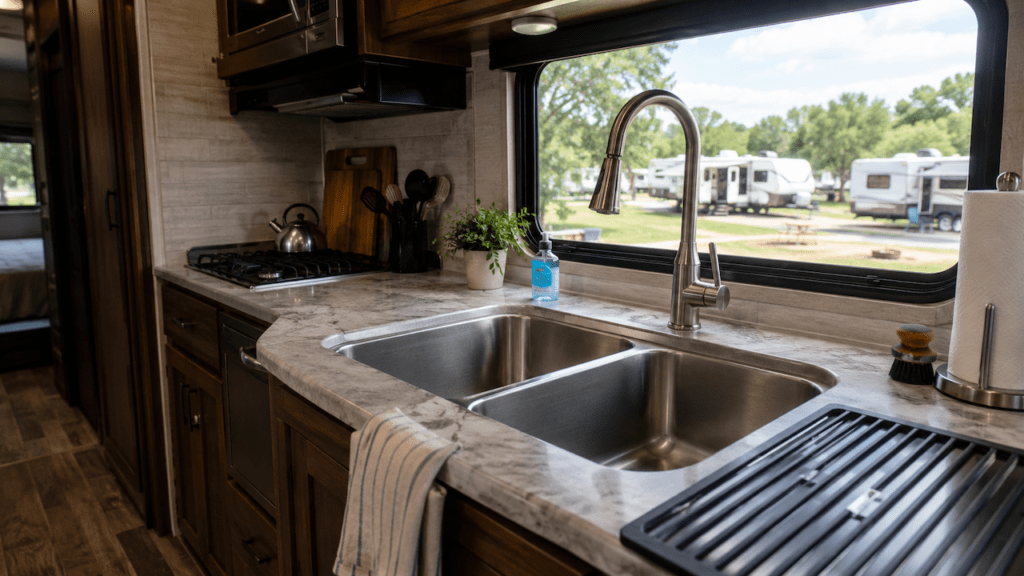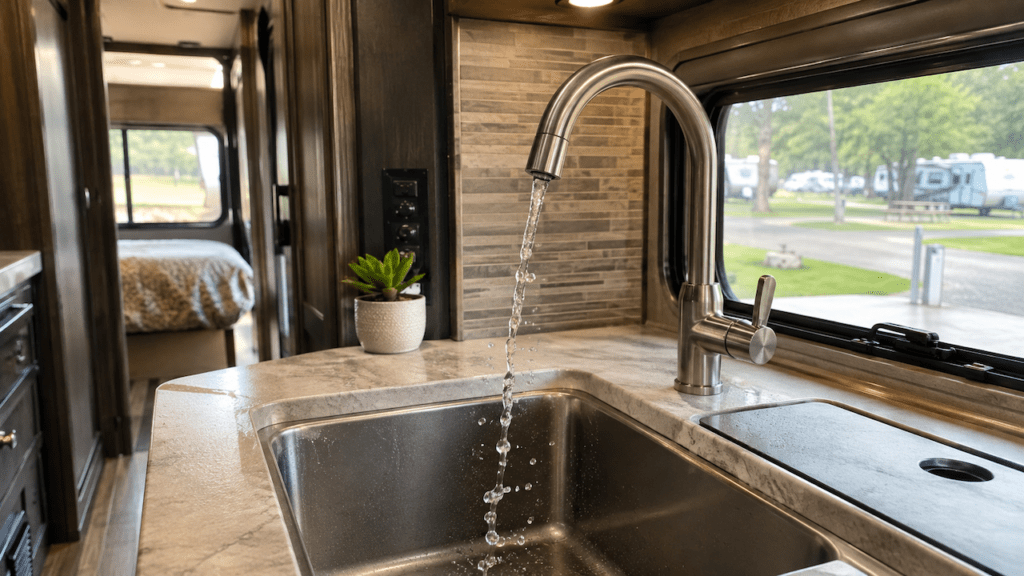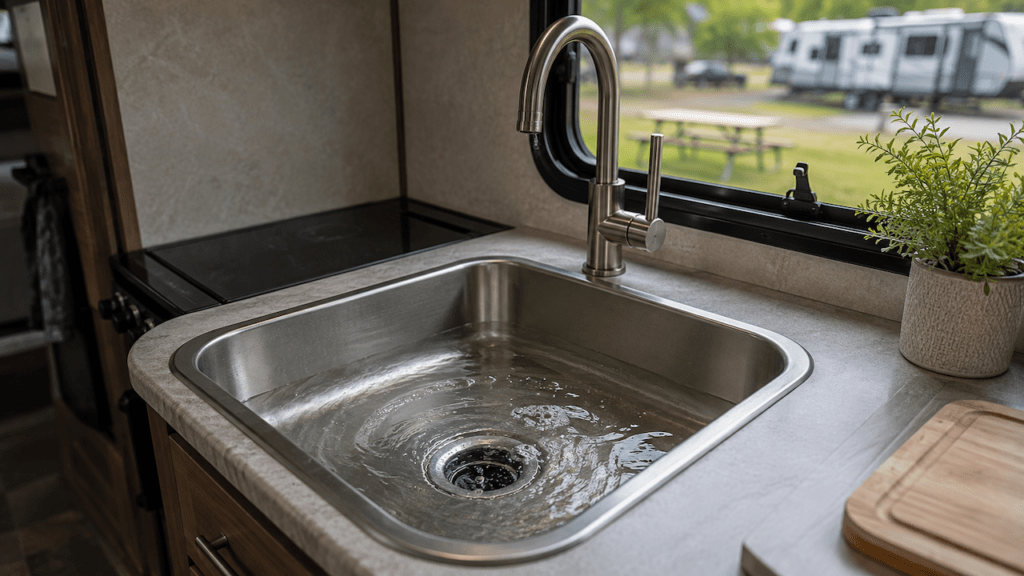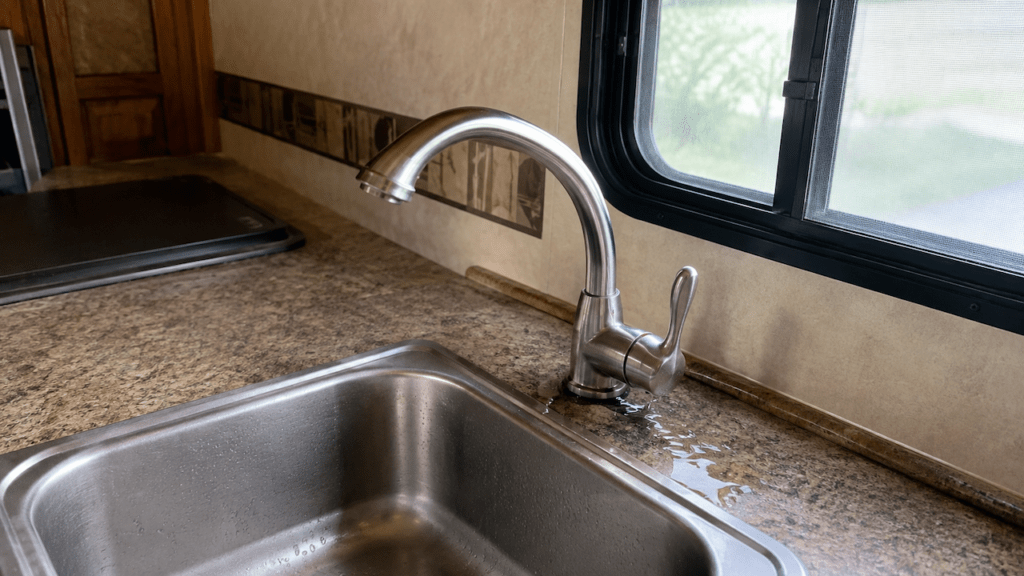
If your RV kitchen sink drains slowly while the gray tank is empty, the problem is usually somewhere between the sink and the tank. Grease buildup, food debris, a restricted trap, poor venting, or kinked drain plumbing can all slow the water.
In this guide, I’ll help you narrow down the cause step by step. We’ll start with the easiest checks before moving into venting and deeper plumbing issues.
Key Takeaways
- An empty gray tank does not guarantee unrestricted sink drainage.
- Kitchen grease and food buildup are common causes of slow draining.
- If only one sink is slow, inspect its plumbing first.
- Gurgling can indicate a partial blockage or venting problem.
- Slide-out kitchens may have flexible drain hoses that sag or kink.
- Some RVs have a separate galley tank for the kitchen sink.
- Check simple local problems before investigating the roof vent.
Why Can an RV Kitchen Sink Drain Slowly With an Empty Gray Tank?
An empty gray tank provides plenty of storage space for wastewater. However, the water still needs a clear path into that tank.
Your RV kitchen sink usually drains through several plumbing components. Water passes through the sink strainer, trap, drain piping, and eventually the gray tank.
A typical setup looks something like this:
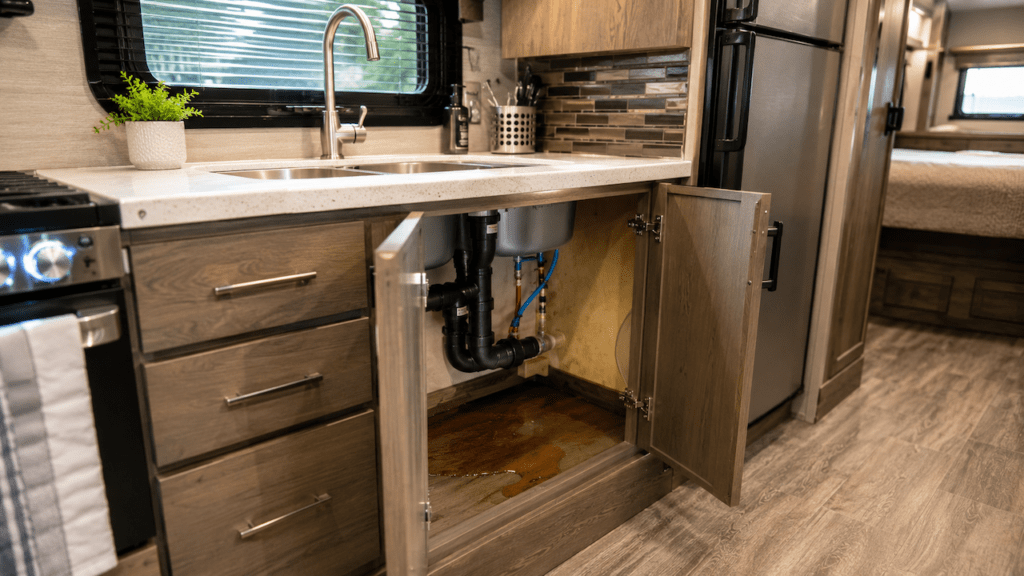
Kitchen sink → drain fitting → P-trap or waterless trap → drain pipe → gray tank
If anything restricts that path, water starts moving more slowly.
That is why an empty gray tank does not rule out plumbing trouble. The problem may happen several feet before water reaches the tank.
In many cases, the restriction develops gradually rather than suddenly. You may first notice water lingering slightly longer after washing dishes.
Over time, the sink may eventually take several minutes to empty.
What Does the Way Your RV Kitchen Sink Drains Tell You?
Before removing plumbing parts, pay attention to how the sink behaves. Those symptoms can tell you where the restriction probably exists.
| What You Notice | Likely Problem Area | What I Would Check First |
| Only kitchen sink drains slowly | Kitchen drain plumbing | Trap and grease buildup |
| Sink drains slowly and gurgles | Drain restriction or venting | Drain line first |
| Kitchen and bathroom drains are slow | Shared plumbing or vent | Common drain and vent |
| Shower backs up when kitchen drains | Downstream blockage | Shared drain connection |
| Sink improves after trap cleaning | Local restriction | Trap and nearby pipe |
| Slide-out kitchen drains inconsistently | Flexible drain hose | Kinks and sagging |
| Gray tank shows empty but sink backs up | Separate galley tank | Tank layout and valves |
| Drain became slower over months | Gradual buildup | Grease and food residue |
| Sink was slow since purchase | Plumbing layout problem | Pipe slope and installation |
This simple comparison can save you from checking unnecessary components.
If only your kitchen sink struggles, I would stay near that sink first. If several drains struggle together, investigate shared plumbing or venting.
Most Common Reasons an RV Kitchen Sink Drains Slowly
Several problems can restrict water before it reaches your gray tank. I recommend checking them roughly in the following order.
Grease and Food Buildup Inside the Drain
Kitchen drains deal with more grease than other RV drains.
Cooking oil, sauces, butter, and tiny food particles enter the drain. Even when you avoid dumping grease directly, residue still washes from dishes.
That material can stick along the inside of narrow drain pipes.
Over time, the opening becomes smaller and water moves more slowly. You do not need a completely blocked pipe to notice problems.
This is especially common if the sink gradually became slower.
A sink strainer helps, but it cannot catch oily residue.
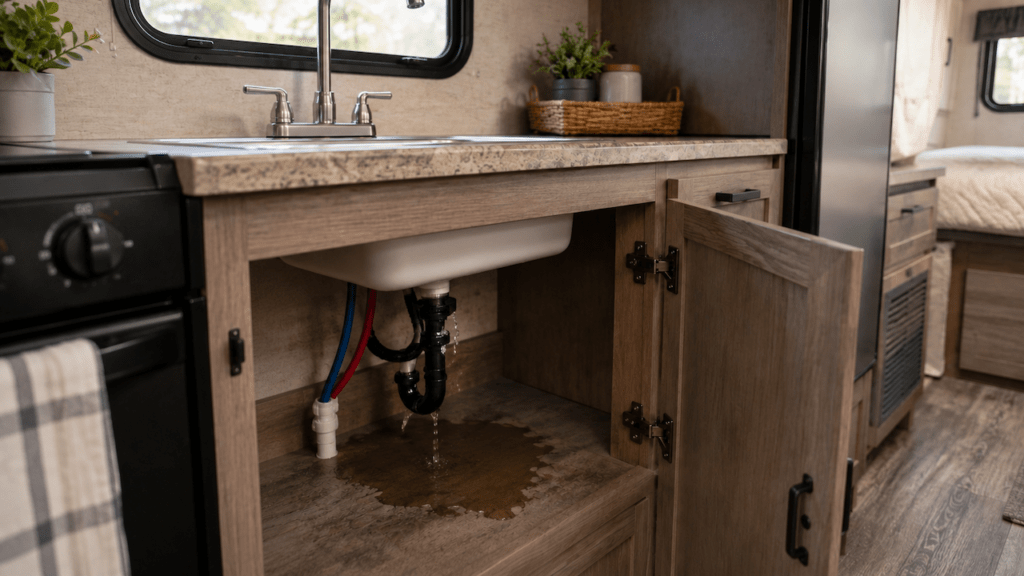
The P-Trap Is Partially Clogged
Your P-trap is another easy place for debris to collect.
The curved shape intentionally keeps some water inside the trap. That water helps prevent odors from entering your living space.
Unfortunately, the curve also catches food particles and greasy sludge.
You may find:
- Greasy residue
- Small food particles
- Soap buildup
- Coffee grounds
- Tiny foreign objects
Fortunately, the P-trap is usually accessible beneath the kitchen sink.
If your plumbing uses threaded fittings, you can often inspect it easily. Place a bucket underneath before loosening anything.
Your RV May Use a Waterless Trap
Not every RV kitchen has a traditional curved P-trap.
Some RVs use compact waterless traps with flexible internal membranes. These are helpful where conventional plumbing takes too much space.
You may see a compact inline fitting instead of a U-shaped trap.
If your RV has this type, do not treat it like a P-trap. Follow the manufacturer’s instructions before cleaning or removing it.
A damaged membrane, contamination, or nearby restriction can affect drainage.
Identifying your actual plumbing setup prevents unnecessary disassembly.
There Is a Partial Clog Farther Downstream
Sometimes the visible plumbing underneath the sink looks completely clean.
The restriction may be farther along the drain line.
Grease and debris can collect around:
- Tight elbows
- Pipe transitions
- Horizontal sections
- Branch connections
- Flexible drain hoses
- Connections near the tank
A deeper clog becomes more likely when cleaning the trap changes nothing.
It also becomes suspicious if another fixture starts backing up.
For example, kitchen water appearing inside the shower usually means the restriction sits downstream.
A Slide-Out Kitchen Drain Hose Is Sagging or Kinked
This is one RV-specific problem that homeowners never think about.
Some RVs place the kitchen sink inside a slide-out section. Plumbing there must accommodate movement when the slide opens and closes.
Manufacturers may use flexible drain hoses for this purpose.
Those hoses can eventually sag, twist, kink, or lose support.
A low spot can hold water and greasy residue between uses.
A sharp bend may also reduce how quickly wastewater travels.
Inspect this area carefully if your kitchen sits inside a slide.
Pay attention if drainage changes with the slide’s position.
The Drain Is Not Getting Enough Airflow
Wastewater drainage requires air movement through the plumbing system.
As water travels downward, air must enter or leave appropriately. Restricted airflow can interfere with smooth drainage and create gurgling.
Your RV may use both a roof vent and under-sink venting.
However, I would not immediately blame the vent.
A partially clogged drain can create very similar symptoms.
That is why checking the trap and nearby drain comes first.
The Air Admittance Valve May Need Attention
Many RV sinks have an air admittance valve underneath them.
It is usually mounted above the drain piping beneath the sink. Its job is to admit air when negative pressure develops.
When working properly, the valve helps wastewater move smoothly.
However, a slow drain does not automatically mean the valve failed.
A partially restricted pipe can sometimes create symptoms that resemble vent trouble.
I would inspect the drain before replacing the valve.
If everything downstream appears clear, the valve deserves closer attention.
Make sure it is installed upright and remains accessible.
The Gray Tank Roof Vent Is Restricted
Your gray tank normally connects to a vent extending through the roof.
That vent helps equalize pressure inside the drainage system.
Leaves, insects, nests, or damaged vent components can sometimes restrict airflow.
However, use the other drains as your clue.
If only the kitchen sink drains slowly, start locally.
If several fixtures gurgle or drain slowly together, the roof vent becomes more suspicious.
Avoid climbing onto your roof unless you can do it safely. Follow your RV manufacturer’s roof access instructions carefully.
You May Have Emptied the Wrong Gray Tank
This possibility is easy to overlook.
Some RVs have more than one gray wastewater tank.
Your kitchen may drain into a dedicated galley tank. Meanwhile, your shower and bathroom sink may use another gray tank.
You can therefore empty one tank while the kitchen tank remains full.
Check your owner’s manual if your tank arrangement seems confusing.
Look for labels such as:
- Gray tank
- Gray tank 1
- Gray tank 2
- Galley tank
- Kitchen waste tank
Also inspect your exterior dump handles and plumbing layout.
This check takes little time and can prevent unnecessary repairs.
The Drain Pipe Has Poor Slope
RV drains depend heavily on gravity.
A horizontal drain section still needs enough downward slope toward the tank.
If a pipe sags or rises slightly, water may collect there.
Flexible lines are particularly vulnerable because their support can move.
Poor slope becomes more likely when the sink always drained poorly.
If the problem suddenly appeared years later, buildup is more likely.
How Do I Find the Cause Without Taking Everything Apart?
You can diagnose most slow-drain problems using simple observations first. Start with easy checks before opening harder-to-access plumbing.
Step 1: Confirm Which Tank Serves the Kitchen
First, verify where your kitchen sink actually drains.
Check the owner’s manual or plumbing diagram when available.
If your RV has multiple wastewater tanks, empty each relevant tank.
Then test the kitchen sink again.
Step 2: Compare the Other Drains
Run some water through your bathroom sink and shower.
If they drain normally, your problem is probably kitchen-specific.
If several fixtures drain slowly, suspect something farther downstream.
This distinction helps prevent you from chasing unrelated components.
Step 3: Listen for Gurgling
Pay attention while the kitchen sink drains.
Gurgling usually means air and water are struggling through the system.
That could indicate:
- A partial clog
- Restricted venting
- Poorly routed drain piping
Do not assume gurgling automatically proves a blocked roof vent.
Step 4: Inspect the Trap
Open the cabinet beneath your kitchen sink.
Look for a conventional P-trap or waterless trap.
If you have a removable P-trap, place a bucket underneath.
Remove it carefully and inspect for debris.
Clean the trap completely before reinstalling it.
Check the seals afterward for leaks.
Step 5: Inspect Accessible Drain Plumbing
Follow the drain pipe as far as you can safely see.
Look for:
- Sagging sections
- Sharp bends
- Kinked flexible hose
- Crushed plumbing
- Loose supports
- Improper upward routing
Pay particular attention around slide-out mechanisms.
Never place your hands near moving slide components.
Step 6: Inspect the Under-Sink Vent
If your sink has an air admittance valve, inspect its installation.
Look for obvious damage, contamination, or loose fittings.
The valve should normally remain upright.
Do not replace it automatically just because drainage is slow.
First make sure the nearby drain itself is reasonably clear.
Step 7: Investigate Shared Venting
Consider the roof vent when several fixtures show symptoms.
You may also notice stronger gurgling from multiple drains.
Inspect the roof only when conditions are safe.
If access seems risky, let an RV technician handle it.
How Do You Clear a Slow RV Kitchen Sink Drain?
Once you narrow down the likely location, start gently. RV plumbing often uses lighter materials than residential plumbing.
Clean the Sink Strainer and Tailpiece
Remove visible debris around the sink opening first.
Food residue sometimes collects immediately beneath the drain fitting.
Clean the strainer and accessible tailpiece thoroughly.
Then run water again and observe the improvement.
Remove and Clean the P-Trap
Place a bucket beneath the trap before loosening it.
Slowly disconnect the fittings and allow trapped water to drain.
Remove grease, food residue, and accumulated sludge.
Wash the trap before reinstalling it securely.
Run water afterward while checking carefully for leaks.
Flush Greasy Drain Buildup
Grease should be treated gently rather than aggressively.
Very hot water combined with appropriate grease-cutting cleaning can help soften residue.
However, I would avoid pouring boiling water blindly into RV plumbing.
Extreme heat may not suit every pipe, seal, or fitting.
Use hot water within the limits recommended for your plumbing system.
RV-safe gray-water cleaners are another option when buildup persists.
Always follow the cleaner manufacturer’s directions.
Clear a Deeper Blockage Carefully
A deeper clog may require a flexible drain-cleaning tool.
However, first understand your plumbing layout.
Do not force a snake through unfamiliar valves or flexible hoses.
You could damage waterless traps or lightweight RV plumbing.
If resistance feels unusual, stop rather than forcing the tool.
Professional drain inspection may be safer for inaccessible sections.
Correct a Kinked Slide-Out Drain Hose
Inspect flexible plumbing with the slide safely stationary.
Look for pinched areas or unsupported low sections.
The hose should move freely without becoming tightly folded.
Do not reroute slide plumbing without understanding its required movement.
Incorrect routing could pull fittings apart when the slide moves.
When necessary, have an RV technician reposition or support it.
Should I Replace the Air Admittance Valve?
A slow sink sometimes leads owners straight toward the AAV. I would treat replacement as a later troubleshooting step instead.
An air admittance valve opens when the plumbing needs additional air.
If it sticks or becomes damaged, drainage can behave strangely.
However, a partially obstructed drain can produce similar symptoms.
That means replacing the valve first may accomplish nothing.
Start by checking:
- The sink strainer
- The trap
- Nearby drain piping
- Flexible hoses
- Downstream restrictions
Then consider the valve if those areas appear clear.
If replacing it, use a compatible part for your RV plumbing.
Is the Roof Vent Really the Problem If Only One Sink Is Slow?
A blocked roof vent can affect drainage, but symptoms matter. One slow kitchen sink usually points closer to that fixture.
Think about the problem this way.
If your kitchen sink drains slowly while everything else works normally, investigate:
- Kitchen trap
- Grease buildup
- Kitchen drain pipe
- Flexible slide hose
- Under-sink vent
If several drains become slow or start gurgling together, investigate:
- Shared drain piping
- Tank venting
- Tank routing
- Downstream blockage
This approach keeps troubleshooting logical and reduces unnecessary work.
What Should You Avoid Putting Down an RV Kitchen Sink?
Preventing buildup is much easier than clearing a clogged RV drain. Kitchen wastewater should contain as little solid material as possible.
Avoid sending these materials down your sink:
- Cooking grease
- Vegetable oil
- Coffee grounds
- Rice
- Pasta scraps
- Vegetable peelings
- Thick sauces
- Large food pieces
- Flour-heavy mixtures
- Excess food residue
I strongly recommend using a small sink strainer.
Wiping greasy cookware before washing also makes a noticeable difference.
These habits reduce buildup inside both pipes and gray tanks.
How Can You Prevent Your RV Kitchen Sink From Draining Slowly Again?
A little routine care can prevent most kitchen drain restrictions. Focus on keeping solids and grease outside your plumbing system.
- Scrape food from dishes before washing them.
- Wipe grease from pans with paper towels first.
- Keep cooking oil out of your kitchen drain.
- Use a sink strainer during every dishwashing session.
- Clean the trap periodically when buildup appears.
- Flush the line periodically using RV-safe methods.
- Inspect slide-out drain hoses for sagging or kinks.
- Learn which gray tank serves your kitchen.
- Investigate new gurgling before drainage gets worse.
- Follow your RV manufacturer’s plumbing maintenance recommendations.
You do not need an aggressive cleaning routine.
Consistent small habits usually prevent larger drainage problems.
When Should You Call an RV Technician?
Many slow drains are simple DIY problems, but not every situation should be handled underneath your sink.
Consider professional help when:
- The sink stays slow after accessible plumbing is cleaned.
- Several fixtures back up at the same time.
- Kitchen wastewater appears inside the shower.
- Plumbing inside a slide mechanism is inaccessible.
- You suspect damaged or separated drain pipes.
- Water leaks into cabinets or the RV underbelly.
- The sink has drained poorly since the RV was new.
- You cannot identify which tank serves the kitchen.
- Roof vent inspection cannot be performed safely.
A technician may use inspection tools to locate deeper restrictions.
That can prevent unnecessary disassembly of your RV interior.
Final Words
When your RV kitchen sink drains slowly despite an empty gray tank, start close to the sink. Grease buildup, a restricted trap, or a partially clogged drain is usually more likely than a tank problem.
I recommend checking things in this order: trap, nearby drain, flexible hose, venting, then tank routing. That approach keeps troubleshooting simple and prevents unnecessary part replacement.
If several drains become slow together, expand your search downstream. Shared plumbing and tank venting then become much more likely.
Related FAQs
Why Does My RV Kitchen Sink Gurgle When It Drains?
Gurgling usually means air and wastewater are struggling through the plumbing together. A partial drain restriction, under-sink vent issue, or shared venting problem can cause it.
Can a Bad Air Admittance Valve Make an RV Sink Drain Slowly?
Yes, a faulty air admittance valve can affect drainage, but do not assume it failed immediately. A partially clogged drain can create similar symptoms, so check the drain first.
Why Is My RV Kitchen Sink Slow but the Bathroom Sink Drains Normally?
That usually suggests a restriction specific to the kitchen plumbing. Check the kitchen trap, grease buildup, nearby drain pipe, flexible hose, and under-sink vent before investigating shared plumbing.
Does an RV Kitchen Sink Always Drain Into the Same Gray Tank as the Shower?
No. Some RVs use separate gray or galley tanks for different fixtures. Check your owner’s manual or plumbing layout to confirm which tank receives your kitchen wastewater.
Can a Slide-Out Cause an RV Kitchen Sink to Drain Slowly?
Yes. Slide-out kitchens often use flexible plumbing that moves with the slide. Sagging, kinking, pinching, or poor hose support can restrict wastewater flow.
Can I Snake an RV Kitchen Sink Drain?
You can sometimes use a suitable flexible drain tool, but identify your plumbing first. Waterless traps, lightweight fittings, and flexible drain hoses can be damaged by aggressive snaking.
Why Does My RV Sink Drain Faster After Cleaning the P-Trap?
The trap probably contained grease, food residue, or another partial restriction. Removing that buildup increases the available opening and allows wastewater to move more freely.
Can an Empty Gray Tank Still Cause a Sink Backup?
An empty tank normally does not cause the backup itself. However, the drain pipe leading into that tank can still be clogged, kinked, poorly vented, or improperly routed.

Gregory Allen covers outdoor RV camping, essential gear, and travel preparation. His reviews are based on real conditions, not spec sheets alone. He helps RVers choose equipment that works reliably in everyday outdoor use.